


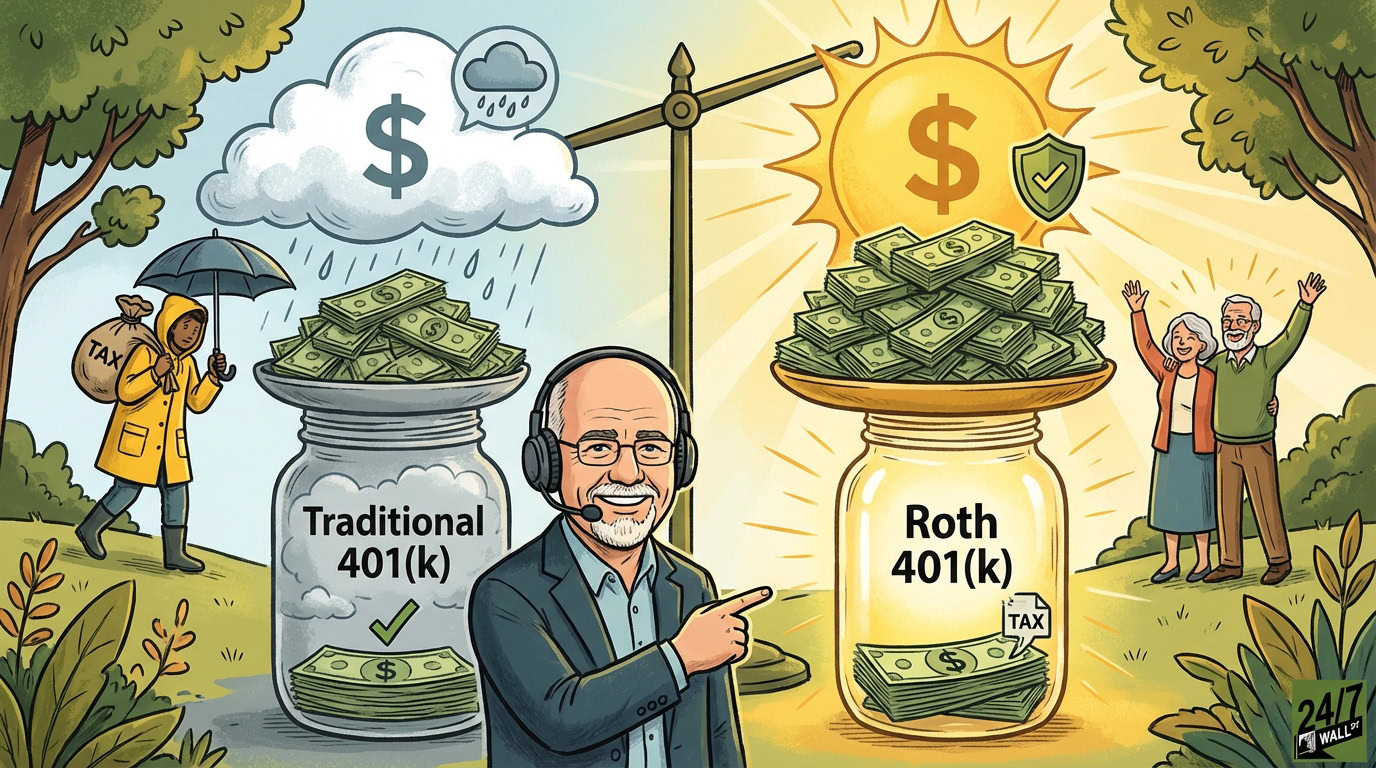
Personal finance guru Dave Ramsey recently weighed in on the subject of 401(k) retirement plans, and a less-known improvement to the concept, called a “Roth 401(k)”. And I have to say:
Rarely have I seen any concept explained more clearly in 45 seconds, than Ramsey did in this video.
Here’s the text of what Ramsey said, in full:
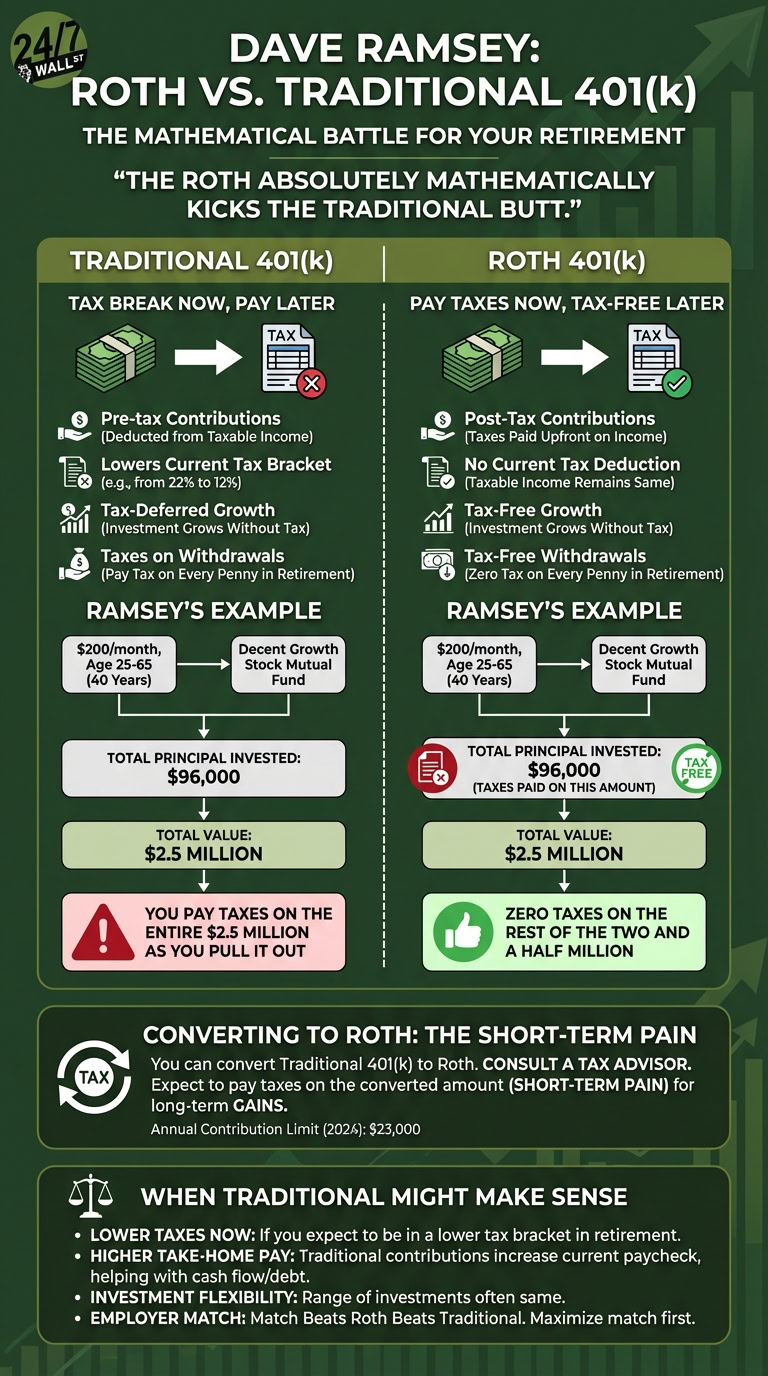
“The Roth absolutely mathematically kicks the traditional [IRA’s] butt. And here’s why: If you take $200 a month from age 25 to age 65, 40 years, and you invest that in a decent growth stock mutual fund, you’re gonna have $2.5 million dollars in there.
However, only $96,000 of the $2.5 million is actual principal that you put in. So if you did a traditional [401(k)], you would have got a tax break on $96,000. You would have not paid taxes yet on $96,000. But you’ll pay taxes on the entire $2.5 million as you pull it out.
If instead you did this with a Roth [401(k)], you would pay taxes on the $96,000 [before you put them in the plan as your contribution] and zero taxes on the rest of the two and a half million.”
As I listen to the explanation, it sounds crystal clear to me. But let’s take this step by step and see if we can make it a bit more systematic.
This post was updated on January 26, 2025 to include a section on when a regular 401(k) might actually be preferable to a Roth.
401(k) versus Roth 401(k)
Created under the Revenue Act of 1978, as Section 401(k) of the Internal Revenue Code, 401(k) plans started to become popular in the early 1980s, and really gained steam as defined benefit pension plans fell out of favor in the 1990s. Then, in 2001, the Economic Growth and Tax Relief Reconciliation Act created a new savings vessel called the Roth 401(k), and this became available to employers on January 1, 2006.
So 401(k) plans have been around for nearly 50 years, and Roth 401(k)s have been around for nearly 20 years, even if many workers don’t know much about the latter. What’s the big difference between the two?
It works like this. (I should say, it works “very roughly” like this. Consult your tax advisor for specifics). Say you earn $50,000, and between your own contributions and those of your employer, you decide to put 10% of your salary, so $5,000, in a 401(k) plan. That $5,000 contribution is made pre-tax, i.e. deducted from your taxable income, so presto-change-o, your taxable income just dropped to $45,000. Incidentally, you also just dropped out of the 22% tax bracket and into the 12% tax bracket!
Pretty cool, huh? Plus, over the years between now and retirement, your $5,000 contribution (plus any future years’ contributions you make) grows without being taxed. Only when you retire, and begin making withdrawals from your 401(k), do you pay taxes. But you pay taxes on every single penny you withdraw in retirement.
The Roth 401(k) is different. Here, you first pay taxes on your $50,000 income, and then, from what’s left over, you deposit your $5,000. Once again, the money in your account grows without being taxed, all the way to retirement. Then, when you start making withdrawals, none of the money you withdraw is taxed. Every single penny, contributions and capital gains alike, is tax-free.
And that’s even cooler.
Convert your 401(k) to a Roth 401(k)
And now you see why Dave Ramsey prefers a Roth 401(k) over an ordinary 401(k). But what if you already have a 401(k)? Are you stuck with the “inferior” version of the retirement plan?
Not necessarily, no. You could always open a Roth 401(k) in addition to your original recipe 401(k). You can even put some money in both plans, so long as you don’t exceed the annual contribution limit (which is $23,000 for tax year 2024).
You can also move funds from your 401(k) plan into a Roth 401(k), or even convert the entire 401(k) into a Roth 401(k), assuming your employer permits this, or you have an individual plan.
Now, we’re dealing with complicated tax laws, and so you’ll almost certainly want to consult a professional tax advisor about the best way to do this. And one of the first things that advisor will tell you is that you’ll have to pay taxes on the money you move, or convert. And if you’re in a pretty high tax bracket right now, that’s going to hurt.
It’s short-term pain, though. And according to Dave Ramsey, the long-term gains will be more than worth it.
When a Traditional 401(k) Might Make Sense
While Dave Ramsey generally prefers Roth accounts, a traditional 401(k) isn’t worthless. And in some cases, it could be a better strategic choice:
-
Lower Taxes Now: If you expect to be in a lower tax bracket in retirement than today, deferring taxes until later can reduce your lifetime tax bill.
-
Higher Take-Home Pay: Because traditional contributions reduce your taxable income now, you keep more of your paycheck today, which can help with current cash flow or paying off debt.
-
Investment Flexibility Doesn’t Change: Whether Roth or traditional, the range of investments offered in your plan is usually the same; it’s simply the tax treatment that differs.
-
Employer Match Still Valuable: Many financial pros recommend contributing at least enough to max out your employer match before worrying about tax treatment. As the saying goes, “match beats Roth beats traditional.”














 Top Gaining Stocks
 Top Losing Stocks