


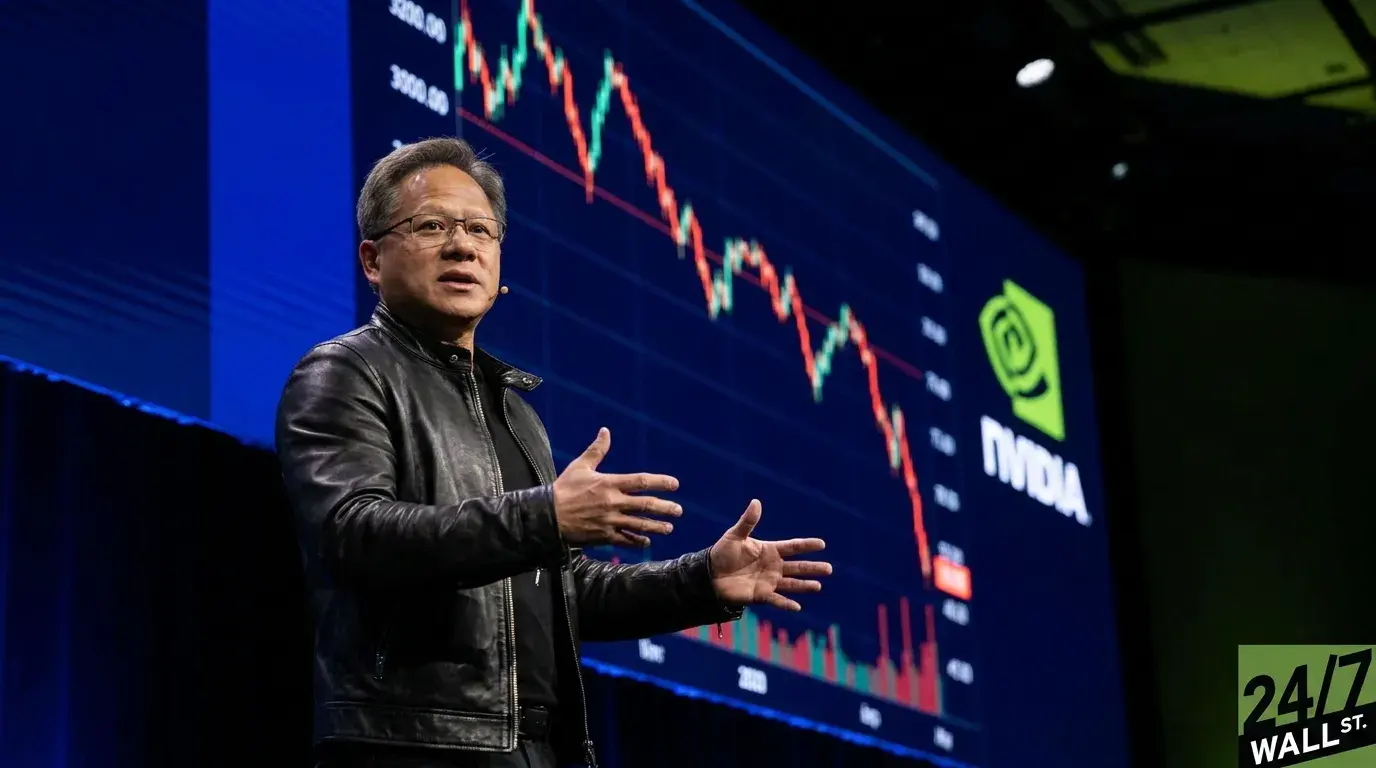
On a recent Motley Fool Money segment titled Nvidia’s Next Big Market, the host described Jensen Huang’s first 15 years running a public company in vivid terms: “If you look at the first 15 years, even as a publicly traded company, it looks like an electrocardiogram of somebody having a heart attack. The stock went down 90% twice.” The host added that many of Huang’s early bets became “$0 billion markets that to this day remain $0 billion markets,” and summarized Huang’s philosophy this way: “As long as one succeeds and you become the most valuable firm in human history, it doesn’t matter if the other ones fail.”
That story gets repeated as inspiration. The stakes for a real investor are different. NVIDIA (NASDAQ: NVDA | NVDA Price Prediction) is now worth roughly $4.82 trillion, but the buy-and-hold-the-winner narrative skips over what those two drawdowns would have done to a portfolio that depended on the money.
The verdict: the strategy worked for Jensen, not necessarily for you
Huang’s approach is sound for an operator with decades of runway and control of the business. As guidance for a shareholder, the “just hold great companies” takeaway is incomplete because it ignores the arithmetic of deep drawdowns.
A 50% loss requires a 100% gain to recover. A 90% loss requires a 900% gain. If you experience two separate 90% drawdowns and reinvest nothing in between, you need roughly a 9,900% return from the second bottom just to reach your original cost basis. NVIDIA delivered that, and then some. Most companies that fall 90% never come back at all.
The historical record shows how violent the ride was. From the start of 2000 through May 2026, NVIDIA returned roughly 221,833% on a split-adjusted basis. Inside that line are two collapses the host described, plus a long stretch in 2002 and 2003 when the stock fell another 66% from $0.51 to $0.18 before any recovery began.
The financial concept the quote points to is concentration risk combined with sequence risk. Time in the market only rewards you if you can stay in the market. A 58-year-old with $800,000 saved who put half into a single high-beta name watched that $400,000 become $40,000 during a 90% drawdown. If that happens in the first five years of retirement, no recovery curve fixes the withdrawals already taken at the bottom.
Who does the “hold through anything” advice fit
- Accumulators with 20-plus years of runway and steady contributions. Drawdowns become buying windows. The math of dollar-cost averaging into a recovering business does the heavy lifting.
- Investors whose position is small enough to fail. A 3% to 5% allocation to a volatile single name lets you sit through a 90% loss without touching your retirement plan.
- Anyone within ten years of relying on the money. Sequence risk dominates. NVIDIA’s 2.335 beta and 52-week range of roughly $111 to $217 are not retiree-friendly inputs, regardless of fundamentals.
- Investors are using concentrated positions to fund near-term spending. The recovery math does not care how good the business is.
What to actually do
Pull up your brokerage statement and add up every position tied to a single company, including employer stock and ETFs with heavy overlap. If any one name represents more than 10% of the money you will need within ten years, write down what your balance becomes after a 90% drop and ask whether your plan still works.
NVIDIA’s fundamentals are strong: four straight quarterly beats, Q4 revenue of $68.13 billion, and analyst targets near $269. None of that changes the recovery math if you own too much and need the money too soon.
Huang’s bet paid off because he had time, control, and nothing else to lose. Most investors have at least one of those constraints inverted.












 Top Gaining Stocks
 Top Losing Stocks