


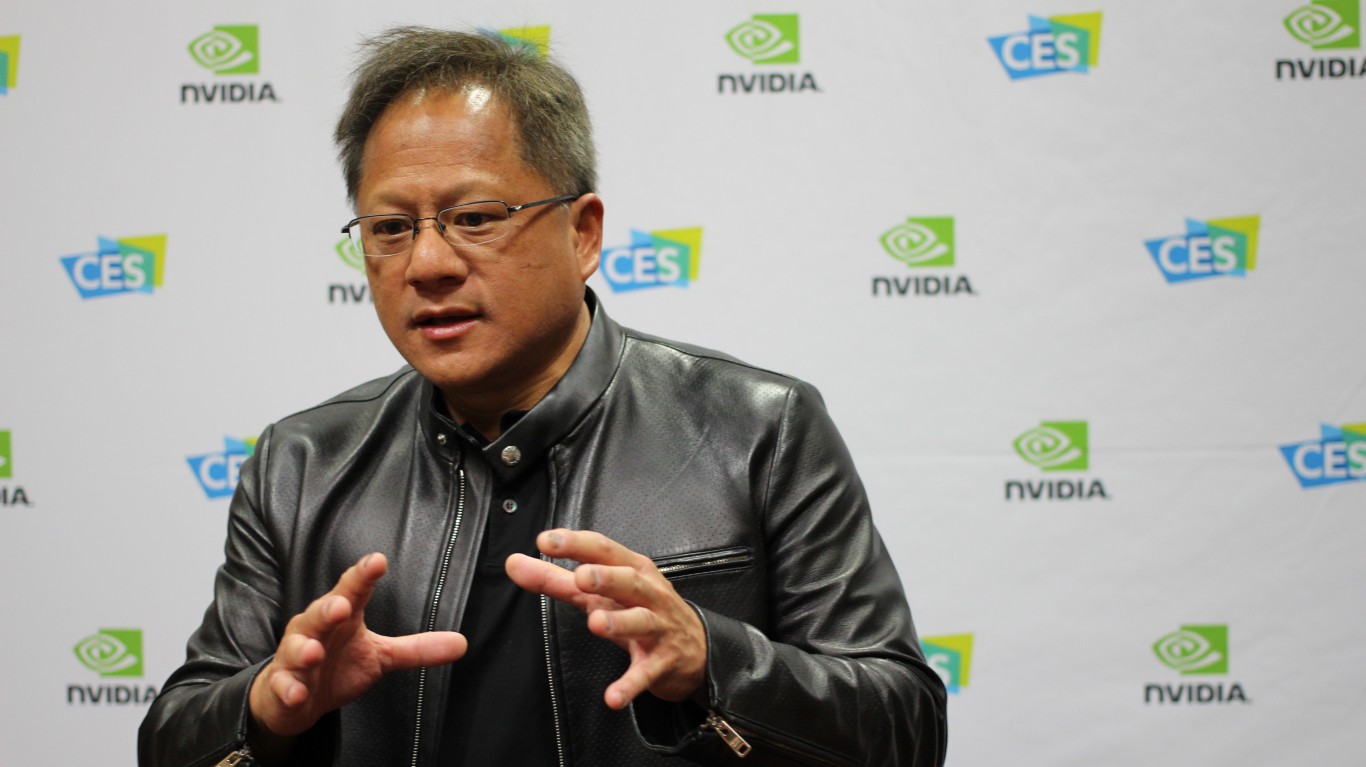
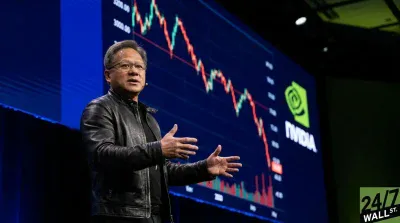
On a recent Prof G Markets segment titled How China Wins The AI War, NVIDIA (NASDAQ: NVDA | NVDA Price Prediction) CEO Jensen Huang delivered a blunt assessment of the competitive threat from China’s Huawei. “The day that Deepseek comes out on Huawei first, that is a horrible outcome for our nation,” he said, adding that, “AI models around the world are developed, and they run best on not American hardware. That is bad news for us.”
For investors with retirement money in U.S. large-cap funds, that warning matters financially. NVIDIA carries a market cap of $5.1 trillion. That makes it the single largest position in nearly every S&P 500 index fund and target-date fund sold in America. If Huawei narrows the gap Huang describes, the pain lands in 401(k) accounts long before it shows up on a chip schematic.
Concentration Risk Is the Real Lesson
The warning is credible, and the financial concept worth learning is concentration risk. How one stock’s weight inside a “diversified” fund quietly turns a passive portfolio into a single-name bet.
NVIDIA’s market cap is roughly 7.5x that of Advanced Micro Devices (NASDAQ: AMD). It’s also 2.6x that of Broadcom (NASDAQ: AVGO). Because index funds are cap-weighted, $100,000 in an S&P 500 fund holds roughly $7,000 of NVIDIA alone, a far larger stake than most investors would deliberately pick.
The China exposure inside that one stock is concrete. NVIDIA’s Q1 FY2027 guidance of about $78 billion in revenue explicitly excludes any China Data Center compute revenue. The company took a $4.5 billion H20 inventory write-down after the April 9 export ban, and Huang told analysts the $50 billion Chinese market is “effectively closed to U.S. industry.” On the Prof G segment, Alice Han noted Huawei’s Ascend 950 PR chip, which powers Deepseek V4, runs inference nearly three times better than the H20 chips China can legally buy, with 60% better multimodal efficiency.
Yet NVIDIA shares are up 83% over the past year and 11% year to date, near $214. The market is pricing in dominance. Huang is publicly warning that dominance is contestable. Both statements can be true at once. It’s why every investor should know exactly how much of one stock they actually own.
Who Gets Hurt and Who Can Shrug
Consider a 58-year-old with $800,000 in a 401(k) split 80/20 between an S&P 500 index fund and a total-bond fund. Roughly $45,000 sits in NVIDIA alone, plus another $15,000 in AMD and Broadcom combined. A 30% drawdown driven by a Huawei-led repricing would erase more retirement income than most people lose in a typical recession.
A 32-year-old with $60,000 in the same fund takes the same percentage hit but has decades to recover. Stay the course fits the 32-year-old. It often fails the 58-year-old planning to draw income within seven years.
The most exposed profile: anyone within 10 years of retirement holding more than 60% in U.S. large-cap or NASDAQ-heavy funds with little cash reserve outside the plan.
Three Questions to Research This Week
Pull up your 401(k) and look at the top 10 holdings of your equity funds. Add the weights assigned to NVIDIA, AMD, and Broadcom. If the combined figure exceeds 12%, you may hold a concentrated AI bet whether you intended one or not.
- Consider whether equal-weight exposure fits your goals. An equal-weight S&P 500 fund reduces NVIDIA’s weight to roughly 0.2%, an alternative worth researching for investors evaluating single-stock risk while keeping broad U.S. equity exposure.
- Evaluate the role of a cash buffer outside the plan. Investors often study whether 12 to 24 months of expenses in Treasury bills or a high-yield savings account could reduce the need to sell stocks at a drawdown to cover bills.
- Examine how rebalancing schedules affects risk. Research suggests that a fixed target allocation rebalanced annually, rather than letting winners run, can convert paper gains in a stock like NVIDIA into realized risk reduction.
Huang’s warning names the largest geopolitical variable sitting inside the largest stock in many retirement plans. Knowing how much NVIDIA you actually own is a useful starting point before evaluating whether to keep that exposure.









 Top Gaining Stocks
 Top Losing Stocks