


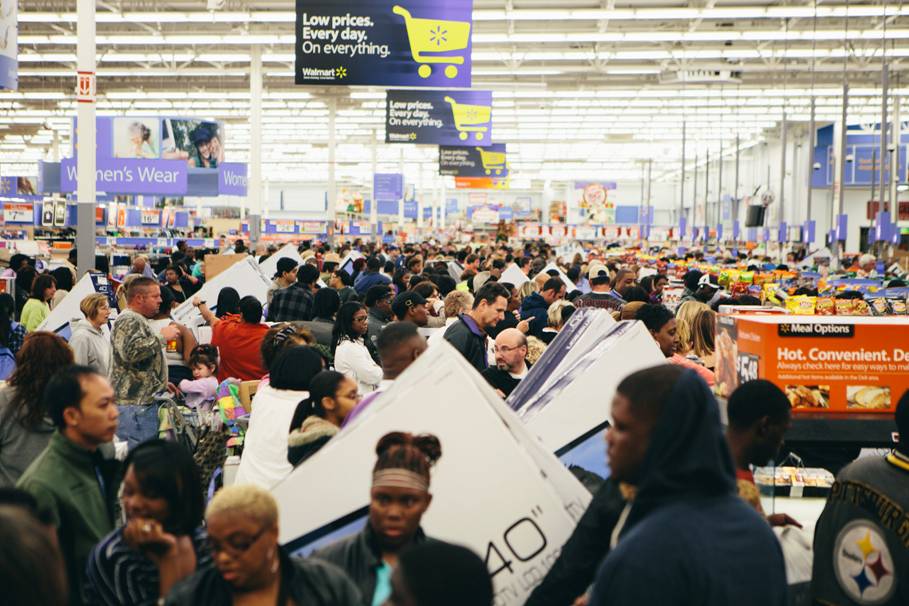
Walmart is the primary target of unions and groups that claim that low-paid workers at the retail company do not make enough to live above the poverty level. The fast-food target is also the largest in its field — McDonald’s Corp. (NYSE: MCD). The argument is not as simple as what workers should make. The interests of shareholders have a place in the debate. So does the longer term damage a higher wage could do to both companies.
There are two fundamental arguments about why the two giants should lift hourly wages to $15. The first is that they can afford to. Walmart’s worldwide revenue is $425 billion, and about two-thirds of that in the United States. McDonald’s is much smaller, with worldwide revenue of $28 billion. However, McDonald’s has returned billions of dollars to shareholders in recent years via higher dividends and share buybacks, which make it particularly vulnerable to charges that it has surplus cash.
The math of exactly how much a move up to a $15 an hour minimum wage would total is not simple. McDonald’s and its franchises likely employ 300,000 people in the United States. McDonald’s does not provide an exact number, or separate its own workers from those of its franchises. The Walmart number is easier to calculate. The company puts its U.S. workforce at 1.2 million. The other challenge to setting a calculation of expenses for the two companies to raise the minimum wage is that neither breaks out its pay bracket levels in groups. How many people at McDonald’s or Walmart actually make $8 an hour? Only the companies know.
Here is some simple but not entirely accurate math about what each company would pay if its hourly minimum wage rose to $15. If 75% of the workers at both companies make $8 and the number rose to $15, Walmart’s expense increase would be $18 billion a year. McDonald’s would be $4.5 billion. In the case of McDonald’s, profits would be cut in half. Walmart’s profit would be cut by 80%.
The defense of the current wage structure that Walmart and McDonald’s make is that their shareholders would be badly damaged if increased wages decimated profits. Even if the minimum wage rose slowly, perhaps over three years, the harm might be devastating. Economists and labor advocates argue that if the increase was spread over several years, each company would have the chance to increase prices to consumers as a means to offset that expense. That assumes consumers will pay higher prices, which may not be the case at all.
Walmart and McDonald’s face other balancing acts. Some portion of the public may turn on both companies and decide that their behavior toward workers is bad enough that boycotts are in order. That probably will not happen. Walmart and McDonald’s offer their customers too much value.
Another challenge each company faces is what poor morale does to a workforce and its productivity. Does low morale mean workers lose enthusiasm? Does lower enthusiasm hurt results? There is a real danger in that, but it is impossible to measure.
McDonald’s and Walmart face challenges as they review what they pay their workers. It is not as simple as what it may do to profits.






 Top Gaining Stocks
 Top Losing Stocks