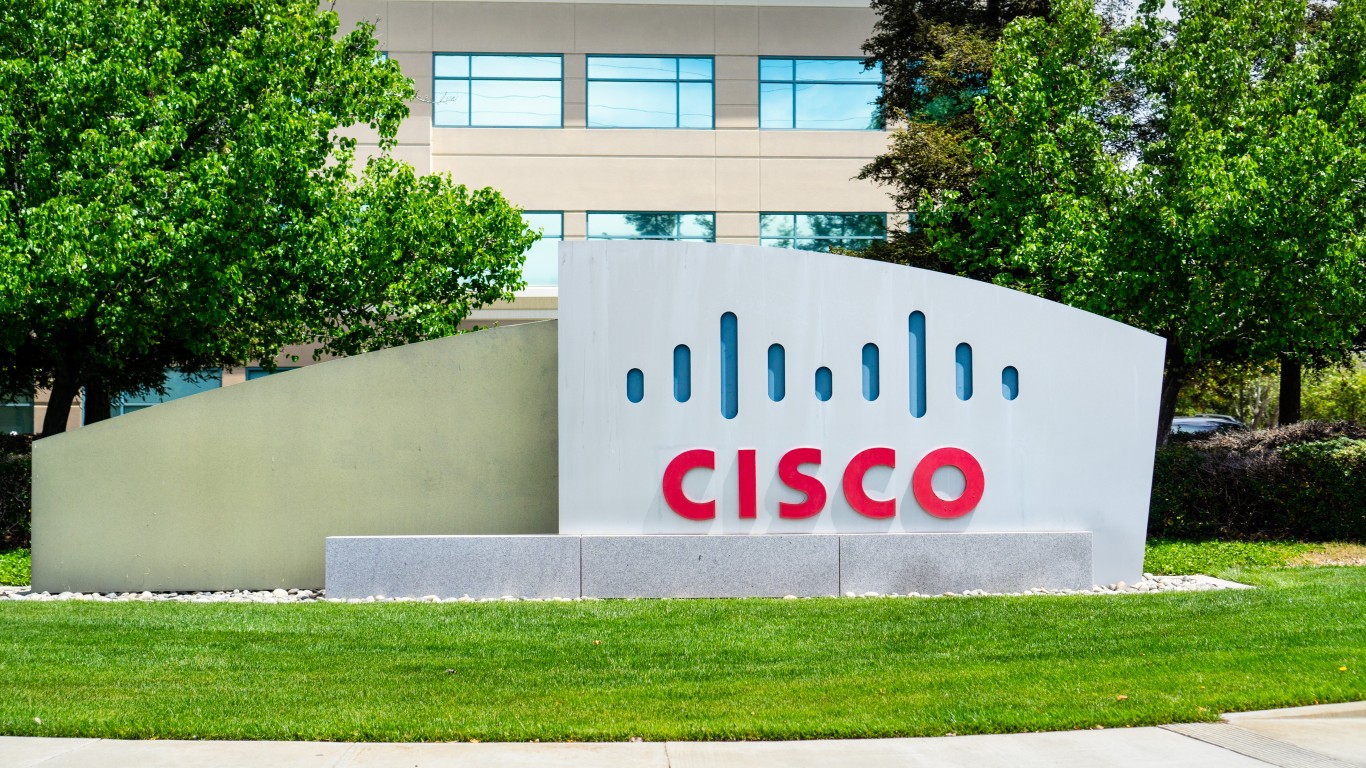
Cisco CEO John Chambers in Trouble Again After Poor Earnings

Photo of Douglas A. McIntyre
By Douglas A. McIntyre Published
This post may contain links from our sponsors and affiliates, and Flywheel Publishing may receive compensation for actions taken through them.

John Chambers has been the dean of Silicon Valley CEOs for years, based on the length of his time in his position, which goes back to 1995. Many of the most successful tech companies were not founded then. Chambers has only had one major brush with investor wrath that was great enough to potentially unseat him. In 2011, earnings at Cisco Systems Inc. (NASDAQ: CSCO) faltered badly as Chamber’s M&A machine failed him. Cisco had diversified too far away from its core businesses and into set-top boxes, Wi-Fi and video conferencing. Although it cost thousands of Cisco workers their jobs, Chambers steadied earnings. However, Cisco’s numbers have dived gain. His nearly 20 years as CEO ought to end as he steps aside for someone more qualified to run the company for the rest of the decade.

The figures for the most recently reported quarter were satisfactory. The forecast for Cisco’s future quarters was not. Cisco reported revenue of $12.1 billion, up from $11.9 billion in the same period a year ago. Net income was $2.0 billion, against $2.1 billion. However, as MarketWatch reported:

Second-quarter revenue may drop 8% to 10% compared to the same period of fiscal 2013, and adjusted earnings are seen between 45 and 47 cents a share. Analysts had forecast 4% revenue growth in the second quarter.

Chambers put much of the blame for this on emerging market soft demand. Cisco’s stock dropped 11% on the news, which wiped out nearly $15 billion in market cap.

Chambers missed a major turn in the market for his company’s products. Routers and switches rely less on hardware and more on software today. Chinese firm Huawei has exploited this change in the industry and has consistently taken market share from Cisco. The entire industry has moved toward using virtualization software that runs on inexpensive servers. Chambers did not move quickly enough in this direction to keep Cisco at the head of the industry. He continues to defend an ancient model because he has been slow to move toward the new one.

The stock market has acknowledged Cisco’s problems for a long time. While the Nasdaq has risen more than 180% during the past five years, Cisco shares are only up 55%. Based on the sell-off of shares after earnings and on concerns about the company’s future, it is difficult to believe that the stock will do any better in the foreseeable future.

The hole Chambers has created at the core of Cisco’s product line is large enough that, even if the company scrambles, the cutting edge of its industry has moved too far ahead of it.

Photo of Douglas A. McIntyre
About the Author Douglas A. McIntyre →

Douglas A. McIntyre is the co-founder, chief executive officer and editor in chief of 24/7 Wall St. and 24/7 Tempo. He has held these jobs since 2006.

McIntyre has written thousands of articles for 24/7 Wall St. He is an expert on corporate finance, the automotive industry, media companies and international finance. He has edited articles on national demographics, sports, personal income and travel.

His work has been quoted or mentioned in The New York Times, The Wall Street Journal, Los Angeles Times, The Washington Post, NBC News, Time, The New Yorker, HuffPost USA Today, Business Insider, Yahoo, AOL, MarketWatch, The Atlantic, Bloomberg, New York Post, Chicago Tribune, Forbes, The Guardian and many other major publications. McIntyre has been a guest on CNBC, the BBC and television and radio stations across the country.

A magna cum laude graduate of Harvard College, McIntyre also was president of The Harvard Advocate. Founded in 1866, the Advocate is the oldest college publication in the United States.

TheStreet.com, Comps.com and Edgar Online are some of the public companies for which McIntyre served on the board of directors. He was a Vicinity Corporation board member when the company was sold to Microsoft in 2002. He served on the audit committees of some of these companies.

McIntyre has been the CEO of FutureSource, a provider of trading terminals and news to commodities and futures traders. He was president of Switchboard, the online phone directory company. He served as chairman and CEO of On2 Technologies, the video compression company that provided video compression software for Adobe’s Flash. Google bought On2 in 2009.

Our $500K AI Portfolio

See us invest in our favorite AI stock ideas for free

Our Investment Portfolio

Continue Reading

Top Gaining Stocks

CBOE Vol: 1,568,143
PSKY Vol: 12,285,993
STX Vol: 7,378,346
ORCL Vol: 26,317,675
DDOG Vol: 6,247,779

Top Losing Stocks

LKQ
LKQ Vol: 4,367,433
CLX Vol: 13,260,523
SYK Vol: 4,519,455
MHK Vol: 1,859,865
AMGN Vol: 3,818,618