


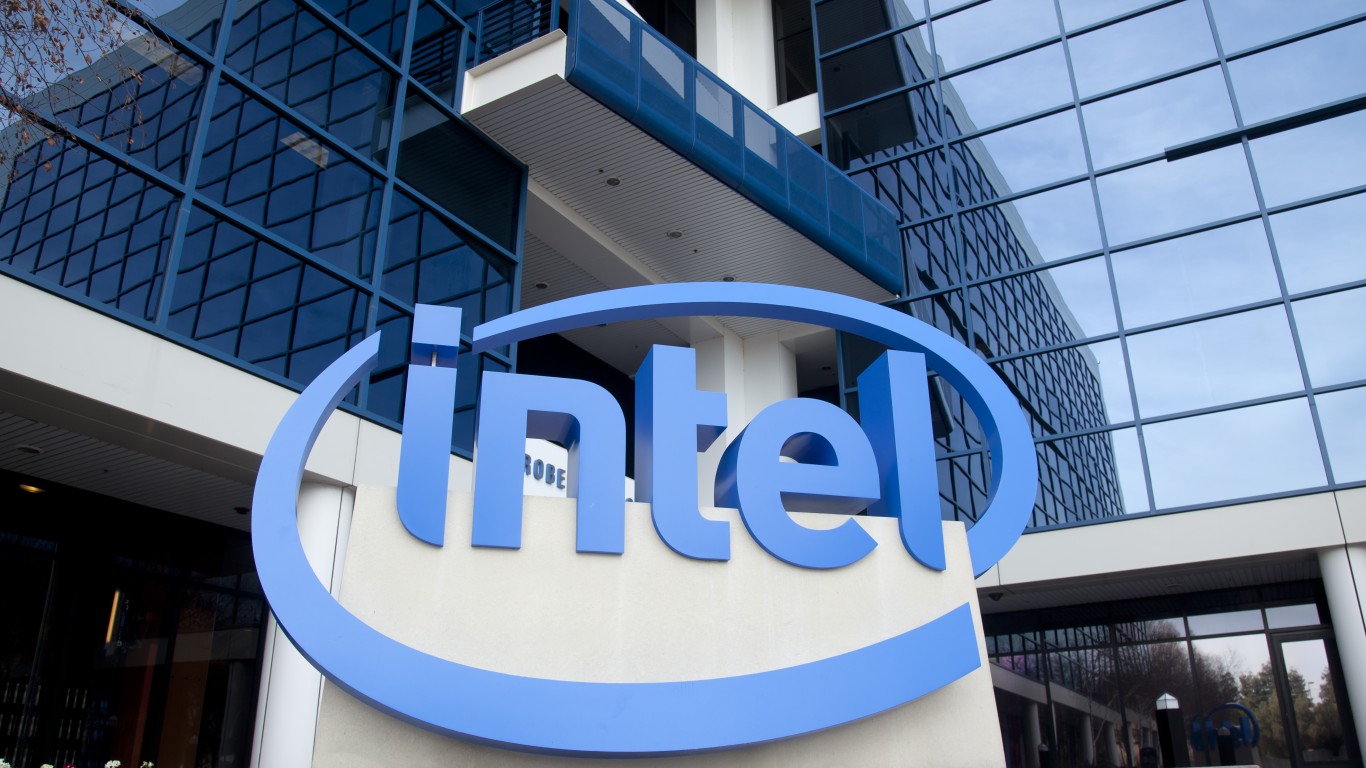
Activist hedge fund Third Point has taken a $1 billion position in chipmaker Intel Corp.’s (NASDAQ: INTC | INTC Price Prediction) stock. Third Point’s founder, Dan Loeb, uses a letter to Intel’s board to savage management’s decisions about chip development and “failed acquisitions.” He urged Intel to seek “strategic alternatives,” which often involve forcing out management and selling assets.
Loeb added specific criticisms about Intel and its competition: “The loss of manufacturing leadership and other missteps have allowed several semiconductor competitors to leverage TSMC’s and Samsung’s process technology prowess and gain significant market share at Intel’s expense.”
[in-text-ad]
Intel was among the companies on 24/7 Wall St.’s America’s 5 Worst-Run Companies of 2020. In the article we wrote:
The successes and failures of America’s largest public companies have been marked in many cases by the effects of the COVID-19 pandemic as much as anything else this year. At one end of this spectrum, the chance of a banner year for cruise ship company Carnival ended in March. Zoom Video Communications, on the other hand, went from a small provider of video conferencing to one of the largest stock market successes in decades, as people moved from their offices to their homes. However, in some situations, management decisions were as important, if not more so, than the pandemic or the economy, to determine how companies performed in 2020.
[nativounit]
24/7 Wall St. looked at large public companies to find those that did particularly poorly against broad measurements. This included the quality of their products and services as measured by third parties, their market share, their financial performance compared to competitors in the first three-quarters of the calendar year, their employee relationships and their stock market performances against peers for the first 11 months of 2020. Finally, we looked at the wisdom of major strategic decisions.
These five companies did unusually badly, based on the tools their companies had to work with. The list did not take include companies with new chief executive officers unless those CEOs had been in senior management immediately before being promoted. Coincidentally, some of these companies had executive board chairs who were previously CEOs but remained in senior management.
About Intel specifically:
CEO Robert (Bob) Holmes Swan, CEO
Swan took up the reins at Intel Corp. (NASDAQ: INTC) at the start of 2019. Since then, the largest chip company repeatedly has been overwhelmed by the competition. Its shares are off 13% this year. The stock of major rival AMD is higher by 106%. Nvidia, another competitor, has seen a 130% gain.
Intel is one of 2020’s few big tech failures. Not only is Intel losing market share and critical customers like Apple, but it has problems with slow product development and lagging production. Swan still has a dominant market share in many of Intel’s key sectors, but in many cases, that is slipping away. One analyst recently wrote that there is “no easy fix” for Intel’s problems.
The stock price movement of Intel and its competitors has changed some over the last four weeks. Nvidia’s shares are higher by 120%. AMD’s are up 97%. Intel’s are down 17%. They gained 4% on the Third Point announcement. The share price changes do not alter the fact that Intel has done a terrible job.
[recirclink id=826646]
[wallst_email_signup]










 Top Gaining Stocks
 Top Losing Stocks