



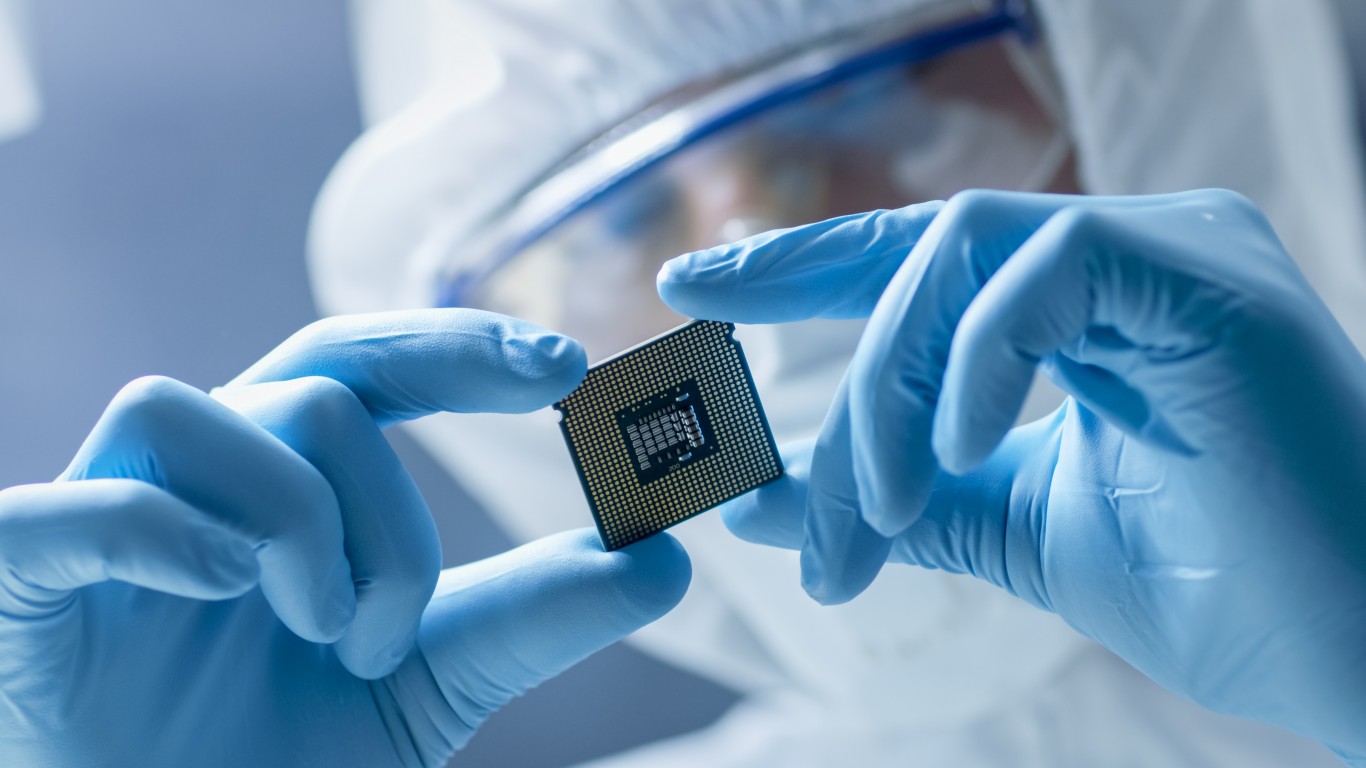
If there is one thing in this world that investors have grown accustomed to, it is a plentiful supply of semiconductors, especially in an age in which they are used in so many different applications, from computers to cars to just about everything. Well, the day has arrived that shortages are being felt and are causing some severe problems across many industries.
[in-text-ad]
In a new Jefferies report, outstanding semiconductor analyst Mark Lipacis notes that, after conversing with supply chain experts and conducting in-depth channel checks, the current shortage of chips is the worst in 30 years and lead times for product delivery have been stretched way out. There is so much demand that some original equipment manufacturers (OEMs) are taking drastic measures for inventory. The report noted this:
OEMs are paying high prices to procure chips, and many are concerned that the component shortage will cause them to shut down factories. One OEM paid a high expediting fee to get parts in 39 weeks, instead of 52. OEMs are concerned that the component shortage would shut down their factories. One OEM placed a “blank check” order, with the quantity and pricing blank, leaving it to the reseller to fill in the quantity and pricing required to procure chips.
[nativounit]
The analyst also said this about why the shortage is so intense:
Supply chain expert, Richard Kwartek attributed the hefty undersupply to a “perfect storm” of factors: 1) fire at a Renesas factory in Japan, 2) cold weather shutting NXP semiconductor and IFX fabs in Texas, 3) drought in Taiwan (3000-10000 gallons per day required for large semi factories, 4) poor OEM forecasting during COVID, 5) transportation shortage, 6) low inventories, 7) substrate & packaging paper shortage, and 8) sudden improvement in demand.
Four semiconductor stocks are favored at Jefferies, and all have Buy ratings. It is important to remember that no single analyst report should be used as a sole basis for any buying or selling decision.
Analog Devices
This stock could very well continue to benefit from the increase in information technology and 5G spending. Analog Devices Inc. (NASDAQ: ADI | ADI Price Prediction) is a leader in the design, manufacture and marketing of analog, mixed-signal and digital signal-processing integrated circuits for use in industrial, automotive, consumer and communication markets worldwide.
The company offers signal-processing products that convert, condition and process real-world phenomena, such as temperature, pressure, sound, light, speed and motion, into electrical signals.
Analog Devices has among the best end-market exposure, with high communications and aerospace/defense market exposure, in addition to offering investors a powerful 5G content growth story. Plus, acquisitions over the past few years like Linear Technology and Hittite Microwave should provide revenue and additional cost synergies that are still coming.
Investors receive a 1.74% dividend. The Jefferies price target for the shares is $188. The Wall Street consensus price target is lower at $182.62. Analog Devices stock closed Wednesday trading at $158.46 per share.
[recirclink id=862878]
Marvell Technology
This top company also is a favored mid-cap pick at Jefferies. Marvell Technology Group Ltd. (NASDAQ: MRVL) is a fabless supplier of mixed-signal and analog semiconductor products to a number of storage, computing and communication applications, including hard disk drives, personal computers, servers, Ethernet switches, printers and connectivity markets.
[in-text-ad]
The company has a unique positioning in markets that could rebound fastest in the second half of the year and into 2022. Top analysts are expecting enterprise and global 5G infrastructure deployments. In addition, multiple product cycles across the cloud, 5G and autos, which collectively are 25% of sales, as well as design internet protocol across processors, storage and computing.
In addition, Marvell has the ability to monetize Arm server internet protocol and drive potential synergies from the company’s Inphi acquisition, which has been approved by Chinese regulators and should close in the second or third quarter.
Shareholders receive a 0.55% dividend. Jefferies has a price target of $55, and the consensus target is $54.84. Marvell Technology stock closed at $48.05 a share on Wednesday.
[recirclink id=862326]
Microchip Technology
This company is a huge Internet of Things benefactor and the stock has been very strong recently. Microchip Technology Inc. (NASDAQ: MCHP) is a leading provider of microcontroller, mixed-signal, analog and flash-IP solutions, providing low-risk product development, lower total system cost and faster time to market for thousands of diverse customer applications worldwide.
The company acquired Microsemi in June of 2018, and most analysts believe that purchase and earlier acquisitions afford Microchip Technology ongoing mergers and acquisitions linked upside potential from cross-selling (to boost sales) and manufacturing synergies (to reduce costs).
Microchip’s sales, margins and earnings per share are somewhat more levered to the cyclical stabilization and recovery that is now upon us than many peers, owing to its relatively more vertically integrated manufacturing network, significant channel inventory reduction over the past seven quarters and elevated financial leverage.
Investors receive a 1.19% dividend. The $194 Jefferies price target compares with a $171.14 consensus price objective. Microchip Technology stock closed on Wednesday at $156.32 a share.
[in-text-ad]
Nvidia
This top chip company has reported strong earnings the past few years, and the stock was absolutely hammered last quarter but had rallied back smartly. Nvidia Corp. (NASDAQ: NVDA) is one of the leaders when it comes to supplying graphics processing technology for the 3D graphics market, including desktop graphics processors and gaming consoles.
Nvidia is also moving into visual computing chips for cars, mobile devices and supercomputers. The company has been able to use its ability to leverage past investments, with a more controlled spending structure ahead on unified, which enables strong cash flow that is allowing a focus on capital return, which is currently estimated to be $1 billion next year.
The analyst feels that the company deserves a higher multiple, as Nvidia is on a roadmap to grow its per-share earnings by an impressive compounded annual growth rate of around 37% over the next five years. This is as it builds its ecosystem, starting with chips, switch fabrics, software and artificial intelligence computing systems. The analyst cites downside risks that include demand destruction due to a prolonged outbreak of COVID-19 virus, slower PC gaming growth and competition from competitors and new entrants to the deep learning market.
Investors receive just a 0.28% dividend. Jefferies has set its price target at $680. The consensus target price is $655.52, and Nvidia stock closed most recently at $611.08 per share.
[recirclink id=860930]
Needless to say, the increased demand and diminished product availability will be great for some companies, but it could put some intense pressure on the companies needing the semiconductors. Some have even indicated there could be factory closings as a result. Buying any of these four solid stocks very well could be a great short-term and long-term strategy for aggressive growth investors.
[wallst_email_signup]












 Top Gaining Stocks
 Top Losing Stocks