


One of the best features of technology is its promise to solve a problem without forcing any change in how people behave. One such technology, called carbon capture, was touted as being able to remove all or most of the carbon dioxide emitted from large coal-fired electricity utilities. The gases were then to be injected into the ground or stored and used.
The big attraction of carbon capture — for coal producers and utility companies — lay in the belief that technology would solve their carbon emissions problems and neither they nor consumers would have to change a thing. Business could proceed as usual. That hasn’t happened yet, and reports of carbon capture’s technological promise have been around for more than a decade.
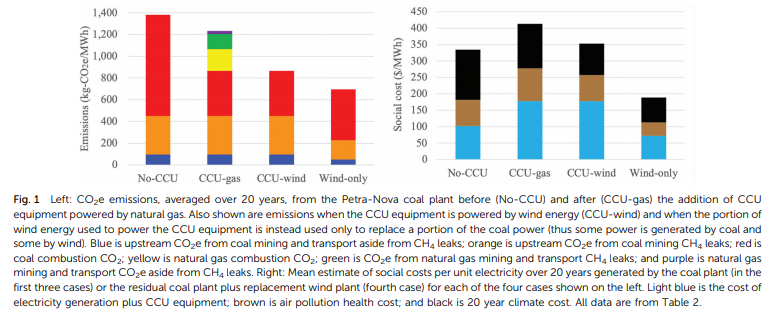
A new study by Stanford University’s Mark Z. Jacobson, professor of civil and environmental engineering and director of the university’s atmosphere/energy program, reveals even worse news for carbon capture. Jacobson analyzed data from coal-fired carbon capture and use (CCU) plant and a synthetic direct air carbon capture and use plant (SDACCU) to determine how much the equipment, by itself, could reduce carbon emissions.
Here’s his conclusion: “A net of only 10.8% of the CCU plant’s CO2-equivalent (CO2e) emissions and 10.5% of the CO2 removed from the air by the SDACCU plant are captured over 20 years, and only 20–31%, are captured over 100 years.”
Jacobson says that the low net capture rates are the result of “uncaptured combustion emissions from natural gas used to power the equipment, uncaptured upstream emissions, and, in the case of CCU, uncaptured coal combustion emissions.” Even using wind instead of natural gas-fired generation to power the CCU and SDACCU equipment increases both air pollution and “total social costs” compared to no capture technology at all. Those social costs include potential health problems, economic costs and costs related to climate change.
[nativounit]
Jacobsen elaborated, “Even if you have 100 percent capture from the capture equipment, it is still worse, from a social cost perspective, than replacing a coal or gas plant with a wind farm because carbon capture never reduces air pollution and always has a capture equipment cost. Wind replacing fossil fuels always reduces air pollution and never has a capture equipment cost.”
The new study could change the Intergovernmental Panel on Climate Change (IPCC) estimate that carbon capture technologies can help lower global carbon dioxide emissions by 75% to 90%. That estimate, Jacobson says, assumes that carbon capture removes 85% to 90% of carbon dioxide, with a penalty of around 25% to operate the carbon capture equipment itself.
In answer to an effort to paint direct air capture technology as a method for removing carbon dioxide from the atmosphere once all electricity is generated from renewable sources, Jacobsen suggests that reforestation — nature’s own carbon capture technology — may be a more cost-effective way to limit global warming than reducing biomass burning or reducing emissions of halogen, nitrous oxides and non-energy methane.
Carbon capture technologies, Jacobsen argues, represent an opportunity cost and are “not close to zero-carbon technologies.” As such, for the same or less cost, people get more bang for their bucks by replacing fossil-fuel burning plants with wind or solar farms.
Jacobson’s research was published in Energy & Environmental Science on October 21, 2019. A draft version is available at no charge from the Stanford website.
[recirclink id=594332]
[wallst_email_signup]









 Top Gaining Stocks
 Top Losing Stocks