



Shares of Walt Disney Company (NYSE: DIS | DIS Price Prediction) gained 2.64% over the past month after gaining 4.54% the month prior. The stock’s one-year gain stands at just 4.83%. However, since its one-year low on April 8, DIS is up nearly 39%. Disney pays a dividend that currently yields 1.32%, or 37 cents per share per quarter.
Earlier in December 2025, the company announced a $1 billion licensing agreement with OpenAI that will allow the tech company to use the likeness of approximately 200 characters that fall under Disney’s intellectual property. OpenAI will allow users of its Sora platform to use the characters to produce short-form content that Disney may make available via its streaming Disney+ service.
When the company reported its Q4 earnings Nov. 13, 2025, it beat analyst estimates on earnings but missed on revenue. The company reported EPS of $1.11 versus analysts’ expectations of $1.05, and revenue of $22.46 billion versus expectations of $22.75 billion.
Earlier last year, the company announced that it is expanding its global theme park footprint — the first such effort in nearly a decade — with a forthcoming location in Abu Dhabi, United Arab Emirates. For the past century, the Disney has been an entertainment pioneer in international branding, animation, films, television, merchandising, and theme parks. Although the media empire holds some of the most cherished brands, and its film studios were responsible for producing the top three movies at the box office in 2024, the stock is hasn’t been kind to investors lately. Over the past five years, shares are down 21.77%.
Disney announced in January 2025 that it will be merging its Hulu + Live TV service with its competitor, Kubo. Disney will own 70% of the new company, which will continue to operate under the Fubo brand. Fubo CEO David Grandler and his management team will continue to lead the company. If Disney and its CEO Bob Iger can continue to grow new and existing business lines, shareholders should take comfort with the company’s future stock performance over the next one, five and 10 years.
While most Wall Street analysts will calculate 12-month forward projections, it’s clear that nobody has a consistent crystal ball, and plenty of unforeseen circumstances can render even near-term projections irrelevant. 24/7 Wall St. aims to present some farther-looking insights based on Disney’s own numbers, along with business and market development information that may be of help to our readers’ own research.
Disney’s Recent Stock Performance
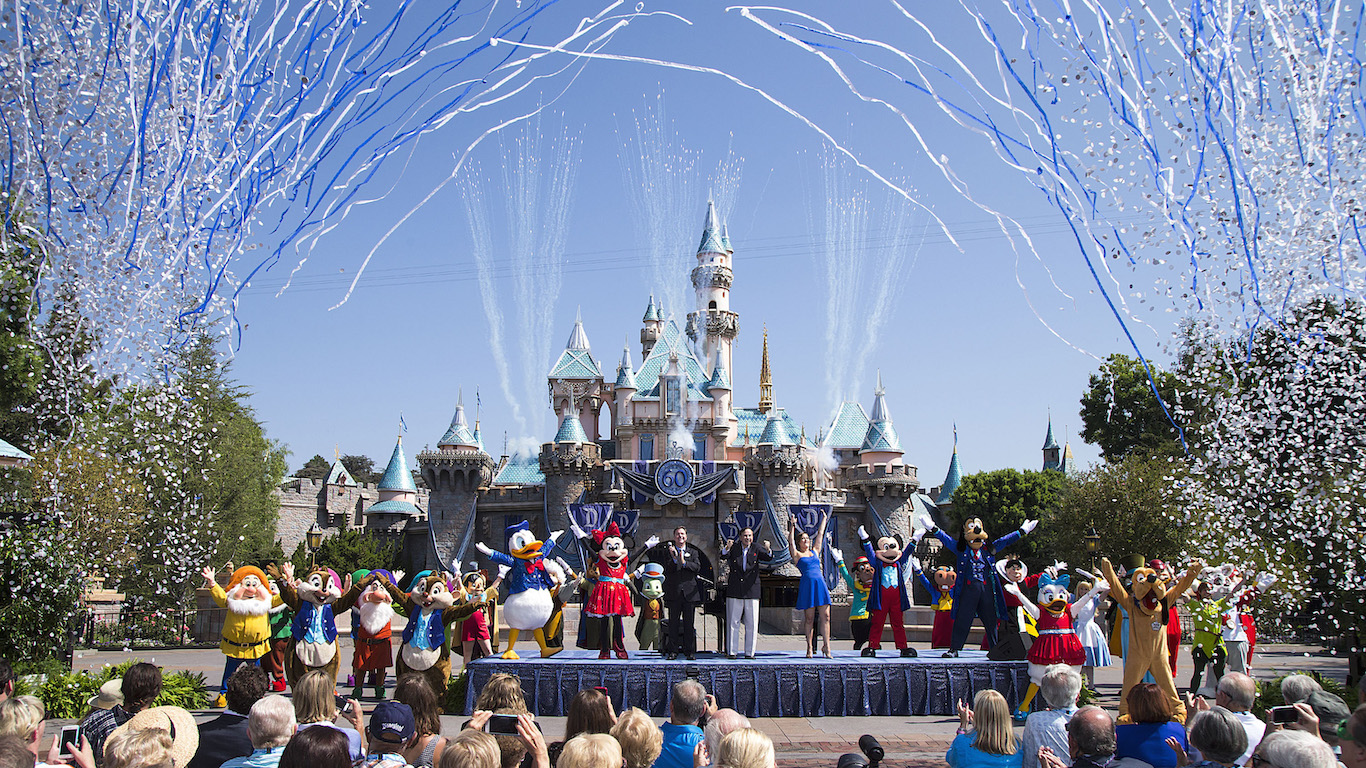
Disney controls 25% of the theme park market, which is expected to grow to over $82 billion by 2032.
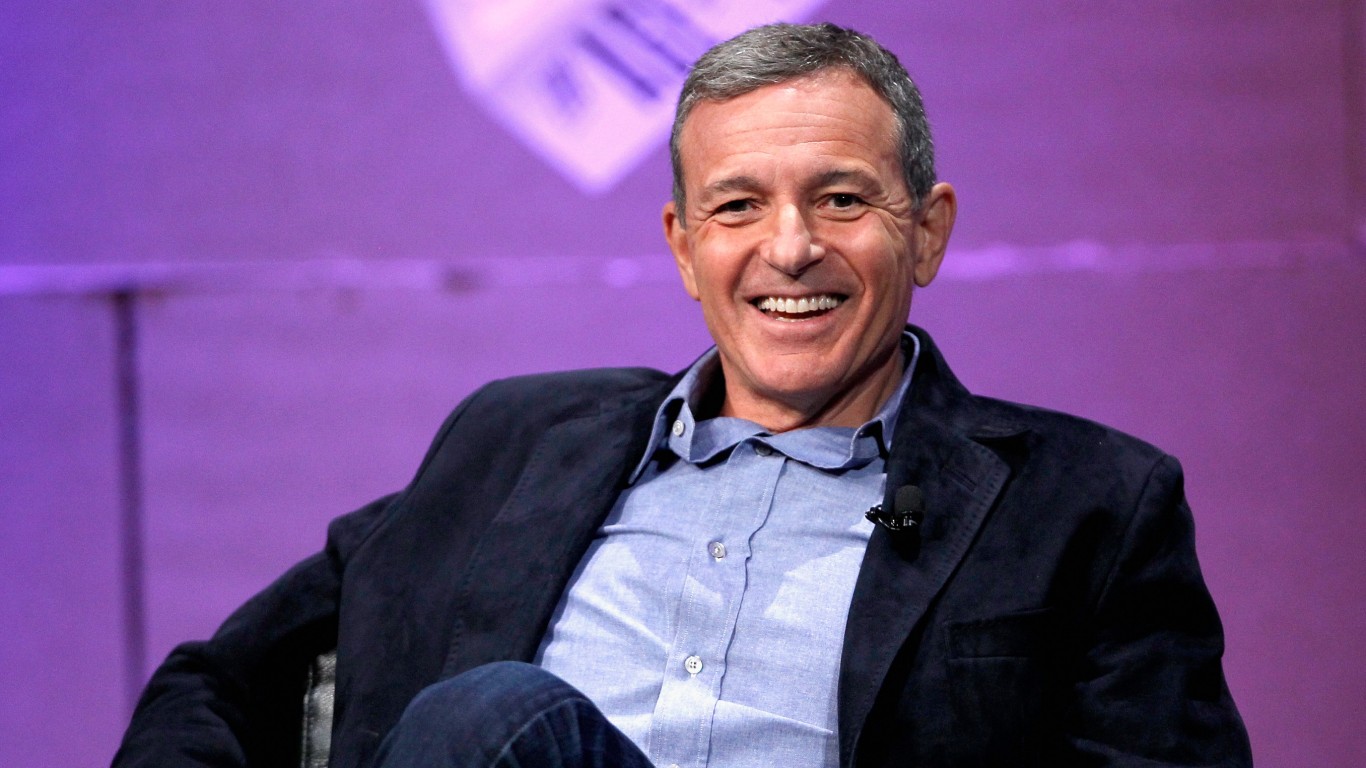
Bob Iger’s 15-year initial tenure at Disney is notable for four acquisition milestones: Pixar in 2006, Marvel in 2009, Lucasfilm in 2012 and Fox in 2019. Disney’s market cap grew from $56 billion to $231 billion by the time his contract expired in 2020. A look at the top 10 all-time box office-grossing films shows that except for Titanic and Jurassic Park, Disney or its subsidiaries are the exclusive US distributor for those films (or a 25% stake in the case of Sony’s Spider-Man: No Way Home).
Iger’s successor, Bob Chapek, was essentially handed the keys to a well-oiled machine but the company hit a number of rough patches and the stock has been on a long-term slide.
- Disney would lose about $11 billion from the delays with Disney+, with operating income decreasing by 18% in the push to attract streaming subscribers for Disney+. ESPN+, Hulu, and its other direct-to-consumer (DTC) platforms.
- Gross over-budget spending of $725 million on Marvel TV shows.
- After Iron Man director Jon Favreau’s success with The Mandalorian TV spin-off from the Star Wars franchise, the subsequent Kathleen Kennedy-produced TV series was met with yawns and outcries from loyal fans who detested the changes she made in the Star Wars canon, along with her intentional killing off of the main Star Wars characters to make room for her new ones.
| Fiscal Year (Sept. 30) | Price | Revenues | Net Income |
| 2015 | $103.00 | $52.465B | $8.382B |
| 2016 | $92.47 | $55.632B | $9.391B |
| 2017 | $100.70 | $55.137B | $8.898B |
| 2018 | $114.78 | $59.434B | $12.598B |
| 2019 | $130.27 | $69.607B | $11.054B |
| 2020 | $122.55 | $65.388B | -$2.864B |
| 2021 | $176.01 | $67.418B | $1.995B |
| 2022 | $94.33 | $82.722B | $3.145B |
| 2023 | $81.05 | $88.898B | $2.354B |
| 2024 | $96.19 | $91.36B | $4.97B |
| 2025 | $113.77 | TBD | TBD |
Key Drivers for Disney’s Future
While Inside Out 2 demonstrated the resilience of Disney’s animation department, Iger’s repairs to Disney’s floundering segments have regained their fan bases and show promise.
- Rectifying the casting and plotline issues with Marvel’s projects, Iger has overseen dumping the storyline starring Jonathan Majors as the antagonist for The Avengers and replacing him with franchise icon Robert Downey Jr. as comic favorite Doctor Doom.
- Restoring the winning formula of the popular Marvel Netflix action series Daredevil with the original cast and continuation of the series storyline, as opposed to the Chapek team’s plan to turn it into a courtroom drama.
- While the Star Wars casting and plot line problems still exist, the recent cancellation notice of the underperforming The Acolyte may be the harbinger of a similar cleanup.
- To cut expenses and extend profits in DTC, Disney announced the elimination of its “TV Everywhere”-style apps, including DisneyNOW, Freeform, FXNOW, ABC, and National Geographic in September. This is intended to drive subscribers to Disney+ and Hulu.
- Challenges from Amazon Prime, Netflix and Peacock to bite into ESPN’s sports coverage are not expected to impact Disney significantly. Both NFL and NBA games may be shared with its rivals, but soccer, racing, and other sports are still firmly in ESPN’s stable. Both Disney’s ESPN and ABC channels have a well-cushioned 37% operating margin, so losing some market share will not impact profits significantly.
- Although inflation has forced millions of people to cut back on their family vacations, sales at Disney theme parks were still up 2% in Q3 2024. Disney has allocated a 10-year, $60 billion plan to add new attractions and to better enhance the guest experience.
The primary issue Disney faces is finding Iger’s next successor. He came out of retirement at the request of Disney’s board but has made it clear that he doesn’t intend to stay for another long haul.
Stock Price Prediction for 2026
Wall Street maintains a 12-month price target for Disney of $137.29, representing potential upside of 21.05% from today’s share price. Based on 19 analysts covering the stock, Disney receives a consensus “Strong Buy” rating with 16 analysts assigning it a “Buy” rating, three assigning it a “Hold” rating and zero assigning it a “Sell” rating.
24/7 Wall St.’s 2026 year-end price target for Disney is $129.14, representing 13.87% upside from today’s share price. That forecast is based on annualized EPS of $5.21 and P/E ratio of 22.
Disney (DIS) stock prediction for 2026–2030
The theme park industry, of which Disney has a 25% market share, was valued at $64.6 billion at the start of 2024. It is estimated to grow to $82.73 billion by 2032. The 10-year, $60 billion plan to add more attractions to Disney theme parks and cruises will likely involve greater interactive technology, virtual reality, and other experiences that could not be replicated elsewhere.
While stages of this development would certainly make their way to Disney’s bottom line in previous years, we anticipate many of their innovations to be in full operation and available to the public in 2029, which would boost the initial novelty value to a $149 five-year high.
However, high ticket prices that compete with other entertainment platforms might require price reductions. That, combined with uncertainty over Bob Iger’s successor, might cause a slight sell-off. Nevertheless, Disney would still be up 28.56% in 2030 over its current market price at the time of this writing.
| Year | Normalized EPS | Projected Stock Price | %Change From Current Price |
| 2026 | $5.87 | $129.14 | 13.87% |
| 2027 | $6.13 | $122.60 | 8.10% |
| 2028 | $6.78 | $135.60 | 19.56% |
| 2029 | $7.45 | $149.00 | 31.38% |
| 2030 | $8.10 | $145.80 | 28.56% |









 Top Gaining Stocks
 Top Losing Stocks