


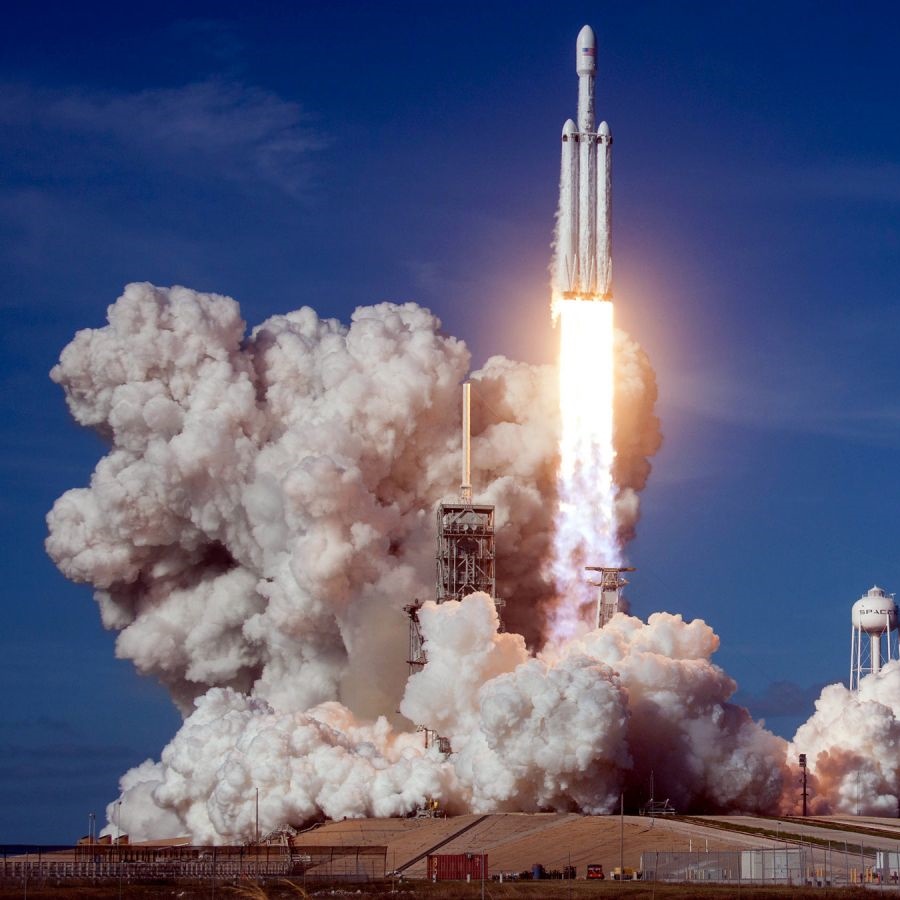
Space Exploration Technologies, better known as SpaceX, on Wednesday was awarded its first-ever U.S. Air Force contract to fire a classified military satellite into space using its Falcon Heavy rocket. The contract was awarded as a firm-fixed-price deal for $130 million.
The company’s rival for this contract was United Launch Alliance (ULA), a joint venture between Boeing Co. (NYSE: BA) and Lockheed Martin Corp. (NYSE: LMT), that builds a rocket dubbed the Delta IV Heavy. That rocket costs an estimated $350 million.
The new contract award calls for SpaceX to provide launch services to deliver the Air Force Space Command-52 satellite into its intended geostationary orbit. Exactly what that orbit is and what the satellite will do when it gets there is undisclosed. The launch is scheduled for September 2020.
Until a few years ago, ULA had a virtual lock on Air Force missile launches. Then, in April 2014, SpaceX CEO Elon Musk sued the Air Force for awarding an exclusive contract for 36 rocket launches to ULA. The contract was worth $11 billion over five years and was awarded to ULA with no competitive bidding. At the time, Musk claimed that an average ULA launch cost $225 million while SpaceX could do the job for less than $100 million.
[nativounit]
By January of 2015, Musk had settled his dispute with the Air Force, and later that year the Falcon rocket was certified to compete with ULA rockets for government contracts. Since then the company has won about half the contracts it has competed for against ULA.
The Falcon Heavy rocket is essentially three Falcon 9 cores strapped together, and its much lower price threatens the future of the ULA Delta IV heavy. But the Falcon Heavy does not meet the requirements of one of its biggest potential buyers — NASA.
After a Falcon Heavy test flight in February, a NASA official said the rocket was “too small” for the deep space exploration. To meet the challenge, SpaceX is developing a larger rocket it calls the BFR (Big F*****g Rocket) intended to be used for missions to Mars.
Boeing is not standing still either. The company is the prime contractor on a NASA project called the Space Launch System (SLS) that would enable exploratory missions into deep space. The catch here is that an SLS launch is expected to cost about seven times the cost of a Falcon Heavy launch.
SpaceX has not provided an estimate for a BFR launch, but a writer for Space Review estimated that a Mars trip with cargo delivery in one ship and people in another would cost $73 million.
[recirclink id=469109]
[wallst_email_signup]








 Top Gaining Stocks
 Top Losing Stocks