


It’s been longer than a year that there has been very much good news for Boeing Co. (NYSE: BA | BA Price Prediction). Apparently, not even bad news for Boeing lasts forever. The aerospace and defense giant reported on Thursday afternoon that it will resume all commercial airplanes production. The move will be in a phased approach at its Puget Sound-region facilities and it will begin in the coming week.
The news sent Boeing shares higher, but it also helped out some of the Boeing suppliers who had seen their shares battered along with Boeing in the downturn.
Even after its dual crashes of the 737 Max planes caused a grounding of every 737 Max, it had a very healthy list of airline customers around the globe. The instant recession from the coronavirus turning into the COVID-19 pandemic caused all of the airline customers to become unhealthy customers who were needing to cancel new airplane orders. All of a sudden, the 737 Max did not even matter all that much under the circumstances and Boeing furloughed workers and announced that it was ceasing production commercial jet production.
Boeing had suspended plane-making operations in March. The company’s announcement indicated that the company is making sure that its personal protective equipment is in place and that it has made the necessary safety measures so that it can resume making planes for its customers.
[nativounit]
According to Boeing’s release, roughly 27,000 people will return to production of the 747, 767, 777 and 787 planes in the Puget Sound area. The company noted that this will support critical global transportation infrastructure, cargo services and national defense and security missions.
While the 737 Max issues have not been front and center in recent weeks, Boeing confirmed in its release that the restarting of its 737 program will include the resumption of work toward restarting production of the 737 Max. As of now, the 737 Max is still not certified for flight by the FAA and other regulators.
It is also important to understand that this is not a restart of every facility. Boeing included a note in its release that the South Carolina operation will remains in a state of suspension at this time. Boeing also noted that it restarted mostly defense production operations in the region earlier this week with approximately 2,500 people.
The press release described the planned phases for returning to work and it gave some specifics on what its plans are for safety measures:
Employees in the Puget Sound for the 737, 747, 767 and 777 will return as early as third shift on April 20 with most returning to work by April 21. Employees for the 787 program will return as early as third shift April 23, with most returning to work by April 24. … Enhanced measures will continue until conditions allow for a return to regular work and cleaning processes. Boeing will continue to monitor government guidance on COVID-19, assess impact on company operations and adjust plans as the situation evolves.
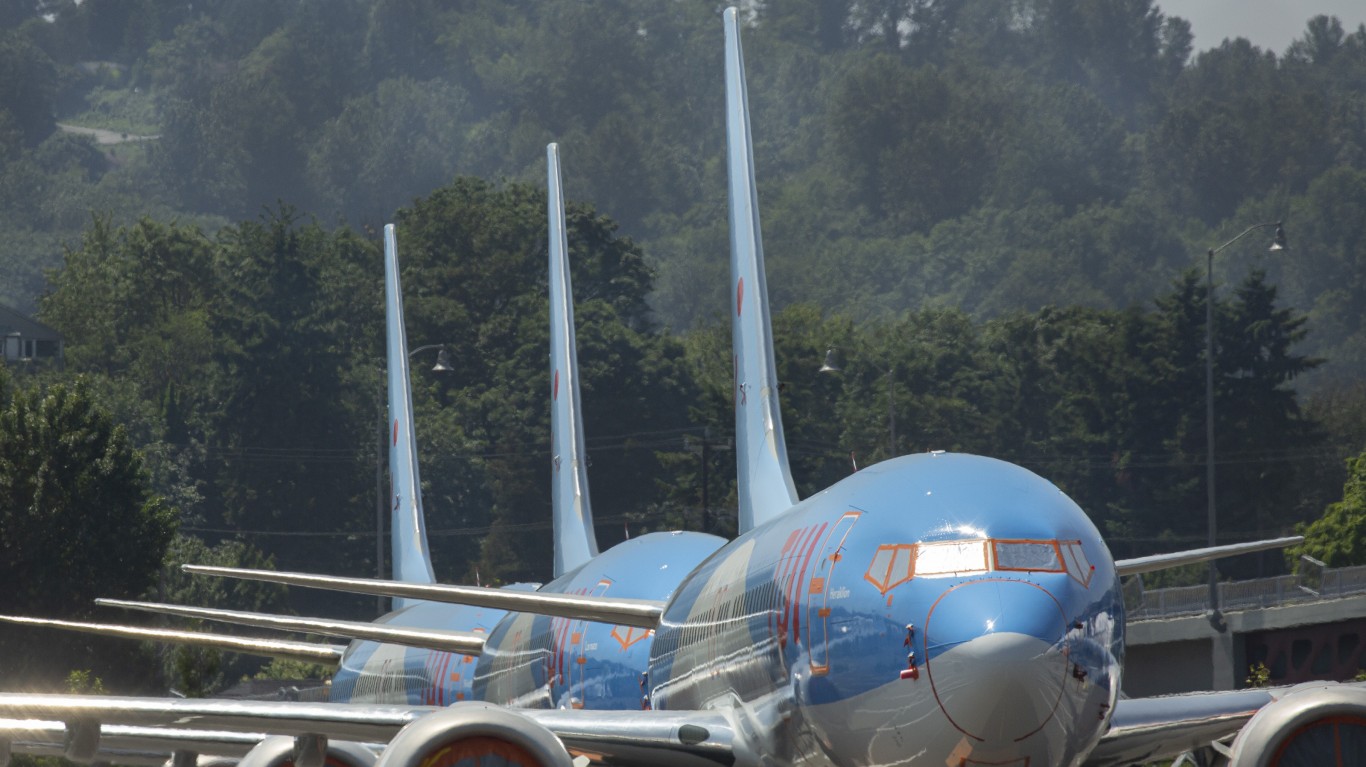
It is obviously good news that Boeing can get started producing planes again. That said, Boeing recently posted its worst quarterly deliveries in years and years. To make matters worse, the major U.S. airlines and carriers in Europe, Asia and elsewhere are operating on very limited schedules with many routes to foreign nations having been shut down mostly or entirely. This begs the question with so many new planes stacked up by runways: will there be buyers for the new planes that it starts making again?
Some analysts have stuck by Boeing, and one went so far as to say it was time to buy the stock very close to the stock market bottom.
Boeing shares closed down 8% at $134.24 on Thursday, and its shares were up about 8% at $144.95 shortly after the announcement. Its 52-week trading range is $89.00 to $391.00 and the Refinitiv consensus analyst target price was $164.00 on last look.
Shares of General Electric Co. (NYSE: GE) closed down 4% at $6.24 on Thursday, but GE was trading back up 3.5% at $6.46 in the after-hours. GE’s 52-week high is $13.26 and GE’s engine operations have been gutted while Boeing’s operations were halted.
Shares of Spirit AeroSystems Holdings Inc. (NYSE: SPR) closed down 8.7% at $19.09 on Thursday, but it was last seen up 8.8% at $20.77 in the after-hours trading session. Spirit AeroSystems is down from a 52-week high of $92.81. It makes plane fuselage and wings for Boeing.
[recirclink id=682812][wallst_email_signup]







 Top Gaining Stocks
 Top Losing Stocks