


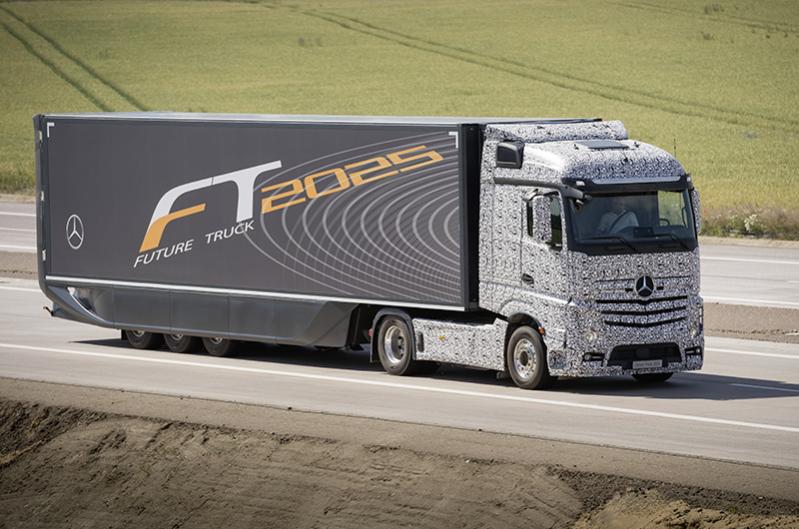
The company calls the vehicle the “Mercedes-Benz Future Truck 2025” and says it relieves the driver of having to drive on tiring and monotonous long-distance routes:
As the truck regulates its own speed and automatically finds the best route using a navigation app, and because the transport company, dispatcher and goods recipient are constantly informed about the locations, route and expected time of arrival in real time, the driver is relieved of time pressure. Today this is a major stress factor for drivers.
ALSO READ: Ten Cars Americans Don’t Want to Buy
The early June collision in New Jersey that killed one person and severely injured actor and comedian Tracy Morgan was reportedly due to a truck driver who had not slept in 24 hours. According to the police report of the crash, the driver for Wal-Mart Stores Inc. (NYSE: WMT) had been awake for more than 24 hours and did not notice that the traffic in front of him had slowed. When the driver did notice, he tried to swerve to avoid the vehicles in front of him, but was unable to do so and hit the bus carrying Morgan and four others. The driver has pleaded not guilty to charges of vehicular homicide and assault by auto.
Daimler calls the system “Highway Pilot” and has built the prototype on its Mercedes Actros tractor-trailer rig with front-facing radar detectors and cameras to scan the road ahead and to communicate with the truck’s Lane Keeping Assist system. Other systems scan the sides and rear of the rig. The truck also includes a vehicle-to-vehicle communication system with a range of about 500 meters.
While the Highway Pilot and similar systems are usually called “driverless,” that does not mean that there will be no one in the driver’s seat. A driver remains at the controls to take over, for example, when the system indicates that the truck is approaching its proper exit. On long stretches of open road or in stop-and-go urban traffic, however, the driver would be freed from the monotony or stress that come with those situations.








 Top Gaining Stocks
 Top Losing Stocks