


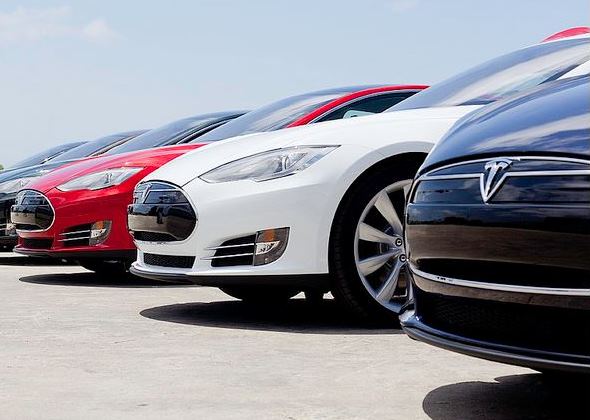
In its most recent quarterly statement, management pointed out:
We still plan to invest about $1.5 billion in capital expenditures this year as we expand production capacity, purchase Model X tooling, continue to build the Gigafactory, and expand our stores, service centers and the Supercharger network
Tesla had $1.5 billion in cash on its balance sheet. Simple math shows that the cash is not sufficient for long-term funding, unless, perhaps, sales of its cars go well ahead of projections, which are 55,000 for this year.
So, Tesla has turned to the banks, according to information it gave the U.S. Securities and Exchange Commission (SEC) recently:
On June 10, 2015 (the “Closing Date”), Tesla Motors, Inc. (the “Company”) and its subsidiary Tesla Motors Netherlands B.V. (“Tesla B.V.” and together with the Company, collectively, the “Borrowers”), entered into an ABL Credit Agreement (the “Credit Agreement”) with Deutsche Bank, Bank of America, Goldman Sachs, JPMorgan Chase, Morgan Stanley, Wells Fargo and Credit Suisse. The Credit Agreement provides for a senior secured asset-based revolving credit facility of up to $500.0 million (the “Credit Facility”), which the Borrowers may draw upon from time to time. The Company may increase the total commitments under the Credit Facility by up to an additional $250.0 million, subject to certain conditions, potentially increasing the Credit Facility to up to $750.0 million. In addition, the Credit Agreement provides for a $100.0 million letter of credit subfacility and a $40.0 million swingline loan subfacility. The proceeds of the loans under the Credit Agreement may be used for working capital and general corporate purposes. The Credit Facility terminates, and all outstanding loans become due and payable, on June 10, 2020. There were no amounts outstanding under the Credit Facility as of the Closing Date.
ALSO READ: How to Protect Yourself From a Summer Stock Market Correction
The terms are onerous:
On the Closing Date, the Borrowers provided an unconditional guaranty of all amounts owing under the Credit Agreement and related credit documents. Certain material subsidiaries of the Borrowers are required to become parties to these guaranties. The Borrowers have also granted security interests in their respective accounts, inventory, certain equipment, certain related assets, specified deposit accounts for the collection of accounts receivable, and certain other accounts to secure all obligations of the Borrowers under the Credit Agreement and the related credit documents. Future subsidiary guarantors are also required to become a party to the applicable security agreements.
The “inventory” and “certain equipment” are particularly burdensome.
At the heart of many start-ups is the soft core of their financials. Tesla has potential problems, just like many of the rest of them. And the likes of Wells Fargo & Co. (NYSE: WFC) will not be sympathetic when the time comes that the loans are due.







 Top Gaining Stocks
 Top Losing Stocks