


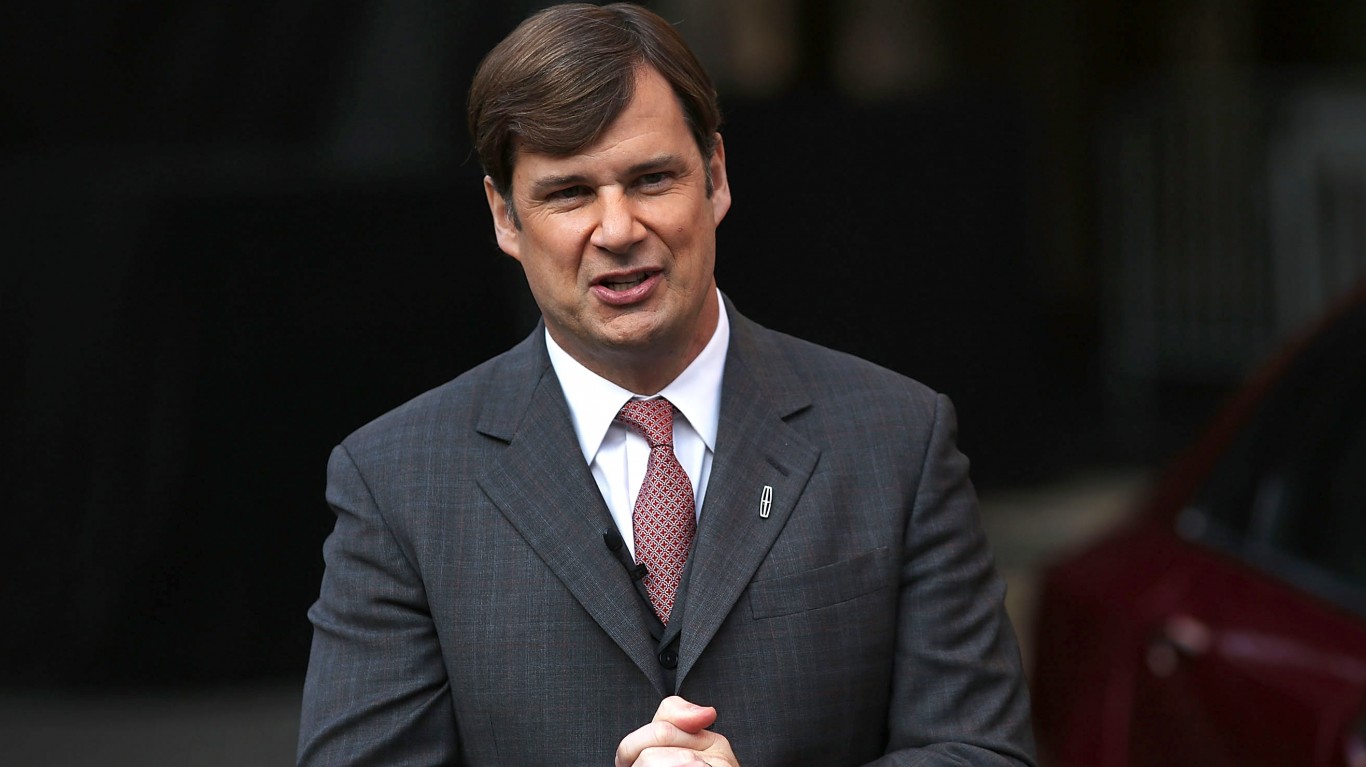
New Ford Motor Co. (NYSE: F | F Price Prediction) CEO Jim Farley has struggled with a problem that has vexed most of the six prior chief executives under Executive Chair William Clay Ford Jr. The shares have posted something between a mediocre and terrible performance. That has not changed recently.
Among the six CEOs is Ford himself. He held the job from October 30, 2001, until September 5, 2006. He replaced himself with Alan Mulally, who ran the company from September 5, 2006, until July 1, 2014. Mulally is considered the one really successful leader under Ford.
Since the start of 2020, Ford’s shares are down just over 5%. By contrast, the S&P 500 is up 12%. Shares of archrival GM are up by over 15%.
Since Farley joined, Ford’s shares have not outperformed that market for several reasons. Most have to do with the fact that Ford’s situation cannot be turned around in a world where many of the large global manufacturers are ahead of it in the development of electric and autonomous vehicles. Another primary reason is Ford’s struggle in China, by far the world’s largest and most competitive car market. Moreover, looming in the background is Tesla, which continues to dominate the electric car business.
[nativounit]
Ford recently launched two vehicles that have drawn positive attention. However, it will not sell enough units of either to affect Ford’s position in the industry in any meaningful way. The first is the Ford Bronco, which is aimed at the “off-road” market, and thus, a competitor of the Jeep lineup. However, it is a niche product and the market for sales is small.
The other vehicle Ford introduced recently is an electric version of its Transit van, which is a commercial vehicle with few sales. Therefore, the new vehicle will not move the needle of Ford’s overall sales. It is a way for Ford to show it continues to take steps into the EV market, but only modest ones.
Ford’s problems with convincing investors that it can be a power in electric and autonomous cars stems from advances at some of the world’s other huge manufacturers. Volkswagen often is described as the car company most likely to challenge Tesla. Ford does not make that list. Ford faces significant challenges in the self-driving sector, which is crowded with car companies, tech companies and divisions of large tech companies.
Ford has no signature project in electric or autonomous vehicles that it can point to as a major advance with substantial commercial possibilities.
Lost in the recent Ford efforts to launch new products with a public appeal is the fact that its position in China has been terrible, though that changed somewhat in the second quarter when sales rose 3% for the period compared to the same one a year ago. Ford’s sales improvement will need to be better than that of the overall Chinese market, which it is not. Without outperforming growth, its market share in China will continue to be a disaster.
It can be argued that Farley has been left in such a troubling position that he cannot improve it much. Based on Ford’s current situation, that is a fair evaluation.
[recirclink id=806027]
[wallst_email_signup]








 Top Gaining Stocks
 Top Losing Stocks