


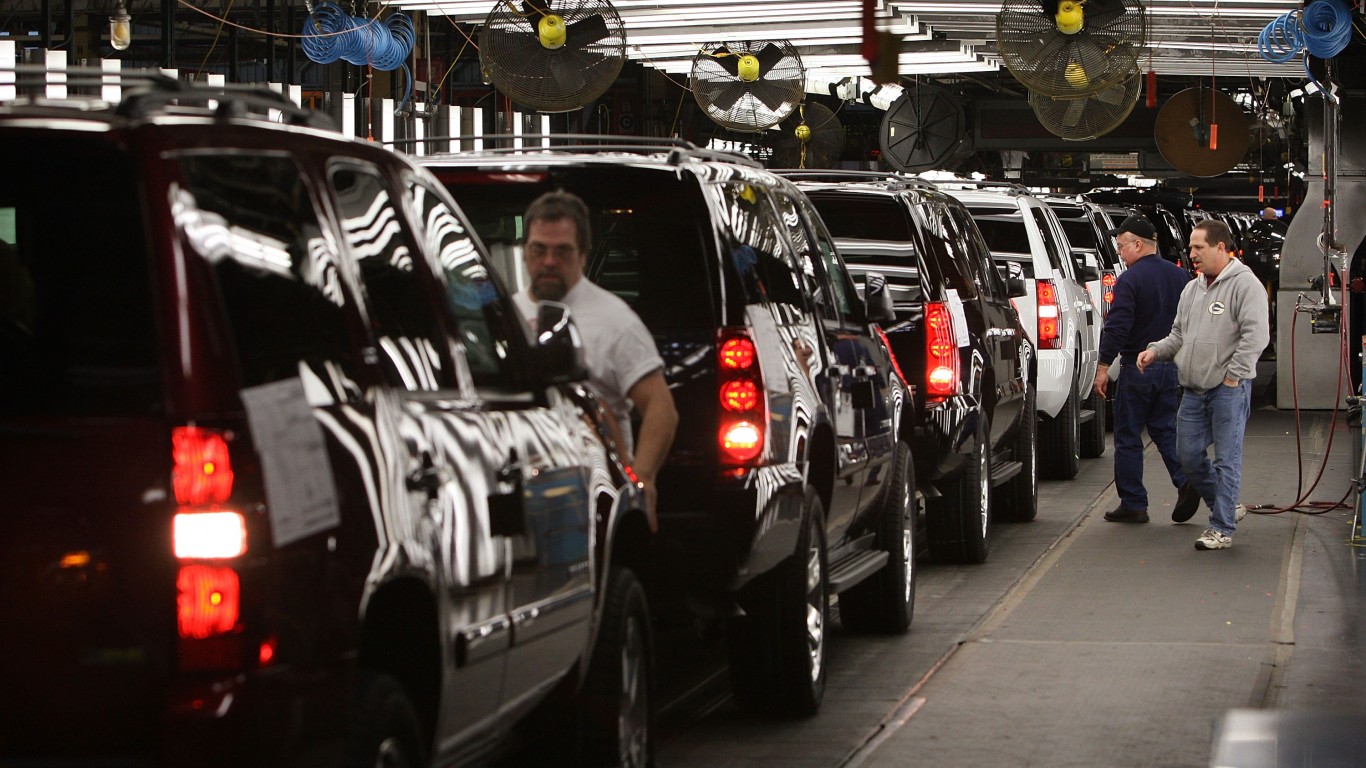
Every one of America’s 10 leading sellers of new cars saw its share price fall since the beginning of 2022. Eight of those 10 also sold fewer cars than they did in 2021.
The sales leader based on unit sales volume was General Motors Inc. (NYSE: GM | GM Price Prediction). According to Cox Automotive’s forecast for full-year 2022 sales, GM’s sales for the year will reach just over 2.25 million vehicles, up 2.3% compared to 2021 sales.
The next eight automakers are all expected to sell fewer units this year. This group includes Toyota Motor Corp. (NYSE: TM), number two with unit sales of around 2.12 million (down 9.0% year over year); Ford Motor Co. (NYSE: F), down 2.9% with sales of 1.84 million units; and Stellantis N.V. (NYSE: STLA), with expected sales of 1.54 million units (down 13.2%).
At number 10, Tesla Inc. (NASDAQ: TSLA) is forecast to sell nearly 525,000 units, up 48.9% year over year. Yet Tesla’s share price is down about 69% with just two more trading days left in 2022.
[nativounit]
Cox has forecast total sales for the year to fall to 13,860,055 units, down 8% compared to 2021 sales.
Here is a chart showing year-over-year sales numbers, along with share price declines. The chart is presented in descending order of share price changes.
| Maker | 2022 Sales | Sales change | Market share change | Share price change |
|---|---|---|---|---|
| Tesla | 524,693 | 48.9% | 1.4% | −69.00% |
| Ford | 1,837,603 | −2.9% | 0.7% | −44.30% |
| GM | 2,253,641 | 2.3% | 1.6% | −42.90% |
| Volkswagen | 555,404 | −13.4% | −0.2% | −35.00% |
| Nissan | 819,989 | −24.1% | −1.3% | −28.80% |
| Toyota | 2,122,665 | −9.0% | −0.2% | −24.87% |
| Hyundai-Kia | 1,470,875 | −1.2% | 0.7% | −24.53% |
| Stellantis | 1,542,301 | −13.2% | −0.7% | −19.38% |
| Honda | 977,363 | −33.3% | −2.7% | −17.08% |
| Subaru | 553,619 | −5.2% | 0.1% | 15.34% |
[wallst_email_signup]
Volkswagen (VOWY) and Subaru (FUJHY) trade over the counter, while Hyundai-Kia and Nissan do not trade at all in the United States.
[recirclink id=1192078]
The outlook for 2023 is muted, to say the least. Cox Automotive cites 10 trends the analysts think will shape new and used car sales next year.
- A slow-growth economy with a high risk of recession. Cox calls this a “worst-case scenario for the auto industry.”
- High new vehicle inventory is likely to rise even more. Kinks in the supply chain are getting worked out, but “stronger production levels and softer demand will lead to higher days’ supply and, ultimately, more vehicle [purchase] options.”
- Retail sales will fall even though new vehicle sales are expected to rise by 3% year over year to around 14.1 million units. Increasing fleet sales will keep volume up, but a shrinking pool of consumers face headwinds like a lack of “nearly new supply” and higher new car prices.
- U.S. electric vehicle (EV) sales will surpass 1 million units next year. More choices and federal incentives will motivate buyers.
- Used car values will depreciate more rapidly. Cox analysts expect used car pricing trends to normalize in the second half of the year because “constrained wholesale supply supports used values and used retail prices fall into a normal relationship with new prices.”
- Affordability is consumers’ greatest challenge. High vehicle prices combined with high loan rates drove monthly payments for new car buyers to a record high in 2022. Cox comments that “automakers [will] increasingly cater to the new-vehicle market with more expensive products for higher-income consumers, leaving less-affluent and subprime buyers struggling to find affordable vehicle payments that satisfy monthly budgets.”
- All-cash deals will increase. More well-heeled buyers will pay cash rather than finance a new car purchase, and that will put pressure on dealers’ finance and interest profits.
- Dealer service volume and revenue will climb. Regardless of a possible recession, auto service operations have sufficient pricing power and consumer demand to hefty increases in average ticket size.
- Half of all car buyers will use at least one digital tool during the purchase process. Fully digital buying is expected to continue to be just a small part of the business.
- Fleet buyers will be looking to take advantage of incentives for purchasing EVs. Cox noted that recent research indicates that nearly two-thirds of fleet buyers have been considering EVs this year, up from less than half in 2021.










 Top Gaining Stocks
 Top Losing Stocks