


Keep in mind that these are not just covering sovereign ratings, because this identifies a sector by sector risk from issuers. There remains a high interest in junk bonds for their high yields, and investors who invest in junk bond funds often hold many foreign issues that they may not be aware of.
Of the big sectors, the downgrade risks were highest in integrated oil and gas with 45% having a negative bias.
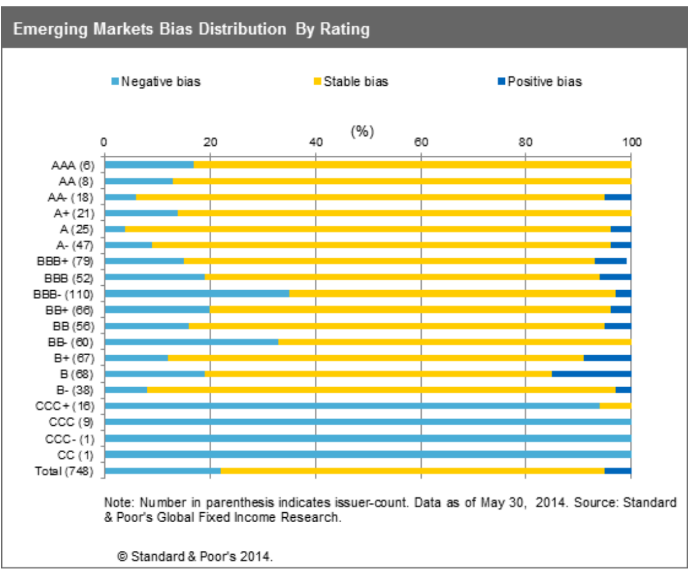
Some 97 emerging market entities were poised for a downgrade as of May 30, 2014. This is pointed out as being significantly higher than the 10-year average of 61 at risk in emerging markets. Only 33 entities were poised for an upgrade, slightly under the long-term average of 37. Of the 97 entities on the potential downgrades list, 27 came from the financial institutions sector.
It also seems that the good will decline while the bad may get better. S&P showed that investment-grade entities lead the list of potential downgrades, while most potential upgrades are speculative-grade.
S&P said,
“We examine the gap between the number of entities poised for downgrades and the number of entities poised for upgrades to monitor potential rating action trends. We define potential downgrades as entities rated ‘AAA’ to ‘B-‘ that have either negative rating outlooks or ratings on CreditWatch with negative implications… The gap between the potential downgrades and potential upgrades widens when the number of entities poised for a downgrade increases or the number of entities poised for an upgrade decreases–both of which are indicators of eminent stress. In the emerging markets, this gap spiked in 2009 during the global financial crisis of 2008-2009. The gap at the end of May 2014 is less than half of what it was in 2009.”
ALSO READ: 11 Ways To Protect Yourself From The Next Stock Market Crash
The image below is a chart from S&P showing the number of ratings by grade, with a color-coded bias for negative, stable, and positive outlooks.








 Top Gaining Stocks
 Top Losing Stocks