


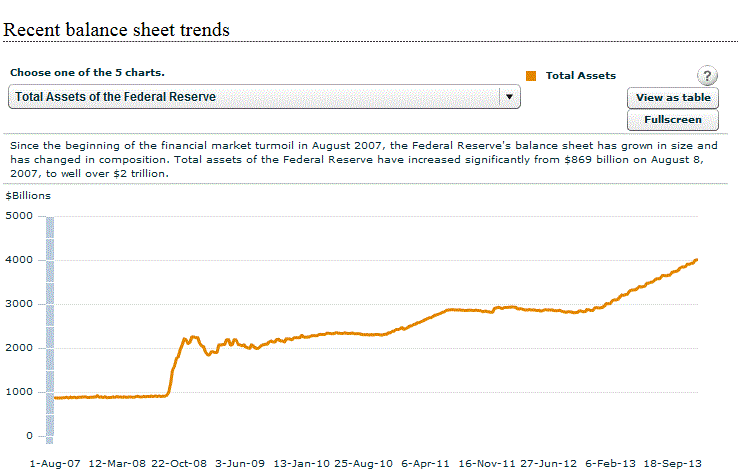
The Federal Reserve’s reported balance sheet for the week ending December 25, 2013, was at $4.071 trillion, and the balance on December 25 was $4.074 trillion. A $10 billion per month of tapering will only slow down the growth of the Fed’s balance sheet. Meanwhile, the balance sheet can continue to grow and grow. It can grow even if the Fed cuts its bond buying in half.
Some $3.759 trillion are of securities held outright. Of that, some $2.204 trillion is held in U.S. Treasury securities. Another $1.497 trillion is held in mortgage securities.
Now go back to before the recession and look at the chart from the Federal Reserve below. This had been handily under $1 trillion before the recession and the bank bailouts. It screamed higher in 2008 and 2009 as the Fed and powers that be raced to save the banks and the financial system.
Through the start of 2011, the balance managed to remain less than $2.5 trillion, and the balance sheet remained under $3 trillion until the start of 2013. Now the $4 trillion mark has been hit due to the $85 billion per month of bond buying.
Maybe politicians in favor of quantitative easing will claim through time that the percentage gains from one inflection point to the next were on par with gains around other woes, but the problem now is that a few hundred billion dollars has turned into a few trillion dollars.
Very few people can predict how this balance sheet growth is going to end. Even predicting how the markets will treat the ending is a coin toss. Some fear hyperinflation. Some fear deflation.
Our own take on how the Fed balance sheet growth will end is a scenario that may not yet be legal. That does not mean that laws are broken, but the rules and methods governing them simply do not yet exist.
Stay tuned. This is no longer just your kids’ futures and the financial future of your grandchildren at stake. At some point someone with enough clout somewhere is going to realize that $4 trillion (or $5 trillion in 2014 or 2015) is actually a serious pile of assets that cannot be dealt with in a rapid manner.
The markets consider Janet Yellen a severe dove. She is on track to succeed Ben Bernanke as the chairman of the Federal Reserve. What she will do with the balance sheet is anybody’s guess.







 Top Gaining Stocks
 Top Losing Stocks