


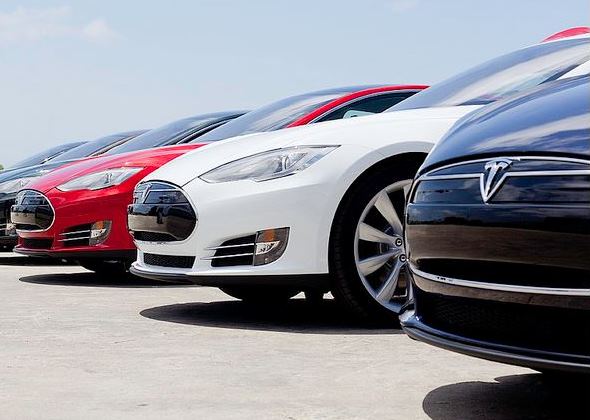
The electric vehicle (EV) industry draws its valuations mainly from sentiment, after being backed up by the main fundamentals of sales and relative financial health. The fundamentals can provide a floor, but nobody really knows where that floor is, because the entire EV industry is so new and unproven.
Tesla’s fundamentals in those terms are quite sound. In terms of sales, it delivered a total of 11,507 vehicles last quarter after delivering 10,030 in the first quarter. After selling 33,000 in all of 2014, the company is on track to beat that handily. If we want to consider potential catalysts, there is the fact that Tesla is growing its car sales in the face of state after state forbidding it to sell directly to consumers. If that regulation ever breaks on a federal level, which is possible considering the political capital inherent in being an electric car advocate, then Tesla sales could explode higher.
That is a purely political issue though, and a gamble if you’re betting on it.
ALSO READ: The Ford E-Bike: An Interesting Urban Solution, but No Replacement for a Car
Financially speaking, Tesla is in tip-top shape for an EV company, with $1.53 billion in cash on its balance sheet and debt that is less than 9% of market cap. Granted, it is much easier to raise equity and keep debt low when everyone is crazy about your stock and wants to give you money. But even further than that, the $2.96 billion in aggregate principle debt that Tesla carries is entirely 100% fixed rate debt. It is essentially riskless.
The only exposure to interest rates that Tesla carries is a tiny $77.7 million warehouse facility loan at floating rates. That is nothing. Interest rates could go through the roof and it wouldn’t add to debt service costs at all. Stable financial footing and conservative accounting is critical in the EV industry as companies have gone bankrupt left and right. Better Place went bankrupt in May 2013, ECOtality in September, Fisker Automotive in November, with many other smaller names lining the streets. (Car Charging Group is still standing though, waiting for Tesla to succeed so it can start charging the Model S.) Tesla is in no danger of bankruptcy, or anything close to it.
So the fundamentals are sound for Tesla. The only question is where the floor is, and how high above it are we? That, nobody really knows. Put another way though, Deutsche Bank is advising caution with a stock that is very near its all-time high. Nevermind Tesla, this certainly seems like prudent advice in general, given the amount of volatility in global markets of late, and the very real possibility that it will get much worse next week for reasons anyone who follows international developments is quite aware of.
Coupled with that is the ominous decline in the aggregate money supply circulating in the U.S. banking system. Judging by the latest release (table 2, final column) it looks like we have about four weeks until growth not only stops but turns negative. The last time that happened was September 2008.
ALSO READ: 3 Top Jefferies New Growth Stocks to Buy With Big Upside Potential
So Deutsche Bank’s downgrade of Tesla really has little to do with Tesla itself. It is more likely just a reflection about the market in general, which should be taken to heart. Tesla is a Hold for now, but in three to four weeks, if money supply growth does not recover, it is a Sell. Not because anything is wrong with the company fundamentally, but because stock market fuel is running dangerously low.











 Top Gaining Stocks
 Top Losing Stocks