


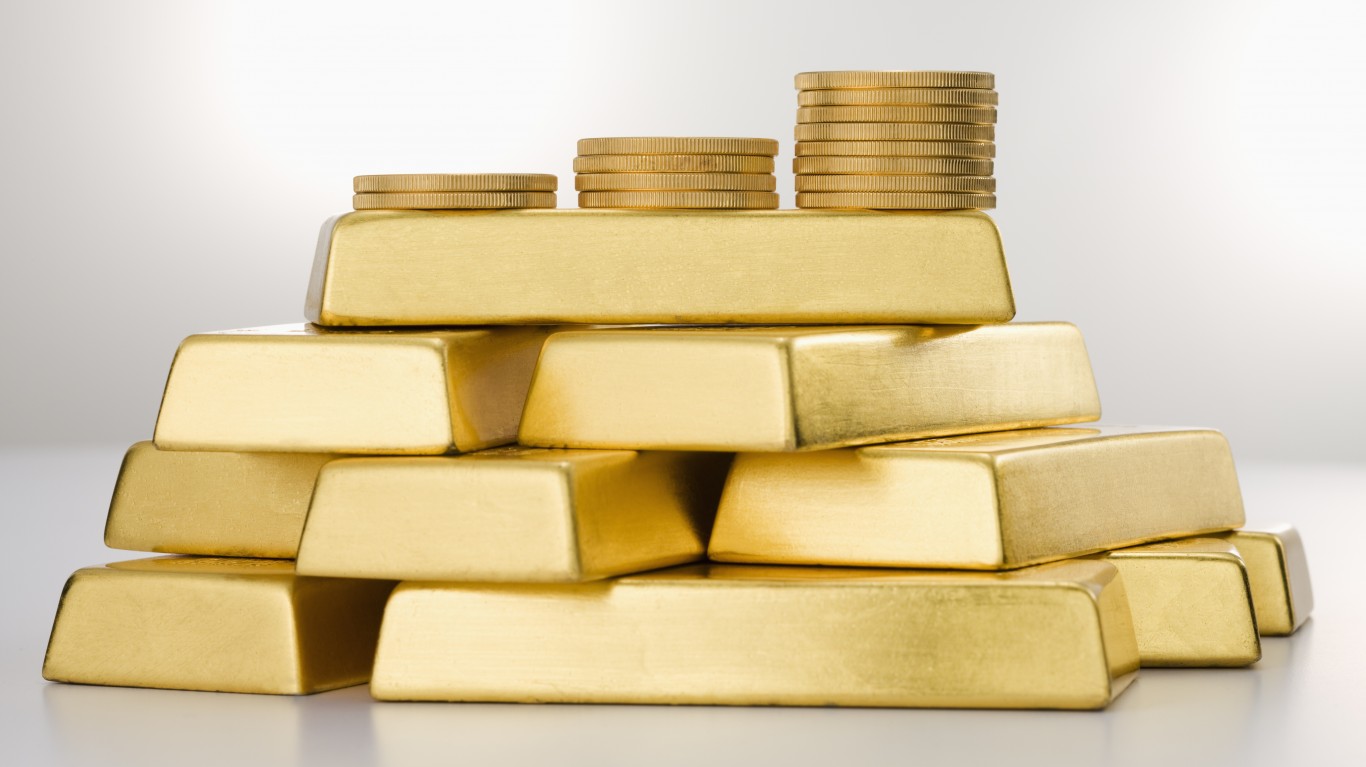
Lack of investment in first-quarter 2018 demand for gold sent overall demand for the yellow metal to its lowest level since the first quarter of 2008. Year over year, demand from exchange traded funds, gold bars and gold coins fell 27% with the decline in ETF demand down a whopping 66%.
Demand from gold-backed ETFs rose to just over 2,400 metric tons (tonnes) at the end of the first quarter, the highest month-end total since April 2013, according to the latest Gold Demand Trends report from the World Gold Council (WGC).
In the market for bars and coins, demand from China — the world’s largest bar and coin market — fell 26% year over year to 26 tonnes. The WGC attributes the decline to the strengthening of the yuan and a relative lack of price volatility.
Demand for gold from the jewelry market dipped by about 1%, with a 12% decline in India partially offset by a 7% increase in demand from China. U.S. demand rose 2% to 23.3 tonnes, the highest level since 2009.
[nativounit]
Central bank demand for gold rose 42% year over year, with purchases totaling 116.5 tonnes, of which 91 tonnes were bought by Russia, Turkey and Kazakhstan. Qatar was the biggest seller, dumping 3.1 tonnes.
Russia’s Central Bank has purchased gold for 38 consecutive months, accumulating 683.1 tonnes in that time. This commitment to growing gold reserves — mandated by the government — shows no signs of abating and reinforces the view of gold as a strategic asset.
Turkey has nearly doubled its holdings of gold to a total of 231.9 tonnes since beginning purchases in May of last year. Kazakhstan has lifted its gold reserves by nearly 200% to more than 200 tonnes since October of 2012.
Gold demand from technology companies rose by 4% year over year to 82.1 tonnes as demand for gold in the wireless and printed circuit board industries rose 5% to 65.3 tonnes. In the wireless industry, demand rose an estimated 20% to 30% year over year.
The world’s supply of gold rose by 35 tonnes, as mining production rose 1% from 759.8 tonnes to 770 tonnes. The WGC expects gold production going forward to focus on brownfield projects in an effort to rein in increasing production costs.
The outlook for 2018 production suggests modest growth, and the WGC noted: “While we have previously expected mine production to decline beyond this year, the picture now appears to hint at greater — albeit modest — upside potential for mine production.”
The full report and methodology are available from the WGC website.
June gold traded at around $1,314.80 just before noon Thursday, in a 52-week range of $1,221.80 to $1,375.50. That’s about 5.6% higher than a year ago and down about 0.8% for the year to date.
[recirclink id=458075]
[wallst_email_signup]






 Top Gaining Stocks
 Top Losing Stocks