


Most Americans are used to spending $50 a month on an iPhone. This is the case with many wireless carriers when customers turn in an old iPhone and take a 24-month contract. The carrier makes money on the monthly fee and probably loses money on the iPhone. However, for people who want to buy an iPhone without a carrier, the number rises as high as $1,599. (Customers are abandoning these 25 brands.)
[in-text-ad]
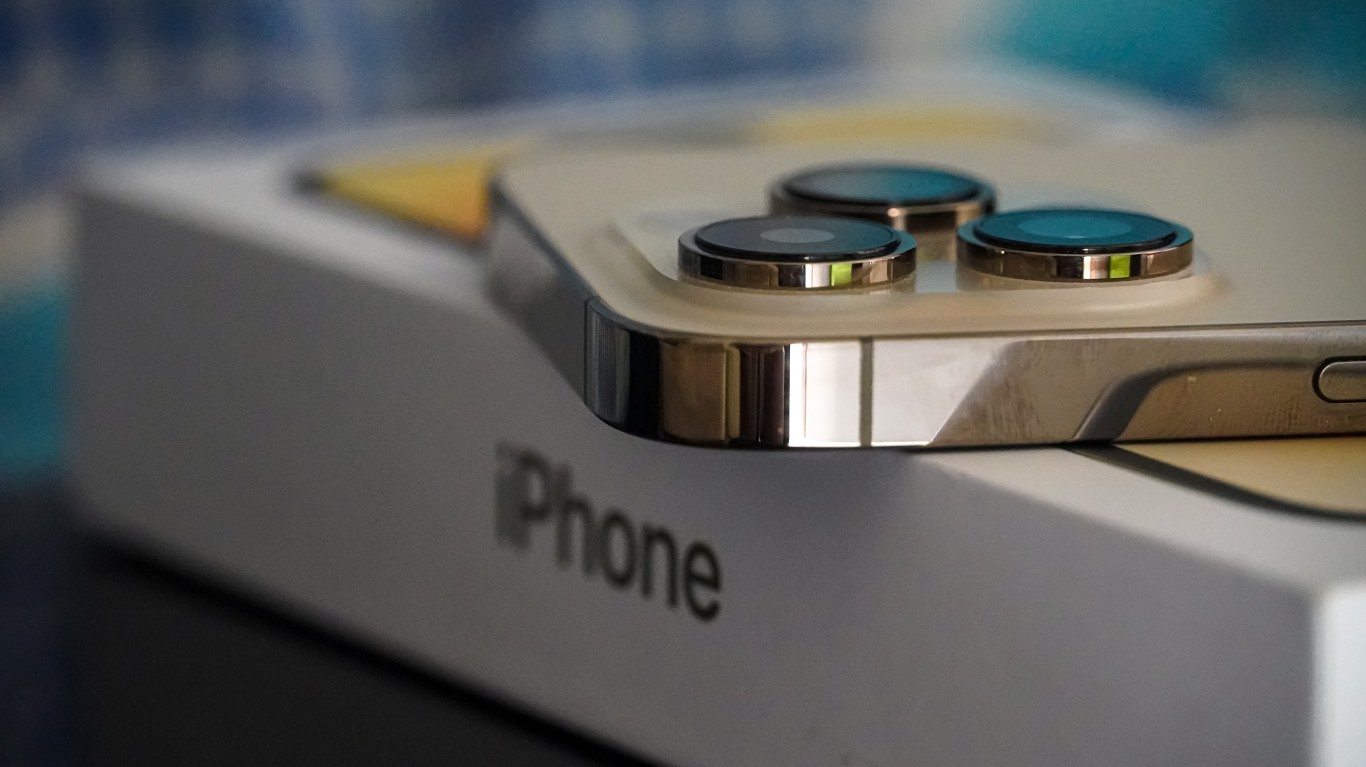
The Apple iPhone 14 Pro Max has a base price when not tethered to a carrier of $1,009. This model has 128 GB of storage. The model with 1 TB is priced at $1,599.
[nativounit]
The storage level depends on use, according to DigiTrends. “The 1TB option may be ostentatious, but if you’re into videography, it isn’t a terrible option to have.” However, how many people shoot and store thousands of hours of video?
[wallst_email_signup]
Among the reasons the iPhone has been so successful over several generations is that Apple has been able to sell millions of units to carriers. Carriers, in turn, use them as enticements to drag in new customers. This cycle has been particularly important as 5G service was introduced. For the first time in years, people had a reason to upgrade their phones. The advent of 5G service also triggered a price war among AT&T, T-Mobile and Verizon. Low-priced iPhone plans became critical for these companies as a means to rob one another of customers.
[recirclink id=529921]
Who will buy a $1,599 iPhone, with both massive storage and not linked to a carrier? Almost no one buys it, making the model the flagship of Apple’s flagship product.
The $1,600 iPhone


© ViewApart / iStock Editorial via Getty Images

Douglas A. McIntyre is the co-founder, chief executive officer and editor in chief of 24/7 Wall St. and 24/7 Tempo. He has held these jobs since 2006.
McIntyre has written thousands of articles for 24/7 Wall St. He is an expert on corporate finance, the automotive industry, media companies and international finance. He has edited articles on national demographics, sports, personal income and travel.
His work has been quoted or mentioned in The New York Times, The Wall Street Journal, Los Angeles Times, The Washington Post, NBC News, Time, The New Yorker, HuffPost USA Today, Business Insider, Yahoo, AOL, MarketWatch, The Atlantic, Bloomberg, New York Post, Chicago Tribune, Forbes, The Guardian and many other major publications. McIntyre has been a guest on CNBC, the BBC and television and radio stations across the country.
A magna cum laude graduate of Harvard College, McIntyre also was president of The Harvard Advocate. Founded in 1866, the Advocate is the oldest college publication in the United States.
TheStreet.com, Comps.com and Edgar Online are some of the public companies for which McIntyre served on the board of directors. He was a Vicinity Corporation board member when the company was sold to Microsoft in 2002. He served on the audit committees of some of these companies.
McIntyre has been the CEO of FutureSource, a provider of trading terminals and news to commodities and futures traders. He was president of Switchboard, the online phone directory company. He served as chairman and CEO of On2 Technologies, the video compression company that provided video compression software for Adobe’s Flash. Google bought On2 in 2009.





 Top Gaining Stocks
 Top Losing Stocks