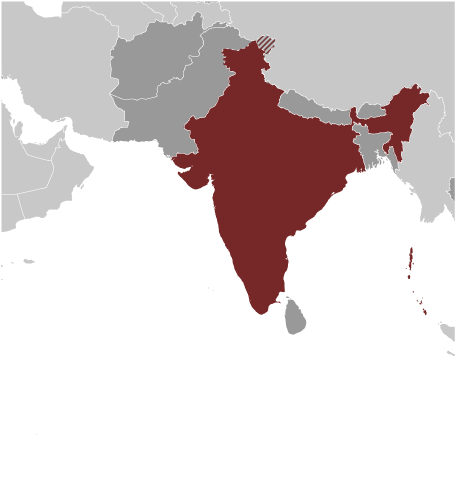
India Micro-Credit Market Starts To Collapse

Photo of Douglas A. McIntyre
By Douglas A. McIntyre Updated Published
This post may contain links from our sponsors and affiliates, and Flywheel Publishing may receive compensation for actions taken through them.

CIA World Factbook
Lend tens of thousands of poor people who do not have normal access to modest sums of money, and do it during a recession, then hope to get the money back. It won’t work

There is body of evidence that Indian citizens who took out small micro-loans to start businesses or expand small enterprises are increasingly defaulting on those obligations. India’s banks are behind most of the loans as they have created pools of money to aid the micro-loan business. Reuters says they have about $4 billion tied up in the sector.

The flaws with micro-lending are not hard to guess. Many of the recipients know nothing about finance. They do not know what their future income compared to expenses will be and are unable to make the most simplistic calculations about those things. The impoverished are a poor credit risk because they are not trained in business which is not something that should be expected in the first place. In the US, even solidly middle class people cannot get loans. Banks fear default rates too much.

The micro-finance business was a kind of movement of the moment which began to be extensively reported in the media about five or more years ago. Muhammad Yunus a founder of the Grameen Bank, an institution that provided microcredit in Bangladesh, won the Nobel Prize. It turns out that his plans may have been well-intentioned, but not practical.

The one thing that is common to all loan pools is that some of the loans in them will default. Among major, profitable companies, that is less likely, but possible. Large numbers of poor Indians are another matter. That says nothing about their standards or willingness to pay. It says a great deal about their circumstances.

Popular financial instruments often go through a pendulum period. They are, at first, among the best ideas in the industry. The reality of how they work and what their returns are finally comes to light. Then, they are suddenly ideas that never could have worked because they were ill-conceived.

Micro-financing in India is about to drop sharply if it has not done so already. No one powerful was willing to put the brakes on the programs, brakes based on history and rational thinking. Now the industry has fallen into disrepute. Due diligence, it seems, always has its place in monetary transactions no matter how small or simple.

Douglas A. McIntyre

Photo of Douglas A. McIntyre
About the Author Douglas A. McIntyre →

Douglas A. McIntyre is the co-founder, chief executive officer and editor in chief of 24/7 Wall St. and 24/7 Tempo. He has held these jobs since 2006.

McIntyre has written thousands of articles for 24/7 Wall St. He is an expert on corporate finance, the automotive industry, media companies and international finance. He has edited articles on national demographics, sports, personal income and travel.

His work has been quoted or mentioned in The New York Times, The Wall Street Journal, Los Angeles Times, The Washington Post, NBC News, Time, The New Yorker, HuffPost USA Today, Business Insider, Yahoo, AOL, MarketWatch, The Atlantic, Bloomberg, New York Post, Chicago Tribune, Forbes, The Guardian and many other major publications. McIntyre has been a guest on CNBC, the BBC and television and radio stations across the country.

A magna cum laude graduate of Harvard College, McIntyre also was president of The Harvard Advocate. Founded in 1866, the Advocate is the oldest college publication in the United States.

TheStreet.com, Comps.com and Edgar Online are some of the public companies for which McIntyre served on the board of directors. He was a Vicinity Corporation board member when the company was sold to Microsoft in 2002. He served on the audit committees of some of these companies.

McIntyre has been the CEO of FutureSource, a provider of trading terminals and news to commodities and futures traders. He was president of Switchboard, the online phone directory company. He served as chairman and CEO of On2 Technologies, the video compression company that provided video compression software for Adobe’s Flash. Google bought On2 in 2009.

Featured Reads

Our top personal finance-related articles today. Your wallet will thank you later.

Continue Reading

Top Gaining Stocks

CBOE Vol: 1,568,143
PSKY Vol: 12,285,993
STX Vol: 7,378,346
ORCL Vol: 26,317,675
DDOG Vol: 6,247,779

Top Losing Stocks

LKQ
LKQ Vol: 4,367,433
CLX Vol: 13,260,523
SYK Vol: 4,519,455
MHK Vol: 1,859,865
AMGN Vol: 3,818,618