Ten Cities with the Highest Unemployment

Photo of Douglas A. McIntyre
By Douglas A. McIntyre Published
This post may contain links from our sponsors and affiliates, and Flywheel Publishing may receive compensation for actions taken through them.

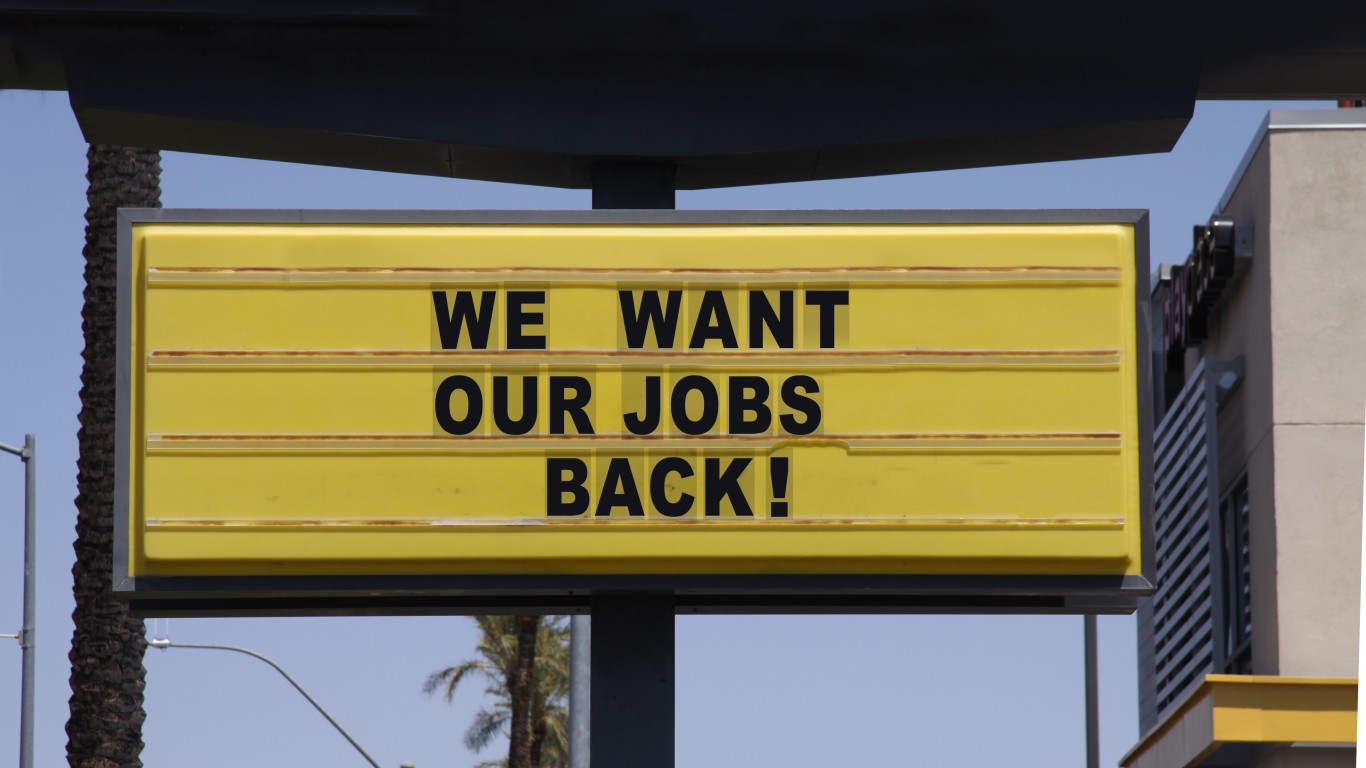
The landscape of unemployment rates has not changed much since the depths of the recession. Most of the cities with the highest unemployment are in the middle of California, and to a lesser extent in the Midwest industrial belt and the east and west coasts of Florida. The California numbers show how intractable the jobless problem can be and how, in some areas, it has gone without solution.

Census data from the Bureau of Labor statistics marks three cities that had unemployment of 20% or better in January. One has a problem that might be considered temporary. Ocean City, N.J., hard hit by Hurricane Sandy, had an unemployment rate of exactly 20%, making it the third worst among all American cities and metro areas. It should rebound more quickly than cities where unemployment has been high for years.

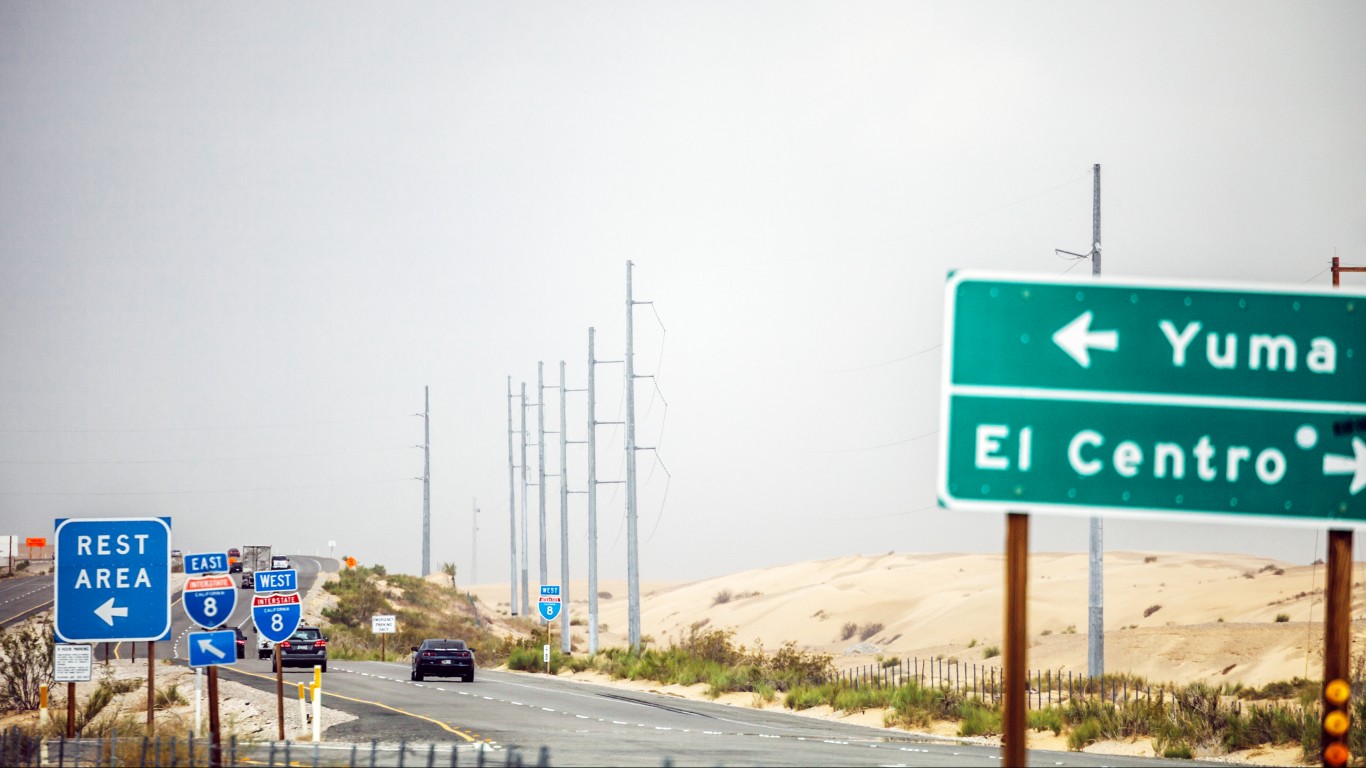
The other two cities with jobless rates above 20% are in the regions most badly hit since 2008. In Yuma, Ariz., the unemployment rate in January was 26.5%, the highest among all cities. The building boom in the state has some hangover, and Yuma is at its center.

The city with the second highest unemployment rate is El Centro, Calif., where it was 25.6%. Merced, in the same area, ranks fourth with a rate of 18.4%. Visalia-Porterville, Calif., is at 16.8%, which puts it in fifth. The Hanford-Corcoran, Calif., jobless rate of 16.7% puts it at sixth.

Atlantic City, N.J., also ravaged by the hurricane, has a rate of 16.1%, putting it in seventh place. Back in central California, Fresno, ranks eighth at 16.0%. Nearby Modesto’s rate of 15.6% puts it in 10th place. Millville-Bridgeton, N.J., is ninth, at 15.8%. Stockton’s 15.5% is just slightly better.

So, almost all of these cities can be divided into two categories. The first are victims of weather, the second of economic conditions that show no signs of letting up.

The California cities are not just victims of real estate overbuilding. Most have among their largest employers the State of California, which almost tipped into insolvency three years ago and has taken the period since to recover. Also high on the list are city governments, the finances of which have been swamped by tax receipt declines that to a large extent are due to home prices that often have fallen by more than half. Finally, agriculture is a dominant industry in these areas. In many cases, these are dairy farms, which have been harmed by the drop in milk prices. Those prices have recovered, but the price of grain to feed cattle has spiked, as one bad problem has replaced another.

All unemployment is local, at least compared to the national average, which does not talk much about geographic areas crushed by outside circumstances. There is no reason these localities will recover at all, at least not in the foreseeable future.


Photo of Douglas A. McIntyre
About the Author Douglas A. McIntyre →

Douglas A. McIntyre is the co-founder, chief executive officer and editor in chief of 24/7 Wall St. and 24/7 Tempo. He has held these jobs since 2006.

McIntyre has written thousands of articles for 24/7 Wall St. He is an expert on corporate finance, the automotive industry, media companies and international finance. He has edited articles on national demographics, sports, personal income and travel.

His work has been quoted or mentioned in The New York Times, The Wall Street Journal, Los Angeles Times, The Washington Post, NBC News, Time, The New Yorker, HuffPost USA Today, Business Insider, Yahoo, AOL, MarketWatch, The Atlantic, Bloomberg, New York Post, Chicago Tribune, Forbes, The Guardian and many other major publications. McIntyre has been a guest on CNBC, the BBC and television and radio stations across the country.

A magna cum laude graduate of Harvard College, McIntyre also was president of The Harvard Advocate. Founded in 1866, the Advocate is the oldest college publication in the United States.

TheStreet.com, Comps.com and Edgar Online are some of the public companies for which McIntyre served on the board of directors. He was a Vicinity Corporation board member when the company was sold to Microsoft in 2002. He served on the audit committees of some of these companies.

McIntyre has been the CEO of FutureSource, a provider of trading terminals and news to commodities and futures traders. He was president of Switchboard, the online phone directory company. He served as chairman and CEO of On2 Technologies, the video compression company that provided video compression software for Adobe’s Flash. Google bought On2 in 2009.

Featured Reads

Our top personal finance-related articles today. Your wallet will thank you later.

Continue Reading

Top Gaining Stocks

CBOE Vol: 1,568,143
PSKY Vol: 12,285,993
STX Vol: 7,378,346
ORCL Vol: 26,317,675
DDOG Vol: 6,247,779

Top Losing Stocks

LKQ
LKQ Vol: 4,367,433
CLX Vol: 13,260,523
SYK Vol: 4,519,455
MHK Vol: 1,859,865
AMGN Vol: 3,818,618