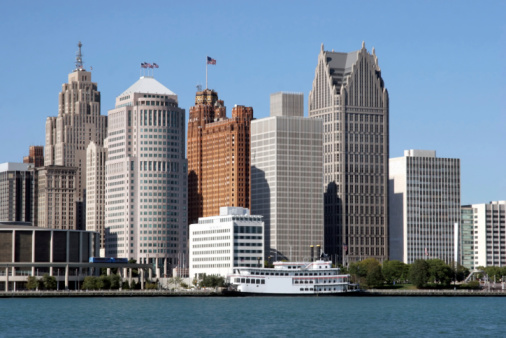
Detroit Could Lose Another 100,000 People

Photo of Douglas A. McIntyre
By Douglas A. McIntyre Published
This post may contain links from our sponsors and affiliates, and Flywheel Publishing may receive compensation for actions taken through them.

The population drain in Detroit likely has not reached a bottom. The Census put the figure at just above 701,000 in 2012 (USA Today put the number lower at 684,799). That is down from a measure of 714,000 in 2010 and 951,000 in 1990. At these rates, Detroit could have fewer than 600,000 citizens by 2020. If there is any biggest threat to the city’s recovery, it is that there will be too few people to support a steady tax base.

Among the major reasons to forecast that people will continue to stream out of the city is a review of its major employers, many of which are part of the city payroll or related entities. Among Detroit’s largest employers are the city itself and the Detroit Public Schools. As Detroit looks for ways to cut costs, public employees will be among them, although current plans to exit Chapter 9 assume that employment among these parts of city government will rise (which implies that money will be available). Other large employers include medical centers, which by the nature of their work will need fewer workers as the city’s population shrinks. The largest two of these are the Detroit Medical Center and Henry Ford Health System.

Among the most powerful arguments that people will continue to flee Detroit is the lack of well-paid jobs. The cause of this to some extent is a vicious circle. As people and businesses leave the city, so do the opportunities for jobs. The drop in population also means that quality housing will disappear as more and more homes are abandoned. The tax base also will shrink, unless taxes are raised on the people who remain (another reason to leave), which means city services will dwindle.

It is the lack of these services that continues to make Detroit an unattractive place to live. Without the normal municipal ability to field effective police, fire and emergency services, the livability of Detroit continues to be destroyed.

In 2012, the Southeast Michigan Council of Governments predicted Detroit’s population would fall to 615,000 by 2040. At the same time, the populations of the counties around Detroit will rise sharply, likely due in part to flight from the city itself. In reality, there are a number of compelling reasons this migration will happen faster and that the drop of people living in the city will be larger.


Photo of Douglas A. McIntyre
About the Author Douglas A. McIntyre →

Douglas A. McIntyre is the co-founder, chief executive officer and editor in chief of 24/7 Wall St. and 24/7 Tempo. He has held these jobs since 2006.

McIntyre has written thousands of articles for 24/7 Wall St. He is an expert on corporate finance, the automotive industry, media companies and international finance. He has edited articles on national demographics, sports, personal income and travel.

His work has been quoted or mentioned in The New York Times, The Wall Street Journal, Los Angeles Times, The Washington Post, NBC News, Time, The New Yorker, HuffPost USA Today, Business Insider, Yahoo, AOL, MarketWatch, The Atlantic, Bloomberg, New York Post, Chicago Tribune, Forbes, The Guardian and many other major publications. McIntyre has been a guest on CNBC, the BBC and television and radio stations across the country.

A magna cum laude graduate of Harvard College, McIntyre also was president of The Harvard Advocate. Founded in 1866, the Advocate is the oldest college publication in the United States.

TheStreet.com, Comps.com and Edgar Online are some of the public companies for which McIntyre served on the board of directors. He was a Vicinity Corporation board member when the company was sold to Microsoft in 2002. He served on the audit committees of some of these companies.

McIntyre has been the CEO of FutureSource, a provider of trading terminals and news to commodities and futures traders. He was president of Switchboard, the online phone directory company. He served as chairman and CEO of On2 Technologies, the video compression company that provided video compression software for Adobe’s Flash. Google bought On2 in 2009.

Continue Reading

Top Gaining Stocks

CBOE Vol: 1,568,143
PSKY Vol: 12,285,993
STX Vol: 7,378,346
ORCL Vol: 26,317,675
DDOG Vol: 6,247,779

Top Losing Stocks

LKQ
LKQ Vol: 4,367,433
CLX Vol: 13,260,523
SYK Vol: 4,519,455
MHK Vol: 1,859,865
AMGN Vol: 3,818,618