


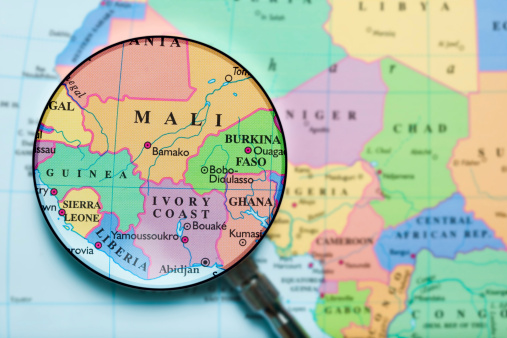
According to the International Monetary Fund (IMF), Liberia’s economy ranked 163rd in the world, based on its gross domestic product (GDP) purchasing power parity (PPP) of $2.9 billion in 2013. On an annual per capita basis, its rank was 184th last year at $703. By way of contrast, the U.S. number was $53,101, putting it in sixth place. In first place, with median income based on GDP (PPP), was Qatar at $98,814.
After the IMF mission to Liberia late last year, the organization’s officials reported:
Liberia’s economic outlook remains favorable, with output expected to expand by 8.1 percent in 2013 and around 7 percent in 2014. This strong performance reflects higher-than-anticipated iron ore production and an acceleration in non-mining real GDP growth boosted by robust private and public investment in line with the government’s development strategy, the Agenda for Transformation. Inflation (in Liberian dollar terms) is projected to pick up to 8 percent in 2013 owing to higher domestic and international food prices and recent exchange rate depreciation pressures, and to gradually decline to 6 percent in 2014. While uncertainty in the global economic environment poses downside risks to the growth outlook, this risk is offset by the coming on stream of new mining and agricultural concessions in the next few years, which could lead to higher growth over the medium term.
No matter how poor Liberia is, the nation has some reasonable prospects for the future.
READ ALSO: The Best (and Worst) Countries to Find a Full-Time Job
The World Bank comments on the country were not as optimistic:
Poor governance and nearly fifteen years of brutal conflict have made Liberia one of the poorest countries in the world. An important objective for the democratically elected government of post-conflict Liberia is to reduce poverty. As part of its long-term vision plan, the Government is preparing a second Poverty Reduction Strategy (PRS) to set out its medium-term approach to poverty reduction. The current climate of peace and security, as well as continued improvements in the economy, offer the Government a unique opportunity to improve on the gains that it has made in reducing poverty under its previous PRS. However, as cross-country evidence has shown, growth alone is not sufficient for poverty reduction. The Government must also take steps to break the cycle of chronic poverty by ensuring that the poor are given opportunities and support to emerge from poverty, and that those who have emerged from poverty do not fall back into poverty.
Add to those negative factors the impact of a disease that could partially close off the country to the rest of the world, including commercially.
The CIA Factbook points out that much of Liberia’s economic future lies with its rich mineral deposits. However, that assumes the country can get access to the technology to tap them. In the meantime, 77% of its GDP comes from agriculture.
Liberia’s economy is close to ruin, and the Ebola outbreak will only make the ruin more complete.






 Top Gaining Stocks
 Top Losing Stocks