


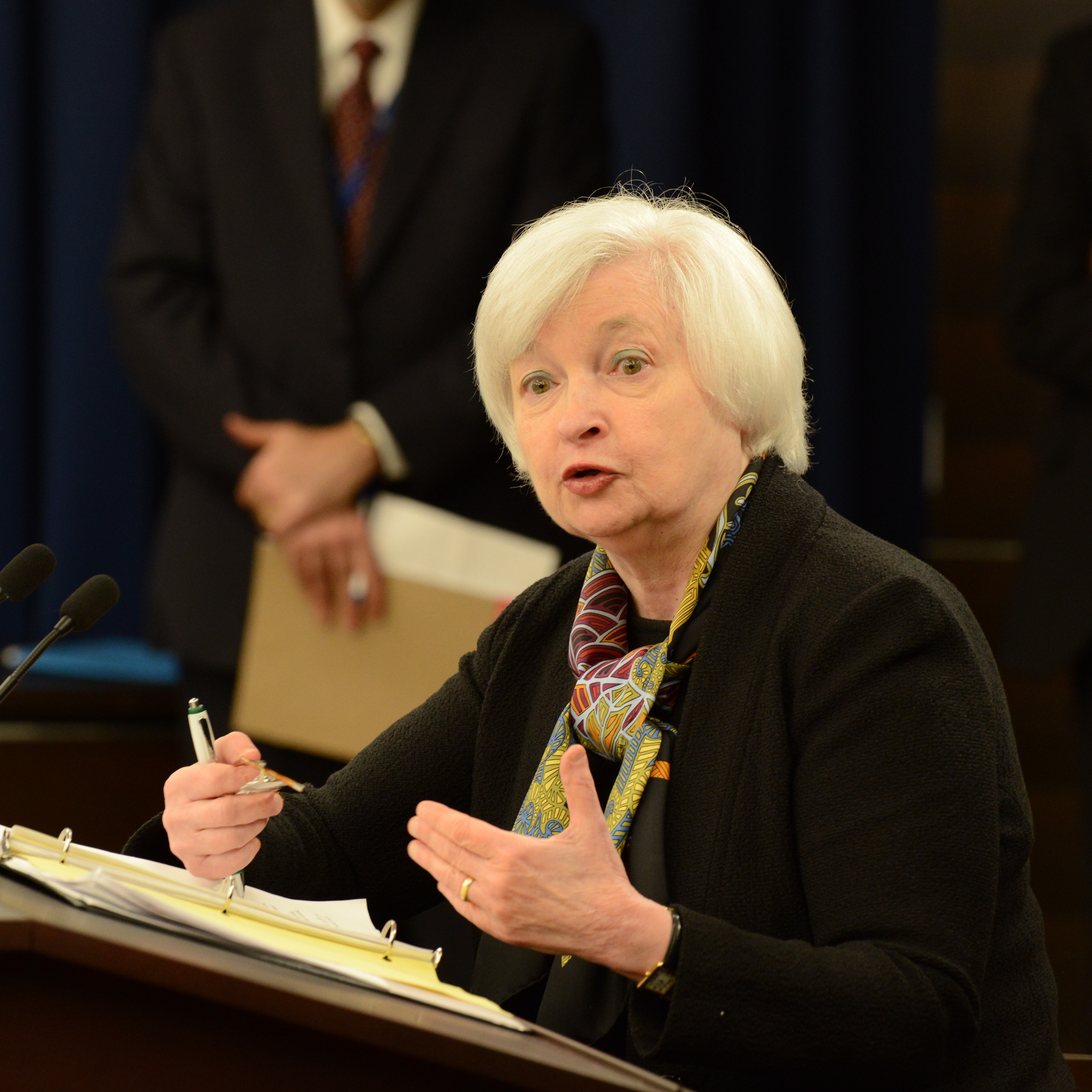
Federal Reserve Chair Janet Yellen said this morning in her remarks from the Fed conference in Jackson, Wyoming, that the core reforms put in place following the financial crisis “have substantially boosted resilience without unduly limiting credit availability or economic growth.”
That was not exactly music to the ears of Fed watchers, but Yellen’s failure even to mention monetary policy is what went traders into a tailspin. The dollar fell, the yield on 10-year Treasuries dipped and gold rose. Equities also gave up early gains.
Concerning financial reforms, Yellen said:
[R]eforms have boosted the resilience of the financial system. Banks are safer. The risk of runs owing to maturity transformation is reduced. Efforts to enhance the resolvability of systemic firms have promoted market discipline and reduced the problem of too-big-to-fail. And a system is in place to more effectively monitor and address risks that arise outside the regulatory perimeter.
[nativounit]
Yellen also addressed the issue of financial system reforms on lending, a subject on which the president commented back in February: “I have some many people, friends of mine, that had nice businesses. They can’t borrow money. They just can’t get any money because the banks just won’t let them borrow it because of the rules and regulations in Dodd-Frank.”
In her remarks, Yellen said:
The effects of capital regulation on credit availability have been investigated extensively. Some studies suggest that higher capital weighs on banks’ lending, while others suggest that higher capital supports lending. Such conflicting results in academic research are not altogether surprising. It is difficult to identify the effects of regulatory capital requirements on lending because material changes to capital requirements are rare and are often precipitated, as in the recent case, by financial crises that also have large effects on lending. … Credit appears broadly available to small businesses with solid credit histories, although indicators point to some difficulties facing firms with weak credit scores and insufficient credit histories. Small business formation is critical to economic dynamism and growth. Smaller firms rely disproportionately on lending from smaller banks, and the Federal Reserve has been taking steps and examining additional steps to reduce unnecessary complexity in regulations affecting smaller banks.
But the dog that didn’t bark — monetary policy — is what moved the markets. European Central Bank president Mario Draghi is now unlikely to give much indication about the ECB’s intentions in monetary policy in his afternoon speech at the conference.
[recirclink id=404027]
[wallst_email_signup]








 Top Gaining Stocks
 Top Losing Stocks