


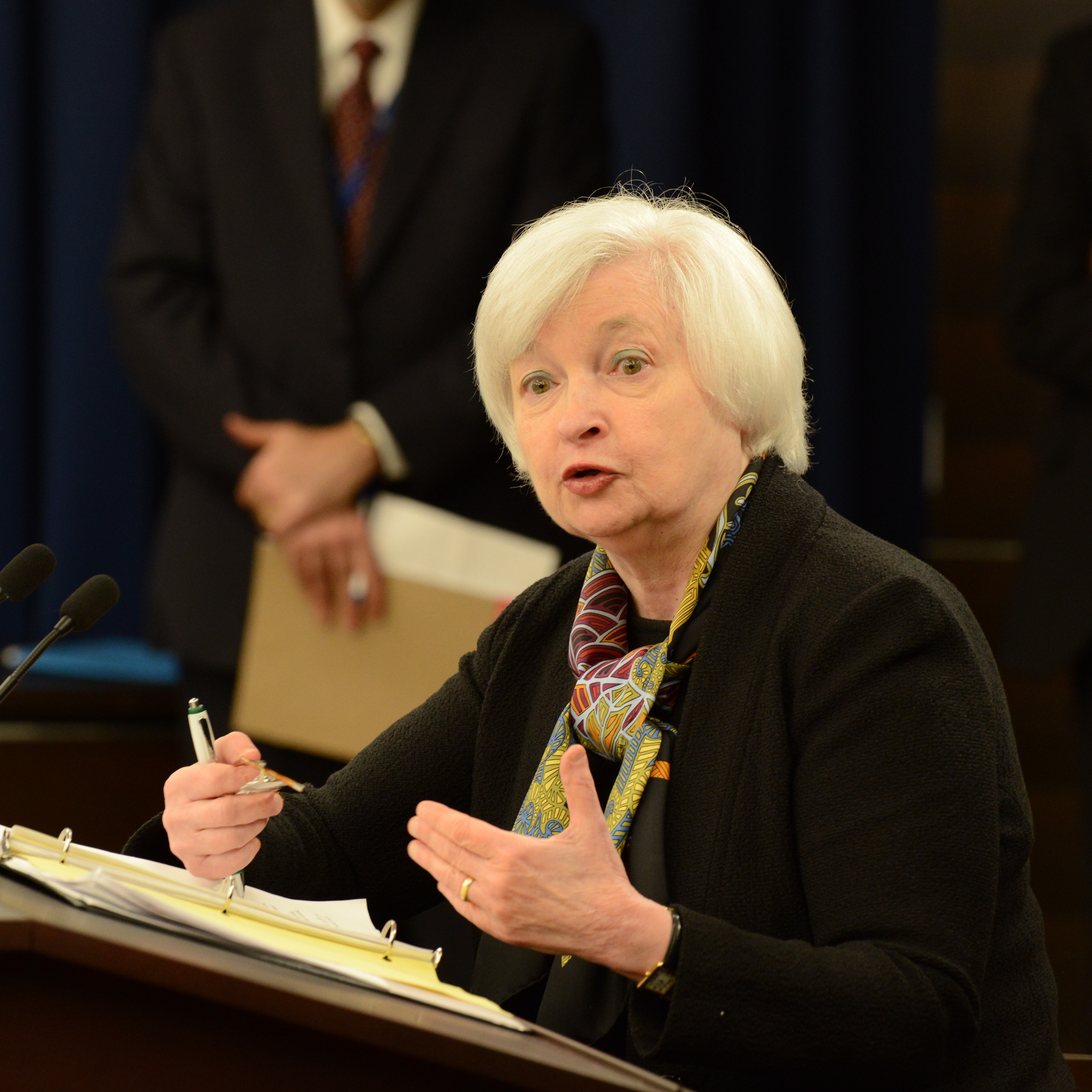
 Janet L. Yellen is the head of the Federal Reserve Bank of San Francisco and a voting member of the Fed’s Federal Open Market Committee. She is highly pessimistic about an economic recovery.
Yellen is under no obligation to follow the party line established by Mr. Bernanke or any other Fed official. That is a good thing for her. Much of what Ms. Yellen has to say is not likely to be welcome in Washington where Fed and Treasury management are promoting the expansion. They are, of course, being very careful to avoid irrational exuberance.
Yellen, nearly 3,000 miles from the nation’s capital, gave her assessment of the future of the economy, at least for the next few years. Her opinion is almost as far from Washington’s thinking as are the miles between California and Washington.
Ms. Yellen gave a speech at her office on September 14 and the central theme was “the unemployment rate will remain elevated for a few more years, meaning hardship for millions of workers.” That view of the jobs market is being mentioned more and more frequently. Time magazine ran a cover that said America may have to brace for double-digit unemployment that will last for some long period, certainly well over a year.
If employment is the signature statistic of the recovery, then Yellen has every right to be worried. She opened her address by saying the economy “ holds hazards that could derail a fragile recovery.” Joblessness remains the greatest among them.
There is still a novel theory that many economists cling to that a “jobless” recovery can be sustained for some time. It is certainly possible that low labor and commodities costs could allow businesses to see a revival for a quarter or two, but that momentum will die very quickly when consumers do not show up to buy goods and services. Every business from McDonald’s (MCD) to GM, to American Airlines (AMR), and Wal-Mart (WMT) relies on someone with a credit card to appear with both the interest and the ability to buy something. Unfortunately, people are not only out of work but those that have jobs have historically low access to credit. It is not hyperbole to say that 15% of the work force is unemployed and another 15% or more cannot borrow enough money to buy a kitchen appliance.
President Obama travelled to Wall St. on the anniversary of the Lehman catastrophe to talk about the need for reform in the financial system which would likely mean more regulation. He is right. The system did not have enough prudence and circuit breakers built into it. He is right; if the system for keeping track of the financial community is not fixed that community could make another set of remarkably dangerous errors and 2008 could be replayed. But, Wall St. is not likely to break again soon. The harsh light of the public’s interest and Congress’s focus will keep the powerful financiers from taking on exorbitant risk, at least for the next few quarters.
Regulation may be a good way for the government to spend its time, but it does very little to solve the economy’s current problem. Most of the headlines and stump speeches of the last two weeks have been about financial regulation and healthcare reform. Wall St. can never truly prosper if the economy is severely crippled. Healthcare cannot be changed substantially if the new system has to carry the costs of insurance for millions of people more than are expected. The Administration and Congress have healthcare, stimulus, budget, and reform programs based on sharp expansion of GDP in 2010 and 2011 and unemployment that will move back toward 7% over that same period.
Plugging in an assumption of 9% of higher unemployment for that period ruins everything about the government recovery plans. Much of the economy can get better immediately but a moribund job market will trump that quickly.
The speeches about how the government is going to put people back to work, specifically back to work with detailed plans and programs, are still astonishingly absent. That may mean that no one in authority really has a solution. At least, Ms. Yellin has the courage to describe the state of unemployment with a dissenter’s voice. No one can make a realistic plan for recovery if the problem at the center of the solution.
All that silence is telling.
Douglas A. McIntyre






 Top Gaining Stocks
 Top Losing Stocks