
Gender Pay Gap in US Won’t End Until 2070

Photo of Douglas A. McIntyre
By Douglas A. McIntyre Updated Published
This post may contain links from our sponsors and affiliates, and Flywheel Publishing may receive compensation for actions taken through them.
Gender Pay Gap in US Won’t End Until 2070

© gorodenkoff / Getty Images

Studies have shown that women in the United States make about 80% of what men do to perform exactly the same job. A new survey forecasts that will not change completely until 2070. The difference between male and female pay is closing, but clearly not very quickly.

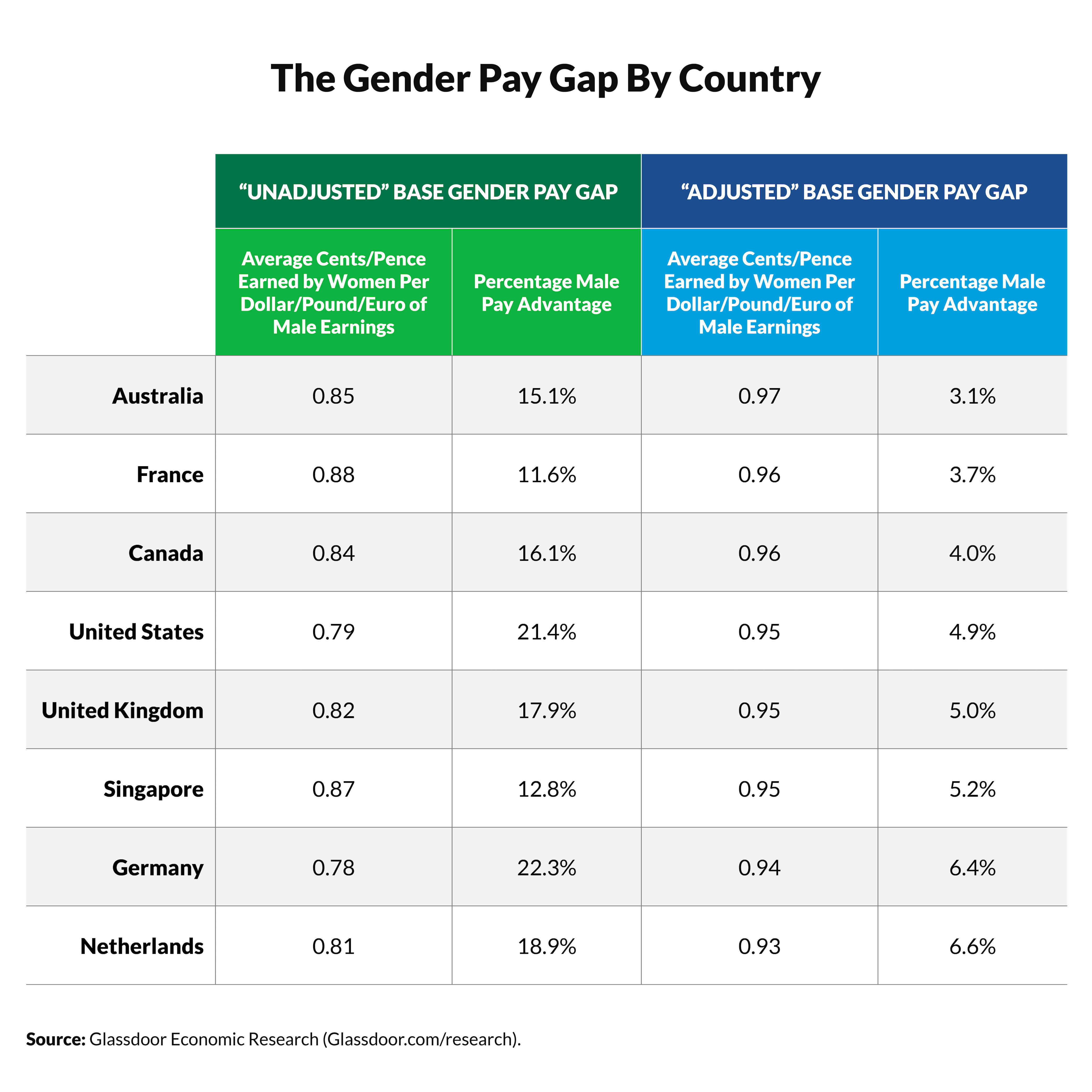
Employee review firm Glassdoor has released its Progress on the Gender Pay Gap: 2019 report, from a survey conducted by its Glassdoor Economic Research. It includes results on gender pay differences for Australia, Canada, France, Germany, the Netherlands, Singapore, the United Kingdom and the United States. The gender pay gap in the United States is $0.79 for women compared to a dollar for men. It was the smallest in France at $0.88 per dollar, and the largest at $0.78 in Germany.
 

[nativounit]

Progress in the United States has been slow. Three years ago, the gap was $0.76 for women in the same job compared to $1 for men. Glassdoor used that rate of progress to make its forecast. The researchers said: “At this current pace, Glassdoor economists estimate pay equality could be achieved in the U.S. by 2070, if all current factors remain unchanged.”

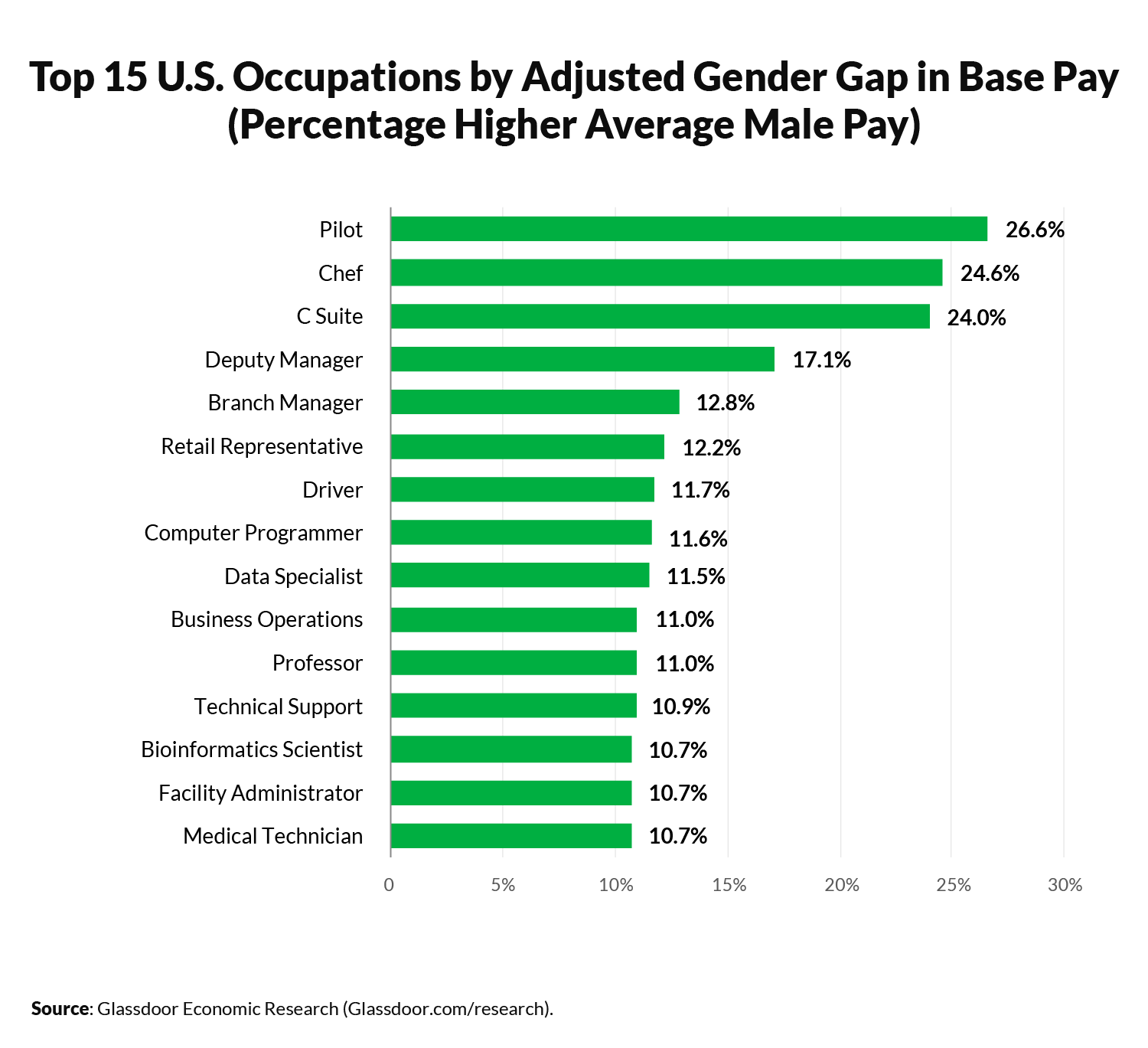
The comparison between men and women varies significantly by job. Glassdoor looked at 15 professions. The gap was largest among pilots, where men make 26.6% more than women, and among chefs, where men make 24.6% more. These numbers vary geographically as well, based on an analysis of the worst-paying states for women.
 

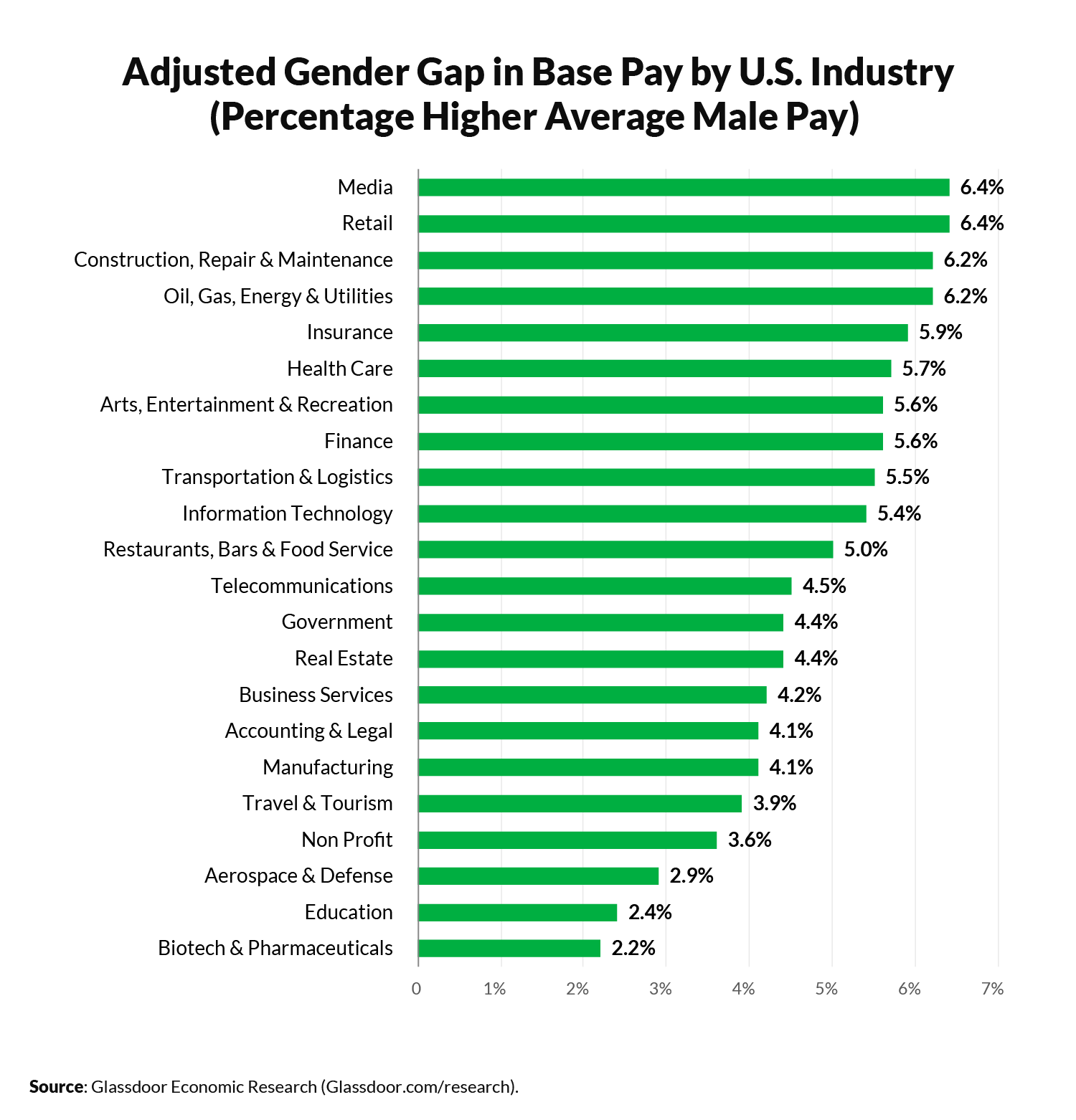
Industries where men make more than women include media, where the difference is 6.4%, and retail, where they have the same advantage. Another analysis was recently made in a study of the 25 highest paying jobs for women.
 

[recirclink id=536305]

Not all the differences in pay can be explained. Glassdoor puts factors into two categories, which are those that can be explained and those that cannot. Those that can be explained, such as age and education, make up 64% of the difference. Those that cannot be are 34%.

Across most of the data, most women, both by country and by career, are making progress, but 2070 is a very long time away.

[wallst_email_signup]

Photo of Douglas A. McIntyre
About the Author Douglas A. McIntyre →

Douglas A. McIntyre is the co-founder, chief executive officer and editor in chief of 24/7 Wall St. and 24/7 Tempo. He has held these jobs since 2006.

McIntyre has written thousands of articles for 24/7 Wall St. He is an expert on corporate finance, the automotive industry, media companies and international finance. He has edited articles on national demographics, sports, personal income and travel.

His work has been quoted or mentioned in The New York Times, The Wall Street Journal, Los Angeles Times, The Washington Post, NBC News, Time, The New Yorker, HuffPost USA Today, Business Insider, Yahoo, AOL, MarketWatch, The Atlantic, Bloomberg, New York Post, Chicago Tribune, Forbes, The Guardian and many other major publications. McIntyre has been a guest on CNBC, the BBC and television and radio stations across the country.

A magna cum laude graduate of Harvard College, McIntyre also was president of The Harvard Advocate. Founded in 1866, the Advocate is the oldest college publication in the United States.

TheStreet.com, Comps.com and Edgar Online are some of the public companies for which McIntyre served on the board of directors. He was a Vicinity Corporation board member when the company was sold to Microsoft in 2002. He served on the audit committees of some of these companies.

McIntyre has been the CEO of FutureSource, a provider of trading terminals and news to commodities and futures traders. He was president of Switchboard, the online phone directory company. He served as chairman and CEO of On2 Technologies, the video compression company that provided video compression software for Adobe’s Flash. Google bought On2 in 2009.

Featured Reads

Our top personal finance-related articles today. Your wallet will thank you later.

Continue Reading

Top Gaining Stocks

CBOE Vol: 1,568,143
PSKY Vol: 12,285,993
STX Vol: 7,378,346
ORCL Vol: 26,317,675
DDOG Vol: 6,247,779

Top Losing Stocks

LKQ
LKQ Vol: 4,367,433
CLX Vol: 13,260,523
SYK Vol: 4,519,455
MHK Vol: 1,859,865
AMGN Vol: 3,818,618