


There are not all that many trade war references from the modern era to refer to when it comes to what is happening between the United States and China. The point about this current trade war is that it simply goes above and beyond traditional economic issues and tariffs. Intellectual property rights are a key component, with the United States wanting to have intellectual property protection for companies doing business in China. And China wants to continue on the forced transfer of intellectual property as the price of a company doing business with the largest population in the world.
[in-text-ad]
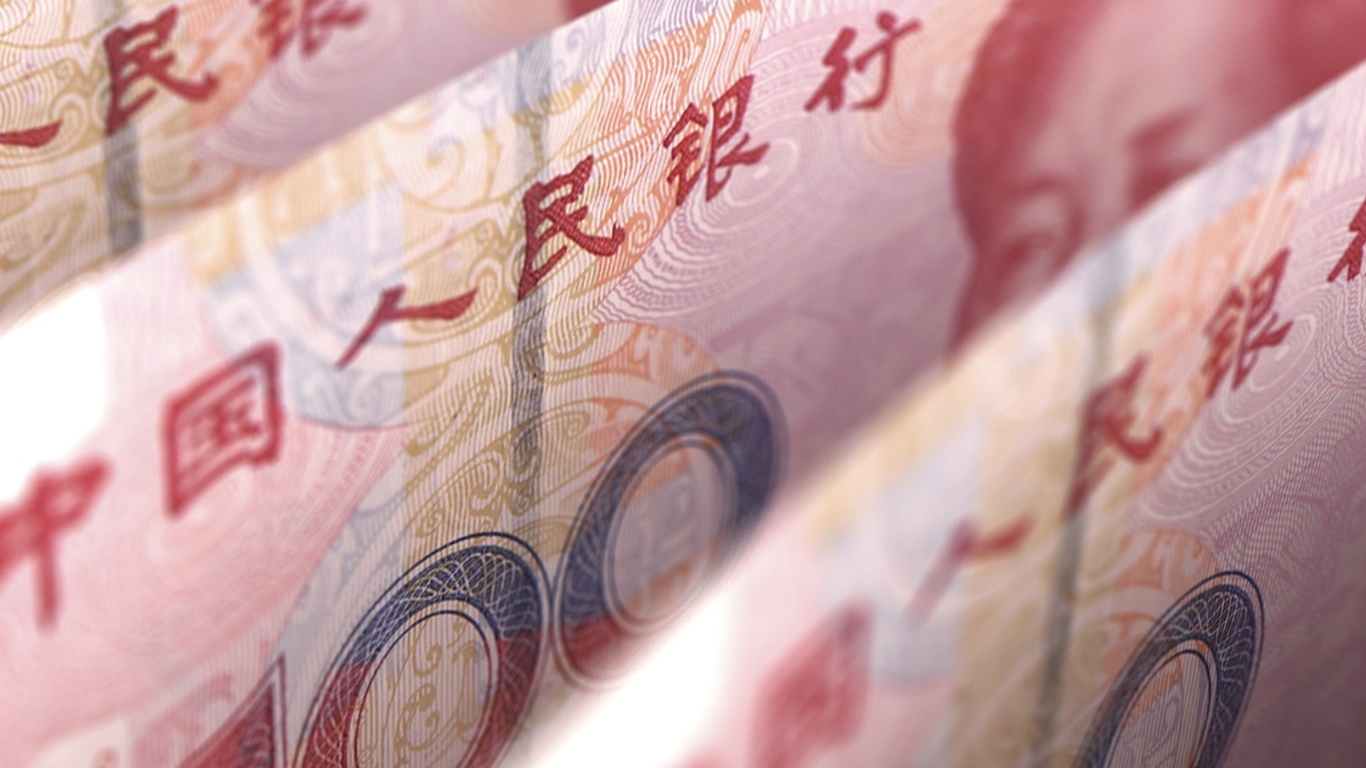
Now that President Donald Trump signaled more tariffs last week, China effectively has devalued its currency in the latest salvo of the trade war. China allowed the yuan to fall to its weakest level in more than a decade. To add even more pressure, China has instructed its state-owned companies to suspend imports of U.S. agricultural products. The yuan was at 6.883 per U.S. dollar on July 31, but after ticking up to 6.90 on August 1 and then to almost 6.94 on August 2, the yuan shot up to almost 7.03 initially and was last seen trading up at 7.044 per U.S. dollar.
Back when China had its official peg from the 1990s to 2005, the yuan was loosely to tightly pegged at almost 8.3 per dollar (see below), with only minor variations. Then the Chinese currency appreciated after becoming being given more float, trading under 7 by 2008 and reaching almost 6 per dollar in early 2014.
[nativounit]
Where this gets interesting is that in the past five years there had been a chart peak of 6.96 yuan per dollar at the very end of 2016 and again in the second half of 2018. This latest move wipes that out, and now traders are going to have to refer back to the charts from more than a decade ago to look for patterns.
While this devaluation looks to be the biggest move in a day, a lesson from market historians would point back to 1994. A piece from Reuters in 2012 outlined how China unified its dual exchange rates in 1994 by aligning official and swap center rates. The move officially devalued the yuan by 33% overnight to 8.7 per U.S. dollar as part of its reforms to embrace a socialist market economy. Later that year, the fix went to 8.28.
The response on Monday from the president Trump was as follows:
While the major stock market indexes tanked on the news, where the big impact has been seen is in U.S. interest rates. The yields on Treasuries, versus Friday’s close, were 1.61% on the two-year (down 11 basis points), 1.76% on the 10-year (down 10 basis points) and 2.31% on the 30-year (down eight basis points). The end result is that the move effectively just priced in somewhere close to half of the next rate cut from the Federal Reserve, even though Fed Chair Jerome Powell seemed to be reluctant and cautious about signaling anything beyond a “mid-cycle adjustment” when the Fed finally did lower interest rates last week.
Most U.S. investors will look at the stock market impact more than bonds, and the S&P 500 was last seen down 54.54 (−1.86%) at 2,877.51 on Monday, after having peaked at 3,027.98 on July 26. The Dow Jones industrial average was last seen down 472.15 (−1.78%) at 26,012.86, and the Nasdaq Composite was last seen down 188.20 (−2.35%) at 7,815.87. The Dow had peaked at 27,398.68 on July 16, and the Nasdaq Composite had peaked at 8,339.64 on July 26.
[recirclink id=565491]
[wallst_email_signup]








 Top Gaining Stocks
 Top Losing Stocks