


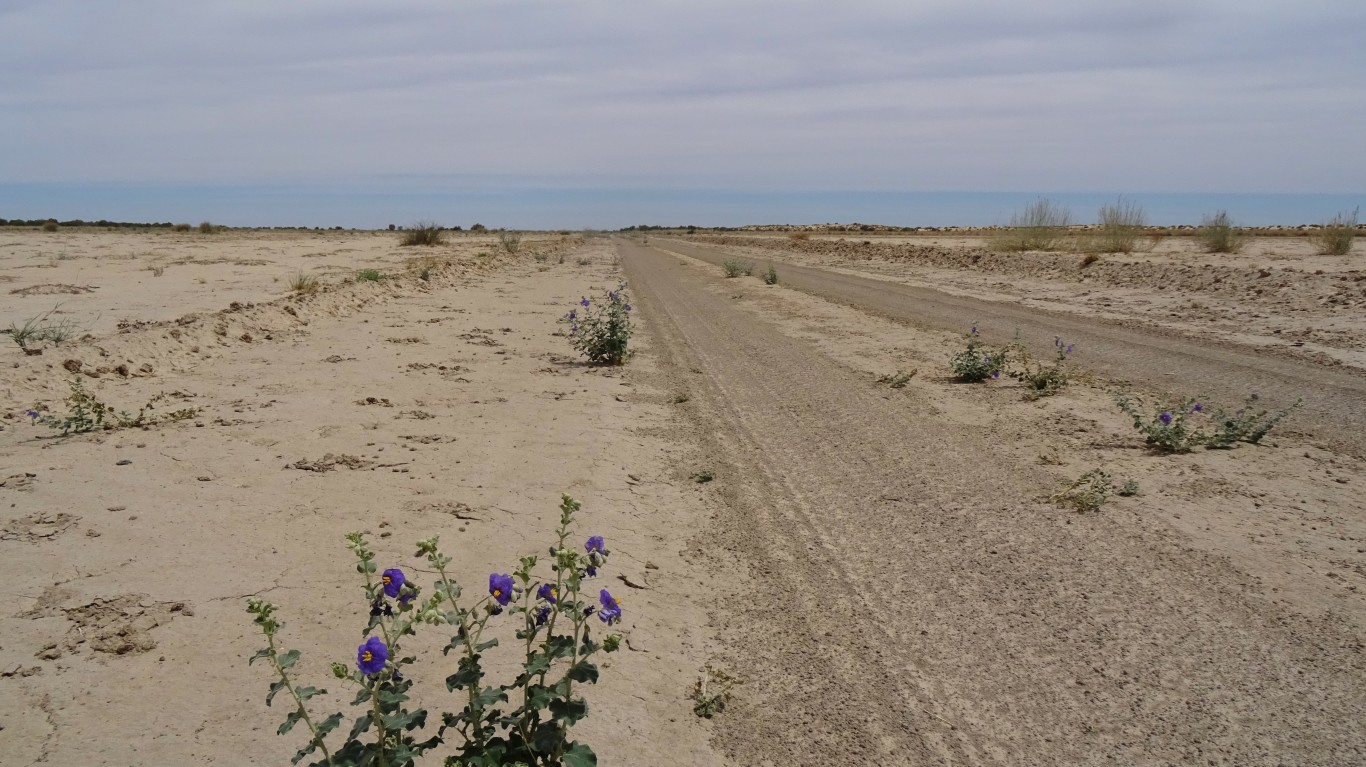
It’s 118° Fahrenheit in Birdsville, which is located in the desert in the state of Queensland, Australia. Wildfires have been burning hundreds of miles away near Sydney. The temperature in the huge Australian city has topped 100° F, but it won’t even approach the Birdsville figure. It is routinely one of the hottest places in the world. As a matter of fact, today, it is the hottest place on earth.
The official Birdsville temperature is taken at Birdsville Airport, where there is a weather center. The airport does not get used much. The town has a population of under 150. It was established in 1882 and has never had a population of more than a few hundred people.
[in-text-ad]
It is hot, and often very hot, in Birdsville through most of the year. The average high in January and February is over 100° F. And the town gets almost no rain. In a typical month, it is less than a quarter of an inch. It usually rains fewer than two days a month. Based on climate history in Birdsville, the temperature may well creep higher in the next few days.
One reason for the high temperatures is that Birdsville is in the Simpson Desert in central Australia. Much of the region has no population at all. Scattered along its fringes, however, lie small cattle-raising settlements, many of which are supplied with water from the Great Artesian Basin.
[nativounit]
The high temperature in Birdsville is notable for another reason. On most days throughout the year, the hottest place on earth is Kuwait City or in parts of Iran or India. These are the hottest inhabited places on earth. Today, all 15 of the hottest places in the world are in Australia. As much of the desert heat has traveled to Sydney, among the questions is whether temperatures around the entire nation will drop. For now, the answer appears to be no.
[recirclink id=600304]
[wallst_email_signup]










 Top Gaining Stocks
 Top Losing Stocks