


By David Callaway, Callaway Climate Insights
Nobody has yet blamed volcanoes on climate change — that we know of. But nature’s wrath takes many forms. Illustrating natural dangers and disasters are part of what the media does, but when it comes to climate change, that also comes with a responsibility to explain — with truth and facts — their causes.
Today Callaway Climate Insights joins journalists from almost 500 newsrooms around the planet to honor World News Day, an annual event to celebrate journalism that makes an impact. This year’s theme is climate change, and we’re proud to present five of our favorite columns and articles from the hundreds that are appearing in newspapers, and online, from newsrooms Singapore to the Sahara.
World News Day is the result of an effort by the World Editors Forum, which I used to be president of, and its current leader, Warren Fernandez, editor and chief of The Straits Times in Singapore. It is the brainchild of David Walmsley, editor in chief of The Globe and Mail in Toronto.
Like many other complex issues, climate change requires truth in reporting and fact-based journalism to get readers past spin and disinformation and focused on the solutions that can help save the planet. We’re proud to do a part to honor the hundreds of journalists around the world now working to bring that truth to you. Check out more of the coverage at #journalismmatters or #WorldNewsDay.
Tuesday’s subscriber insights: Ford bets big on batteries, EV jobs
. . . . Ford’s $11 billion bet on four electric vehicle factories — one for vehicles and three for batteries — is a bold attempt to leapfrog itself into the EV equation. Currently, it has only one EV (a Mustang), with two other vehicles (a pickup truck and a van in the pipeline). GM, meanwhile, made much earlier noises in the market, with the Bolt and more coming, including a pledge to be all-electric by 2035. Chrysler, meanwhile, appears left in the dust. Ford’s big battery investment, part of which we reported on last week, is a sensible bet because battery tech is what is going to define this sector. And it doesn’t hurt that it will add 11,000 manufacturing jobs. Read more here. . . .
. . . . Another sign that Ford may be on the right track with its electric vehicle strategy is the petrol crisis in the UK, where a combination of Covid and Brexit have led to a huge shortage in truck drivers to get petrol to the stations for consumers, resulting in long lines, fistfights at the pump and a government crisis in the last several days. All of that good news for EV sellers, who reported a record day on Friday for inquiries into electric vehicles. Guess it’s a warm-up for when peak oil finally arrives. . . .
. . . . Either ExxonMobil has been unlucky in having its lobbying and PR moves to further its fossil fuel business exposed or it’s a sign it still just isn’t on board. It finally fired its lobbyist who was caught on tape revealing some of its lobbying strategy, only to now have it reported it’s been using a top PR firm to push its oil and gas agenda, including in a Facebook campaign. What happened to those new board members? Read more here. . . .
Editor’s picks: MacArthur Foundation to divest from fossil fuels; Californians lose insurance protections
MacArthur Foundation to divest from fossil fuels
The John D. and Catherine T. MacArthur Foundation has announced it will divest from fossil fuels. Philanthropy News Digest reports the foundation began taking steps toward divestment from fossil fuels in late 2019, when it halted new investments in private funds that invest in oil and gas exploration; those funds are winding down as the foundation continues to sell those assets. According to the report the MacArthur Foundation will begin shifting from holding derivatives based on broad indices to using an index that excludes companies with fossil fuel reserves — starting in the U.S. and, as those derivatives become practical to use globally, for global equity exposure as well. While the foundation invests primarily through pooled funds, it also adopted a proxy policy several years ago to communicate to asset managers its preferences on climate change and other issues linked to its programs.
Californians risk losing homeowners insurance
A moratorium guaranteeing insurance in parts of California at high risk of wildfire has lapsed. Bloomberg Green reports some 347,000 homes in Pasadena and other areas near the Los Angeles foothills have lost protections, and, according to the report, as many as 2.4 million homes are at risk of losing protection in 2021 as year-long grace periods expire. The report quotes David Russell, co-director of the Center for Risk Management and Insurance at California State University, Northridge, as saying, “We’re going to pay the bill for climate change one way or the other and it’s just a question of how we divvy up that cost. … What California politicians are trying to do is tinker with how we do that. They’re buying time, hoping they get a break.” After the deadly 2018 Camp Fire destroyed more than 18,000 buildings, the state prohibited insurance companies from canceling homeowner policies in or adjacent to wildfire areas for 12 months after the day of an emergency declaration.
Today in wildfires
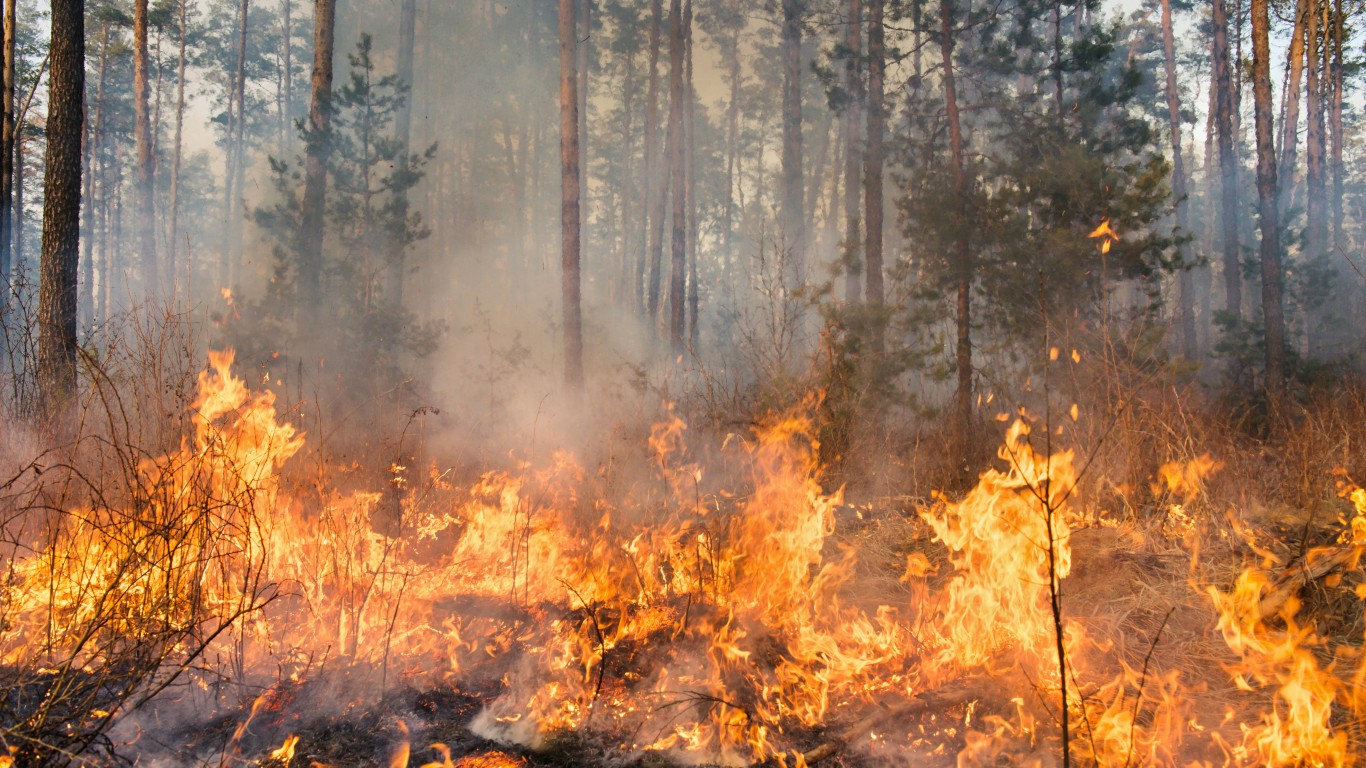
. . . . As of Sept. 28, the Fire Information for Resource Management System reported two new large incidents, three large fires contained and 44 uncontained large fires in the U.S. As the map shows, fire activity remains high in the northwest and California. There were 11 new fires in Northern California overnight, with seven uncontained large fires. Southern California reported nine new fires, and is battling three uncontained large fires. In the northwest, there were 15 uncontained large fires. Across the nation, the National Interagency Coordination Center reports that as of Tuesday morning, more than 16,842 firefighters are battling 63 blazes that have burned 3.2 million acres. . . .









 Top Gaining Stocks
 Top Losing Stocks