



It seems impossible to think that a commodity price could trade below zero. Particularly when you are talking about oil, which still powers most of the world’s transportation at this time. While the negative oil price anomaly was just in futures under extreme circumstances, the entire oil sector has been crushed and the bankruptcies are likely just starting to be seen.
The Dow, S&P and NASDAQ had their best monthly returns in April 2020 of any month for the stock market in the last 30 years. It seemed that the oil sector just could not ever catch any interest from investors whether it was in the bull market or in the bear market. Perhaps the mantra that “low prices ultimately cure low prices” can even apply to oil stocks as value stocks.
24/7 Wall St. has tracked the crude oil and energy sector for years, and the carnage that was seen in this latest meltdown was unprecedented. It is almost with disbelief that the energy sector managed such a strong recovery in oil and gas. Many investors still expect bankruptcies and failures to increase even if the price of oil continues to rise.
The damage has just become too severe and many companies, particularly those which are not hedged to sell oil at much higher prices, are not able to operate profitably in the current oil price environment. And the oil and gas sector is very well known for having companies with boatloads of corporate debt maturing in the next year or two. Some oil companies have good balance sheets still, and others remain at risk.
[nativounit]
It turns out that twelve of the top twenty S&P 500 stock gainers in April were in the oil and gas sector. Value investors have tried and tried to use “low valuations” as a reason to buy for longer than memory serves, but it may have finally worked over the last month.
Apache Corporation (NYSE: APA | APA Price Prediction) closed up just 3-cents at $13.08, but its shares were up more than 200% from the lows a month ago. But with a $33.77 high in the last 52-weeks its shares are still down a sharp 58% from a year ago. Apache’s market cap is almost $5 billion and it has come back above its Refinitiv consensus analyst price target of $10.57.
Southwestern Energy Company (NYSE: SWN) closed up over 5% at $3.23 on Thursday, and that stock price is up over 90% in the last month. Still, Southwestern Energy shares are down 16% from a year ago and its 52-week high is $4.25. Refinitiv’s consensus analyst price target is $2.24.
Marathon Oil Corporation (NYSE: MRO) closed up 4.6% at $6.12 on Thursday. Marathon is up over 85% in the last month but is still down 60% from a year ago. Its Refinitiv consensus analyst price target is $7.32.
Devon Energy Corporation (NYSE: DVN) closed down over 1% at $12.47 on Thursday, and that is up about 80% in the last month. Still, Devon Energy shares are down 60% from a year ago and its 52-week high is $32.00. Refinitiv’s consensus analyst price target is $12.75.
Diamondback Energy, Inc. (NASDAQ: FANG) closed down 1.5% at $43.54 on the last day of April, but its stock was up over 60% for the month and its shares are still down about 55% from a year ago. Its Refinitiv consensus analyst price target is $53.17.
[recirclink id=684173]
Noble Energy, Inc. (NYSE: NBL) closed down over 2% at $9.81 on the last day of April, and that is up over 60% in the last month. Still, Noble Energy shares are down 60% from a year ago. Its 52-week high is $27.31 and Refinitiv’s consensus analyst price target is $11.54.
Halliburton Company (NYSE: HAL) looks like the strongest of the oil services companies in April, Despite a 4.7% loss at $10.50 on the last day of April, its shares were up over 50% coming into the day from a month earlier and the stock was down over 60% from this time a year ago. Halliburton’s 52-week high is $28.18 and it has now risen back above its consensus analyst price target of $9.65.
The Dow’s two oil stocks have also risen. Exxon Mobil Corp. (NYSE: XOM) and Chevron Corporation (NYSE: CVX) are both Dow stocks and are both reporting earnings on Friday. We have set a detailed preview of expectations, and it’s hard to imagine any great earnings reports. That said, the companies are trying to keep their super-high dividends going at more than 7% and 5%, respectively.
Chevron’s 2.7% drop on the last day of April to $92.00 is still above its plunge-depth lows of $51.60 and it had seen a gain of more than 25% in the last month but is still down over 20% from a year ago. Exxon Mobil closed down 2% at $46.47 on the last day of April, but it was up over 20% in the last month and is up from a 52-week low of $30.11 and is still down over 40% from a year ago.
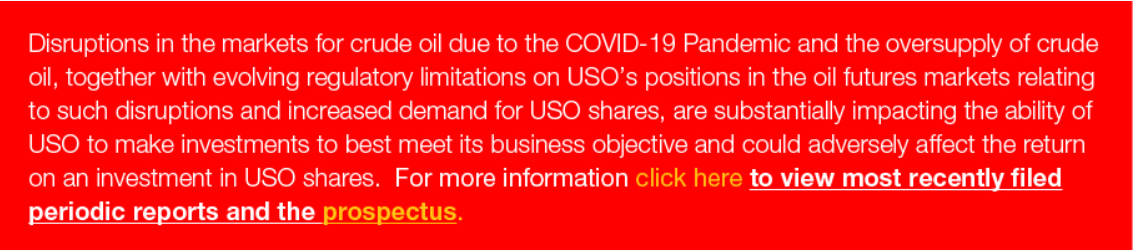
Meanwhile, confusion still leads in the so-called “Oil ETF” that is actually an exchange-traded security that is based on oil futures contracts and has atrocious tracking errors and has been unable to maintain sticking to its net asset value. The United States Oil Fund, LP (NYSEArca: USO) did manage to close up 6.2% at $19.12 after having seen a reverse stock split this week. The fund has been allowed to grow too large and it has made some rather stark changes in the futures contracts it holds as it was too dominant in front-month contracts. The USO’s fund website even has a red warning label (see below) that is similar to adverse side effects of pharmaceutical products to warn investors at this time.
The VanEck Vectors Oil Services ETF (NYSEArca: OIH) was down 3.6% at $109.78 on the last day of April and it conducted a 1:20 reverse split in April. That’s up 36% from the last day of March and up almost 50% from the lows back on March 23 and is still down almost 60% so far in 2020.
[wallst_email_signup]












 Top Gaining Stocks
 Top Losing Stocks