


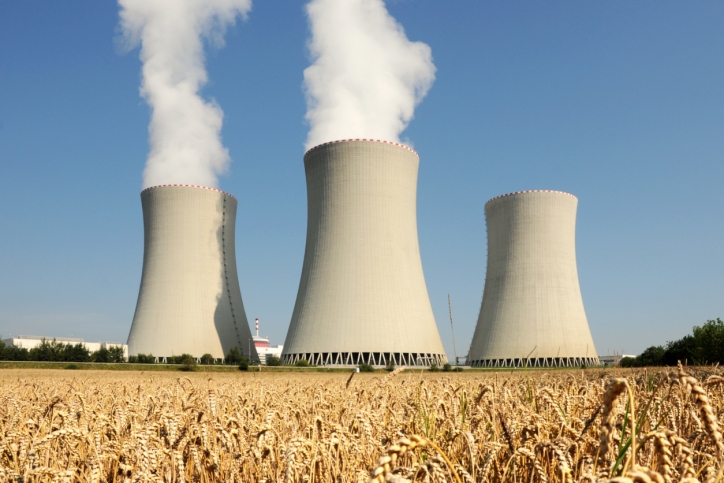
Could France, a heavyweight in nuclear power, begin to see its position crumble?
Areva, France’s iconic nuclear power builder, reported a massive financial loss for 2014. The state-owned company revealed that it lost 4.9 billion euros ($5.6 billion) in 2014, an enormous decline from the 500 million euro loss it posted the previous year.
Weighing on the company is its much-heralded rector in Finland. The Olkiluoto 3 unit under construction in Finland was supposed to be completed in 2009, but it has since turned into a nightmare. Billed as the first Generation III+ pressurized water reactor – dubbed the Evolutionary Power Reactor (EPR) by Areva – the project was intended to demonstrate nuclear technology that had advanced well beyond the designs seen in today’s operational power plants, which were built in the 1970’s. Now expected to be completed in 2018, the decade of delay could double the reactor’s eventual total cost.
Also, Areva is building another reactor in Normandy that has suffered a similar fate. The Flamanville 3 is several years behind schedule – it may not come into operation until 2016 or 2017 after an original start date of 2012. That reactor, which will be operated by fellow state-owned nuclear operator EDF, has also seen its costs skyrocket because of the delays.
While Areva’s $5.6 billion loss may be shocking at first glance, it looks even worse when compared to the company’s total market capitalization of $3.5 billion. In other words, Areva lost more money in 2014 than the company is worth in its entirety. Despite what appears to be an obvious need for injection of cash to keep the company afloat, France’s energy minister Segolene Royal said that it is “too early” to discuss such a measure, although she added that “all solutions are being looked at.”
The delays from multiple projects have one thing in common – they are using Areva’s EPR design, which has proven to be far more complex than anticipated. That raises serious questions about Areva’s future as a leading nuclear power company. “The EPR is a rotten design that they should have given up on a long time ago,” Steve Thomas, a professor at the University of Greenwich in Britain, told the New York Times last year. Areva’s share price has plummeted over the last year as it became clear the company was quickly burning through cash.
Compounding Areva’s problems is the fact that the west is no longer building nuclear reactors, aside from a few projects in the U.S. Even worse, France, which is the second largest generator of nuclear power in the world (and the leader in terms of percentage of total electricity from nuclear power), is considering a transition away from nuclear power.
French President Francois Hollande has pledge to cut France’s reliance on nuclear power by one-third by 2025. That is easier said than done for a nation that gets 75 percent of its electricity from nuclear. The French National Assembly approved a bill late last year that would slash nuclear’s share down to 50 percent over the next decade, but the Senate is trying to water down the bill. While the outcome is uncertain, what is clear is the fact that France – a global champion in nuclear power – is set to shrink its nuclear energy sector.
To make matters worse, a few safety issues have cropped up in recent weeks that could amount to a significant blow for nuclear power in Europe. A leak at the Fessenheim plant on the border with Germany and Switzerland was discovered in late February, forcing the plant’s temporary closure. This is the same plant that President Hollande specifically pledged to close during his 2012 presidential campaign.
And in neighboring Belgium, cracks have formed in the walls of the pressure vessels at several plants, raising alarm about their safety. The cracks at Belgium’s Doel 3 and Tihange 2 point to a potentially larger problem. Experts fear “material fatigue,” the possibility that radiation is wearing down the materials much quicker than expected. Such a development, if true, “could be a problem for the entire global nuclear industry,” said Jan Bens, general director of the Belgian Federal Agency for Nuclear Control (FANC), according to Deutsche Welle.
Aging European nuclear power plants, potentially presenting serious safety concerns, could well be slated for closure in the coming years. With France’s nuclear champion, Areva, unable to build suitable replacements, France is quickly seeing its position as a global leader in nuclear power slip.






 Top Gaining Stocks
 Top Losing Stocks