


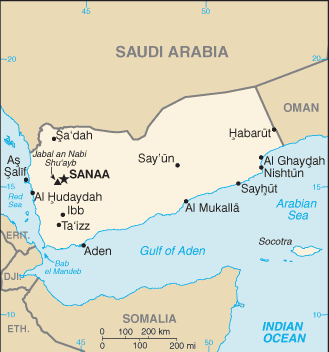
The nation is not in good shape at all, with a governmental structure that is currently questionable at best. Recent conflict in Yemen has raised concerns about the security of oil shipments from the Middle East. Word that its President had fled did not help matters on Wednesday, but this was considered a key driver for oil prices in the 3% gain.
The US Energy Information Administration (EIA) report earlier in the day dropped crude prices for a brief moment on news that storage for oil in the U.S. is filling up, but the price rose thereafter as well. A weaker U.S. dollar and speculators looking for any excuse to buy oil may have really trumped Yemen’s real news. Surprisingly, requests for US planes to bomb ISIS positions in Iraq was less cited as a driver than Yemen in oil circles.
Still, here is Yemen’s economy by the numbers.
The US Energy Information Administration (EIA) estimates that Yemen’s crude oil production was only about 100,000 barrels per day as of March 2014. While its production is low, the EIA estimates that more than 3.4 million barrels of oil per day passed through Bab el-Mandab in 2013. The country’s location at the Bab el-Mandab is a key chokepoint in international shipping, making Yemen more important than its own production in terms of international energy trade.
24/7 Wall St. looked at the CIA World Factbook for additional data on Yemen.
Yemen has a total population of 26 million people who inhabit it on the Southwest coast of the Arabian Peninsula. Out of this population the most prominent group is in the age range of 0 to 14 years old (41.7%), followed by the group in the range of 25 to 50 years old (30.9%).
The official Gross Domestic Product (GDP) of Yemen was estimated to be $43.89 billion in 2013. At the same time the GDP considering Purchasing Power Parity was estimated to be $61.63 billion, which breaks down to $2,500, per capita.
Gross national saving was estimated at 4.2% for 2013.
The GDP breaks down by sector to:
- Agriculture 7.7%
- Industry 30.9%
- Services 61.4%
In terms of the industries within Yemen, its strongest are surrounding oil and gas. Apart from this, the country focuses on cotton and textiles, aluminum products, cement, and commercial ship repair to name a few.
The labor force was estimated to be at roughly 7.1 million in 2013. The CIA World Factbook pointed out that the nation had a very high unemployment rate of 35%. Out of Yemen’s entire population the labor force made up about 27% in 2013.
Yemen’s prime exports are crude oil, coffee, liquefied natural gas and, dried and salted fish. Yemen’s primary trade partners were China (41%), Thailand, (19.2%), India (11.4%) and South Korea (4.4%) in 2013.







 Top Gaining Stocks
 Top Losing Stocks