


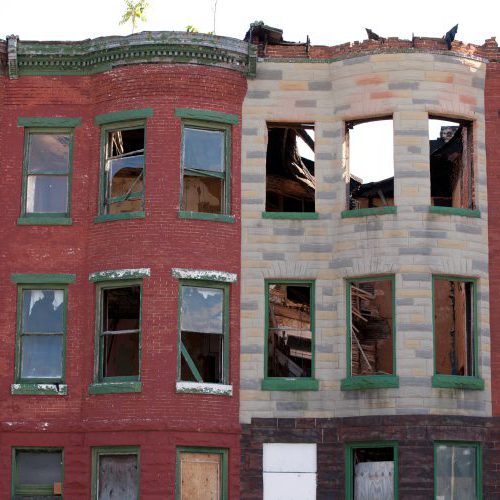
 No other large American city has the rows and rows, blocks and blocks of empty homes that Detroit has. Evidence indicates that some houses in Detroit can be bought for less than $10,000, at least by people who do not care whether they have neighbors. New Case-Shiller data show that Detroit’s housing problem barely has improved. Given the urban blight in the city, there are few reasons to believe this will change.
Average home prices in the 20 large cities Case-Shiller covers rose 1.3% from April to May. That barely reverses the longer-term trend. The same study shows that home prices in these markets were down 1.9% from a year ago.
On the Case-Shiller scale, the average price of a home at the start of 2000 had an index of 100. As of the new Case-Shiller report for May, Detroit’s index is 65.26. Las Vegas is often mentioned as the most troubled housing market, but it has an index of 90.84. The only rust belt city in the measure, aside from Detroit, is Cleveland, which has an index of 96.85. Overall, the 20-City Composite was 135.8, well above the 2000 start point, and back to 2003 levels. The home market across the nation has improved recently, but based on the Case-Shiller data, the recovery is still very modest.
Detroit almost certainly will not make it back to the 100 index level. It has too far to go. That is probably because the prices of many homes in the city have moved close to zero. Most of these homes will disappear eventually, a sign that demand has vanished in some parts of the city.
Detroit’s problem stems from the fact that the city has started to run out of people. Its population dropped by 25% from 2000 to 2010, according to the Census. No other city on the Case-Shiller index has close to that attrition level.
Most data indicate that Detroit’s population continues to dwindle. The city is nearly bankrupt. The fact that it cannot provide essential services in many cases should push more people outside the city limits. The Detroit housing market will continue to crumble, because there is nothing to hold it together anymore.
Douglas A. McIntyre











 Top Gaining Stocks
 Top Losing Stocks