Five States Where Renters Can’t Afford to Live

Photo of Douglas A. McIntyre
By Douglas A. McIntyre Published
This post may contain links from our sponsors and affiliates, and Flywheel Publishing may receive compensation for actions taken through them.

With the collapse of the housing market, the argument about renting versus buying a home was reset. Home prices suddenly plunged. For people who kept their jobs through the Great Recession, houses in some markets like Las Vegas were available for prices 40% below 2005/2006 peaks. The other component of his argument is personal finances. People who have no savings cannot afford down payments. People with low incomes can barely afford to rent or buy.

The ability to rent a home was studied recently by the National Low Income Housing Coalition. Its calculations were based on the fact that, nationwide:

[A]n individual needs to earn $18.92 an hour to afford a two-bedroom rental unit at Fair Market Rent. This figure is referred to as the “Housing Wage.” Today’s national average Housing Wage is more than two-and-a-half times the federal minimum wage, and 52% higher than it was in 2000.

Housing prices in many markets, on the other hand, have returned to near 2000 levels, according to the latest S&P/Case-Shiller report.

The coalition’s conclusions were grim, particularly for low-wage Americans. In its new report titled “Out of Reach 2014,” it concluded:

In 2014, the mean renter wage, or what the average American renter earned, is $14.64 an hour. While housing costs vary nationwide, Out of Reach 2014 finds that in no state can a full-time minimum wage worker afford a one-bedroom or a two-bedroom rental unit at the Fair Market Rent.

The worst markets for these Americans:

  1. Hawaii, with a two-bedroom housing wage of $31.54
  2. District of Columbia, with a two-bedroom housing wage of $28.25
  3. California, with a two-bedroom housing wage of $26.04
  4. Maryland, with a two-bedroom housing wage of $24.94
  5. New Jersey, with a two-bedroom housing wage of $24.92

For more details, by city and region.

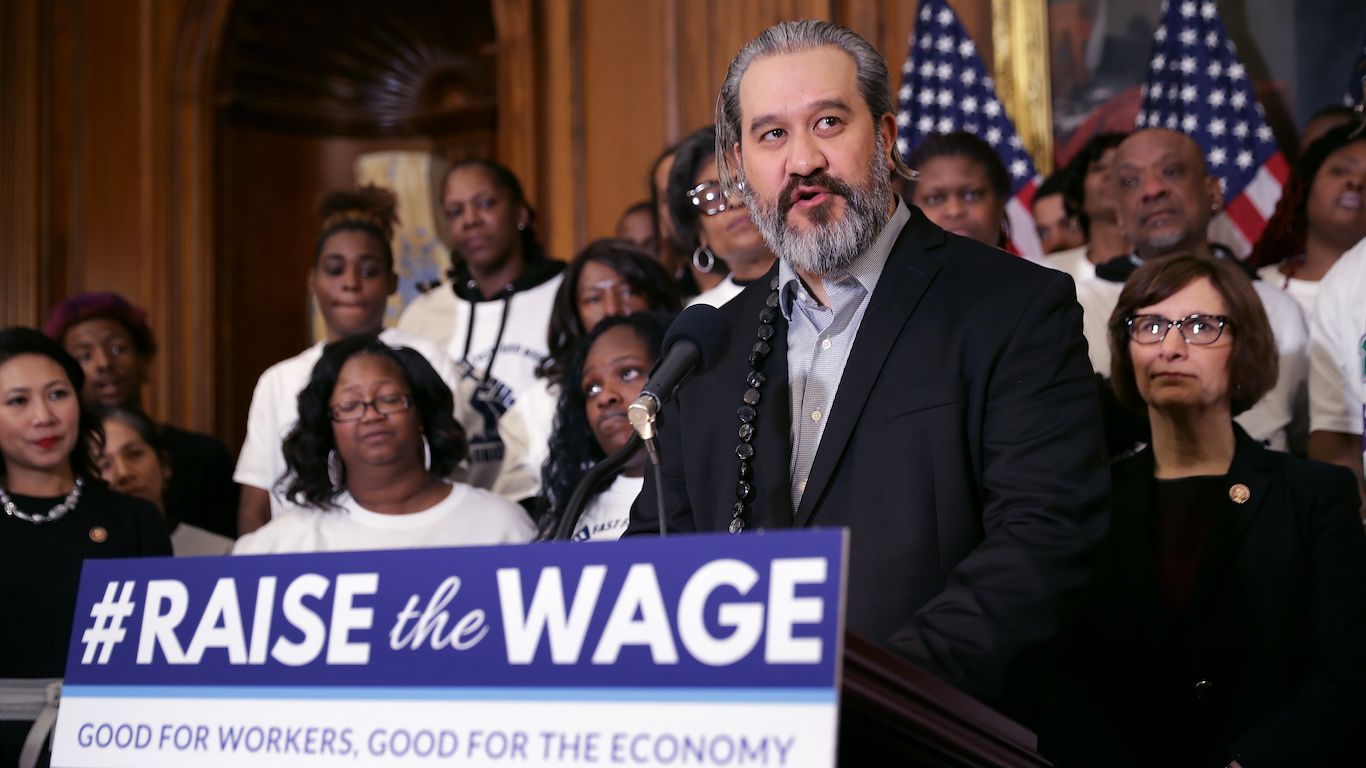
The National Low Income Housing Coalition suggests that the debate about raising the federal minimum wage and how to address income inequality must include the issue of the shortage of affordable housing for the lowest income households.


Photo of Douglas A. McIntyre
About the Author Douglas A. McIntyre →

Douglas A. McIntyre is the co-founder, chief executive officer and editor in chief of 24/7 Wall St. and 24/7 Tempo. He has held these jobs since 2006.

McIntyre has written thousands of articles for 24/7 Wall St. He is an expert on corporate finance, the automotive industry, media companies and international finance. He has edited articles on national demographics, sports, personal income and travel.

His work has been quoted or mentioned in The New York Times, The Wall Street Journal, Los Angeles Times, The Washington Post, NBC News, Time, The New Yorker, HuffPost USA Today, Business Insider, Yahoo, AOL, MarketWatch, The Atlantic, Bloomberg, New York Post, Chicago Tribune, Forbes, The Guardian and many other major publications. McIntyre has been a guest on CNBC, the BBC and television and radio stations across the country.

A magna cum laude graduate of Harvard College, McIntyre also was president of The Harvard Advocate. Founded in 1866, the Advocate is the oldest college publication in the United States.

TheStreet.com, Comps.com and Edgar Online are some of the public companies for which McIntyre served on the board of directors. He was a Vicinity Corporation board member when the company was sold to Microsoft in 2002. He served on the audit committees of some of these companies.

McIntyre has been the CEO of FutureSource, a provider of trading terminals and news to commodities and futures traders. He was president of Switchboard, the online phone directory company. He served as chairman and CEO of On2 Technologies, the video compression company that provided video compression software for Adobe’s Flash. Google bought On2 in 2009.

Featured Reads

Our top personal finance-related articles today. Your wallet will thank you later.

Continue Reading

Top Gaining Stocks

CBOE Vol: 1,568,143
PSKY Vol: 12,285,993
STX Vol: 7,378,346
ORCL Vol: 26,317,675
DDOG Vol: 6,247,779

Top Losing Stocks

LKQ
LKQ Vol: 4,367,433
CLX Vol: 13,260,523
SYK Vol: 4,519,455
MHK Vol: 1,859,865
AMGN Vol: 3,818,618