


The Joint Center for Housing Studies (JCHS) at Harvard University on Tuesday released its 2019 report on the State of the Nation’s Housing. While household formation has returned to pre-crash levels, the shortage of housing is keeping prices and rents high, making it difficult for Americans with modest incomes to find affordable housing.
New home construction is “barely keeping pace” with the number of new households, which the report chalks up to a slow recovery in the housing construction sector resulting from the excess supply that had built up in the boom that preceded the recession and to labor shortages.
Chris Herbert, managing director of the Joint Center for Housing Studies, focused on the two factors that are most significant in keeping building depressed: rising land prices and regulatory constraints on development. Those constraints, he said, “are largely imposed at the local level, rais[ing] costs and limit[ing] the number of homes that can be built in places where demand is highest.”
[nativounit]
That second constraint even has its own nickname and acronym: not in my backyard, aka NIMBY. Recent legislation in California that would have required areas around public transit hubs to permit multifamily construction (supported by 62% of the state’s residents) had to be withdrawn when pressure was brought to bear on state legislators by homeowners in the affected area.
As Herbert puts it, “[F]or the millions of families and individuals who struggle to find housing that fits their budget, public efforts will be necessary to close the gap between what they can afford and the cost of producing decent housing.” Neither local nor state governments have either the power or the backbone to set and enforce housing policy. That will take federal action.
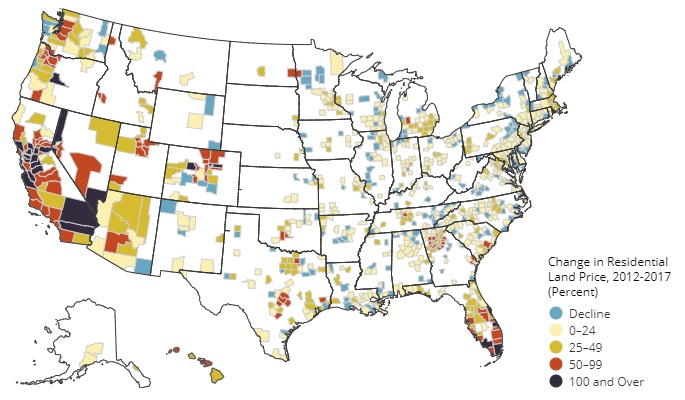
The median price per acre of residential land in the United States rose from $159,800 to $203,000 in 2017, an increase of 27%. Land values rose in 80% of U.S. counties in the same period with prices rocketing higher some western states: Nevada, up 158%; Colorado, up 96%; California, up 88%; and Arizona and Utah, up 81%. The following map from the Harvard study shows land price increases by county. An interactive version with more detail is also available.
Nearly half (46%) of the nation’s for-sale inventory at the end of last year was in the top third of homes by value within each market, while 31% was in the middle tier and only 23% was in the bottom tier. Still, after declining for four consecutive years, the number of homes for sale in the bottom and middle price tiers increased by 4%, while supply in the top tier continued to fall by 4%.
The share of renter households declined by 1% between 2016 and 2018 to 35.6% of all U.S. households. High-income renters (incomes of at least $75,000) now comprise more than 25% of all renter households, up from 19% in 2008. Yet more than half of all renter households make less than $45,000 annually with a median of $40,530.
[recirclink id=555564]
[wallst_email_signup]











 Top Gaining Stocks
 Top Losing Stocks