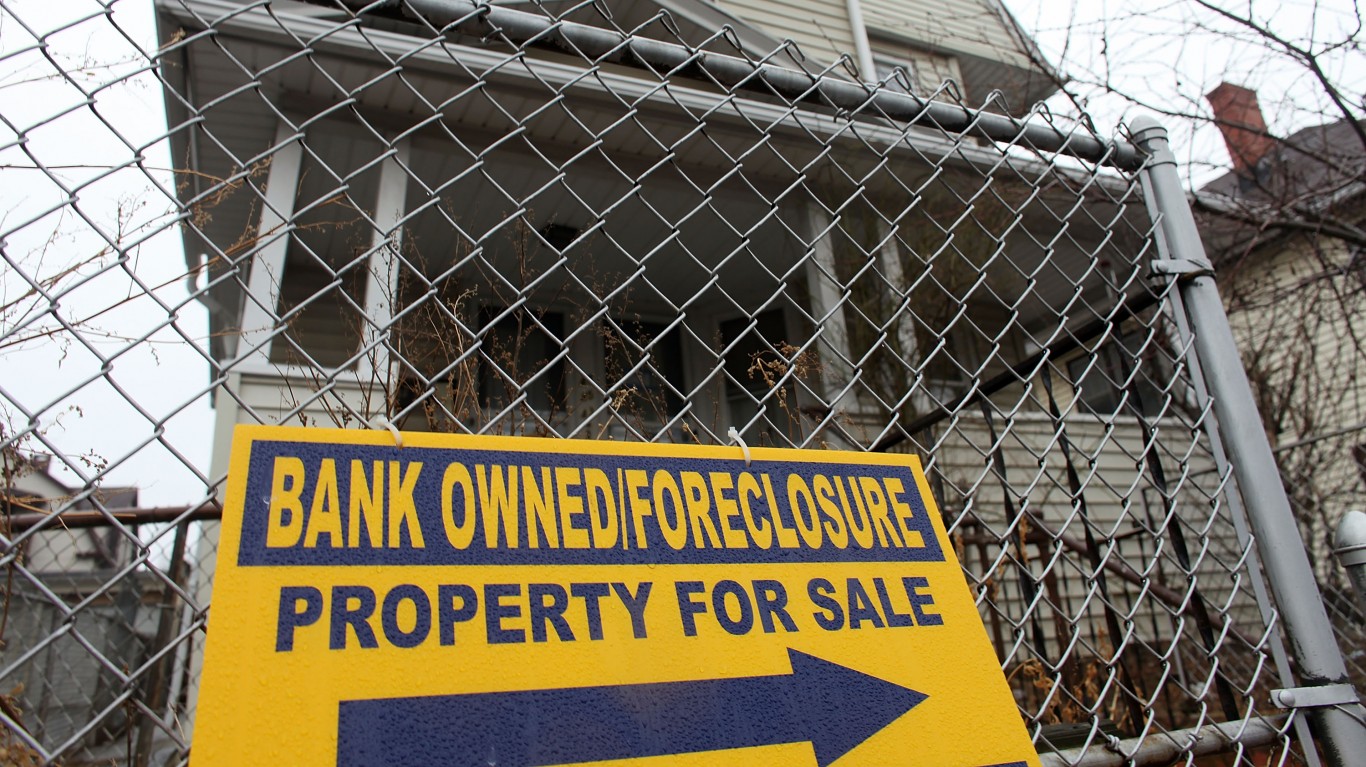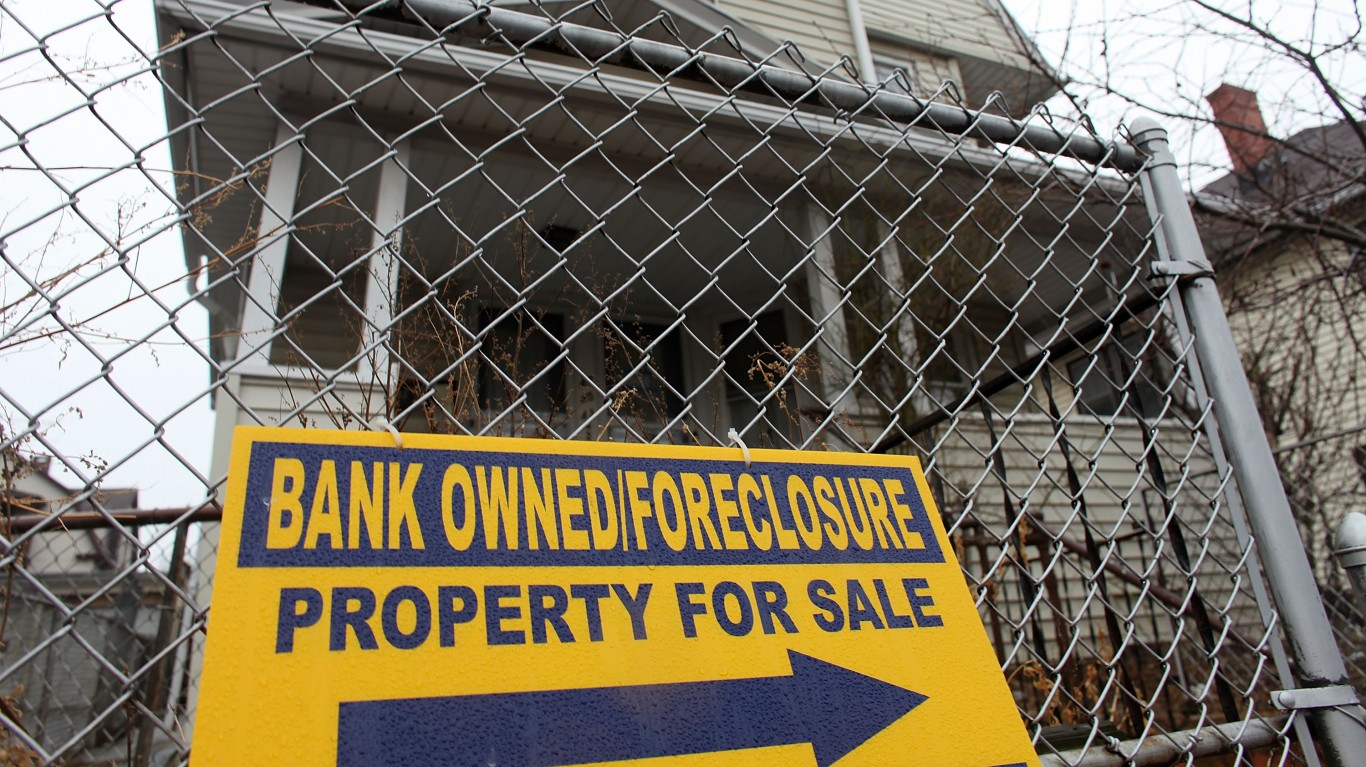
Foreclosures Surge in America’s Poor Cities

Photo of Douglas A. McIntyre
By Douglas A. McIntyre Updated Published
This post may contain links from our sponsors and affiliates, and Flywheel Publishing may receive compensation for actions taken through them.
Foreclosures Surge in America’s Poor Cities

© arkbuildermedia / Getty Images

Foreclosures are supposed to be a thing of the past. Tens of thousands of homes fell into foreclosure during the 2008/2009 housing crisis. It took years for home prices to recover. Prices recovered aggressively enough that they rose to records two years ago. Then came 6% mortgage rates, and some homeowners were in trouble again. The recent foreclosure spike is particularly acute in several cities, almost all of which are poor. (These American cities have the most foreclosures.)
[in-text-ad]
Real estate research firm ATTOM recently released its July 2023 U.S. Foreclosure Market Report. A total of 31,877 homes had foreclosed filings (default notices, scheduled auctions or bank repossessions). That is one of every 4,830 housing units in America.
[nativounit]
ATTOM also looks at cities. This yardstick includes the numbers for metros with populations of over 200,000. In July, the city hit the hardest by foreclosures was Fayetteville, N.C., where one in every 1,367 housing units had a foreclosure filing. It was followed by Atlantic City, N.J., with 1 in every 1,708 housing units; Columbia, S.C., with one in every 1,747 housing units; Trenton, N.J., with 1 in every 1,870 housing units; and Cleveland, Ohio, with 1 in every 1,957 housing units.

Fayetteville has 208,873 residents, 41% of which are white and 42% Black. The median household income is $48,923, almost $20,000 below the national figure. The poverty rate is 19.1%, which is well above the national number.
[wallst_email_signup]
The demographic profile of Atlantic City is even worse than Fayetteville’s. It is smaller, with a population of 38,561. Twenty-one percent of the population is white, 33% is Black and 32% is Hispanic. The median household income is an extraordinarily low $29,733. The poverty rate is 37%, one of the highest of any city in the country.
[recirclink id=1222007]
Foreclosure rates in these cities and others of America’s poorest cities will always be higher than the national average. When the cost of food, transportation and energy are taken into account, many of the residents simply have no money left over for housing.


Photo of Douglas A. McIntyre
About the Author Douglas A. McIntyre →

Douglas A. McIntyre is the co-founder, chief executive officer and editor in chief of 24/7 Wall St. and 24/7 Tempo. He has held these jobs since 2006.

McIntyre has written thousands of articles for 24/7 Wall St. He is an expert on corporate finance, the automotive industry, media companies and international finance. He has edited articles on national demographics, sports, personal income and travel.

His work has been quoted or mentioned in The New York Times, The Wall Street Journal, Los Angeles Times, The Washington Post, NBC News, Time, The New Yorker, HuffPost USA Today, Business Insider, Yahoo, AOL, MarketWatch, The Atlantic, Bloomberg, New York Post, Chicago Tribune, Forbes, The Guardian and many other major publications. McIntyre has been a guest on CNBC, the BBC and television and radio stations across the country.

A magna cum laude graduate of Harvard College, McIntyre also was president of The Harvard Advocate. Founded in 1866, the Advocate is the oldest college publication in the United States.

TheStreet.com, Comps.com and Edgar Online are some of the public companies for which McIntyre served on the board of directors. He was a Vicinity Corporation board member when the company was sold to Microsoft in 2002. He served on the audit committees of some of these companies.

McIntyre has been the CEO of FutureSource, a provider of trading terminals and news to commodities and futures traders. He was president of Switchboard, the online phone directory company. He served as chairman and CEO of On2 Technologies, the video compression company that provided video compression software for Adobe’s Flash. Google bought On2 in 2009.

Featured Reads

Our top personal finance-related articles today. Your wallet will thank you later.

Continue Reading

Top Gaining Stocks

CBOE Vol: 1,568,143
PSKY Vol: 12,285,993
STX Vol: 7,378,346
ORCL Vol: 26,317,675
DDOG Vol: 6,247,779

Top Losing Stocks

LKQ
LKQ Vol: 4,367,433
CLX Vol: 13,260,523
SYK Vol: 4,519,455
MHK Vol: 1,859,865
AMGN Vol: 3,818,618