


 Steve Jobs worked at Apple (AAPL) for $1 a year in 2000, just before the launch of the iPod which completely changed the company’s fortunes and made him astonishingly wealthy. Lee Iaccoca worked for $1 in 1978 when he took charge of crippled Chrysler.
The dollar-a-year tradition has fallen on hard times. The most recent apostle of the practice was Edward Liddy who took the CEO’s job at AIG (AIG) when it was deeply troubled. He had been the head of Allstate (ALL), so he probably did not need to make several million dollars. Liddy took the job as a public service, an action which seems to be both anachronistic and idealistic. Liddy worked hard to restructure the insurance company. He was derided mercilessly by Congress because AIG executives received large pay packages on his watch. The irony of this issue was that Liddy had nothing to do with the compensation agreements. Liddy was replaced by Robert Benmosche, the former CEO of MetLife (MET). He presumably is wealthy enough to work for nothing, but insisted on being paid $7 million. The taxpayers who own 85% of AIG are appropriately enraged that AIG let Liddy leave.
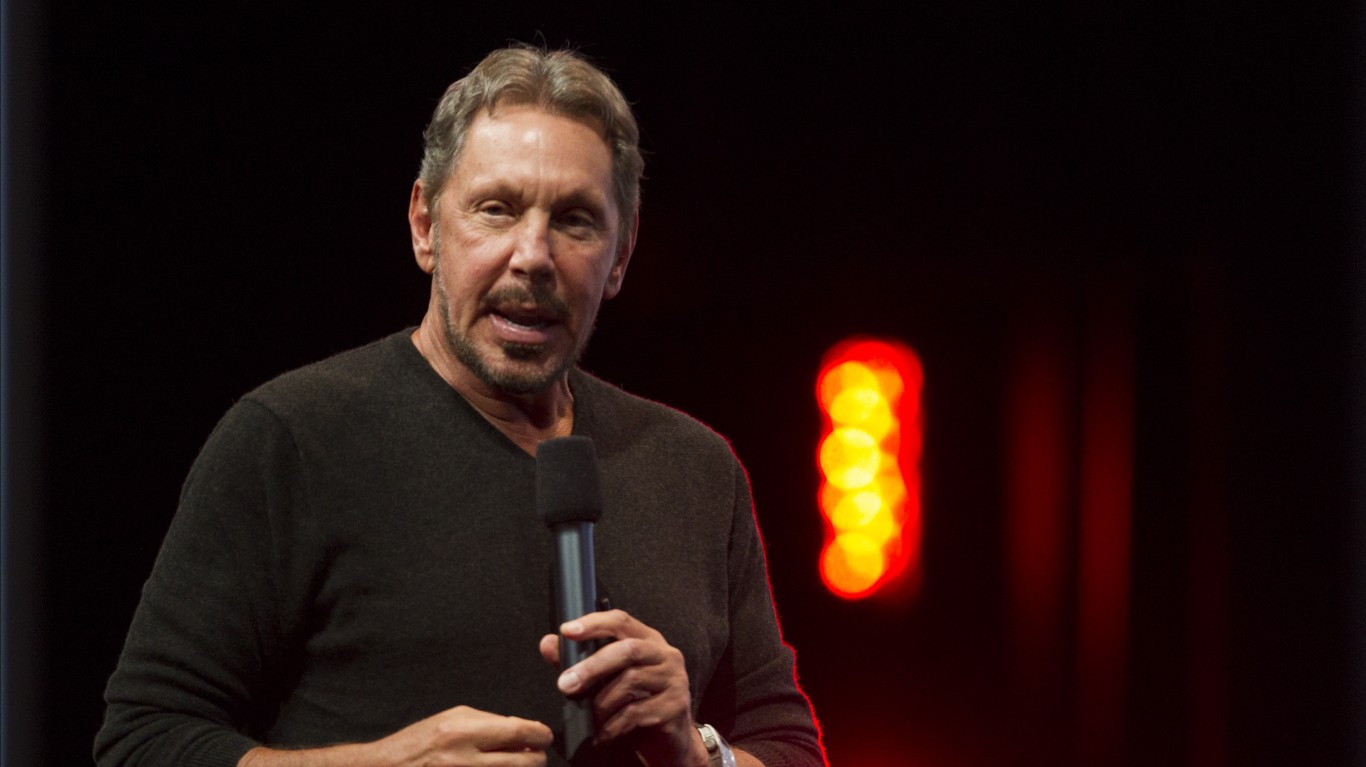
Much to the surprise of a number of compensation experts and probably the company’s shareholders, Larry Ellison, the founder and head of Oracle (ORCL) has decided to work for $1 in base salary in 2010. It would be easy to take a cynic’s view of the decision. Forbes says Ellison one of the ten richest people in America. Ellison owns 23.4% of Oracle’s stock, so he has every reason to make certain the company does well. But, other corporate founders including Howard Schultz of Starbucks (SBUX) have seven figure base salaries even though their shareholders have not done well since the beginning of the market sell-off in the fall of 2007. Ellison’s decision is all the more remarkable because Oracle’s stock has outperformed the market by a very wide margin over the last two years.
Ellison understands shareholder sentiment and is willing to have his compensation tied to corporate performance, something that most CEOs are not willing to do. Shareholders in large American companies were comfortable when management received big compensation packages during the 2002 to 2007 bull market. The idea of most CEOs making millions, if not tens of millions of dollars, after that run-up turned into a sharp slide was obscene, the same shareholders reasoned. Goldman Sachs (GS) is the firm that has received the most criticism because it appears that it will pay out record bonuses for its current fiscal year. The investment bank took government TARP funds. Goldman’s management, of course, argues that it paid that money back. Its shares have not recovered entirely, however. Late in 2007, they traded at just below $250. The stock now sits at $163, so the share price will have to rise a long way to support the case that Goldman Sachs has taken proper care of shareholder interests.
Goldman’s situation is a case in point, but it is beside the point. Boards and managements may choose to ignore the chance that the federal government will work to restrict pay packages, but it is foolhardy to ignore public sentiment. Ten percent of Americans, more by some measures, are out of work. Some of those people worked for AIG, Starbucks, and Goldman Sachs. Firing people while drawing a multi-million dollar pay check is not an endearing act.
Many major companies have arranged for management to be paid large performance bonuses and to get valuable stock option and restricted stock grants. That should be enough incentive to do a good job, that plus pride in having done something beneficial to shareholders. But, those things don’t seem to matter much at most firms.
It is easy to pick though proxies to find executives who are overpaid. Jeff Immelt, CEO of GE (GE) gets a base salary of $3,000,000. The company’s share price is down about 65% from its peak less than two years ago. Immelt is easy to attack because of his high visibility, but he is still a good example of an overpaid CEO, who has not voluntarily and symbolically taken a pay cut.
The general population of public company shareholders cannot fathom why someone like Immelt makes $3 million. They don’t understand why the government would let Benmosche at AIG make $7 million after all of the taxpayer money that has gone into the company. Theses compensation numbers are inappropriate, not because the people who run these companies are inexperienced or greedy. They are inappropriate simply because the firms are doing poorly.
Larry Ellison is working for $1 a year. His board would have given him more. He has done a good job for his shareholders. But, at some point recently, it must have occurred to him that the people who work at Oracle have made sacrifices and some have even lost their jobs. Oracle’s stock is at a 52-week high, which very few companies can claim, but the firm is still suffering the effect of the recession.
It’s too bad that a number of CEOs won’t follow the Oracle chief’s move. But, it is almost certain that not a single public company chief will read about Ellison’s action in the paper this week and follow suit.
Douglas A. McIntyre






 Top Gaining Stocks
 Top Losing Stocks