


 Infrastructure repair data often misleads, and this makes the argument about how government should spend money on upgrading America’s roads and bridges complicated and often biased.
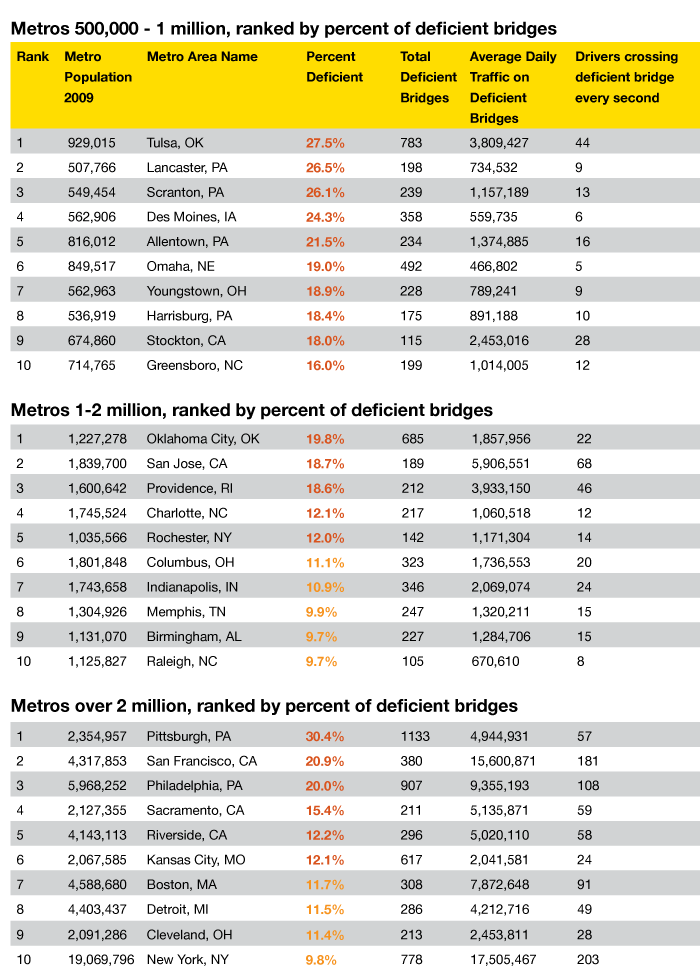
Transportation for America has come out with another of its surveys of the state of bridges in major cities. The part of the report most of the media focused on is that Pittsburgh’s bridge infrastructure problems are worse than those of any other big city. They are, for example, much worse than Cleveland’s, a city of similar size. That is almost certainly because Pittsburgh has 1,133 bridges in trouble and Cleveland has 213. When adjusted for total bridges, both those in need of repair and those not, Pittsburgh has double the number that Cleveland does.
Cities with modest budgets to repair bridges and roads have to spread resources over the miles of road and bridges they have to maintain. Pittsburgh’s problem is not really a result of the city’s neglect of its infrastructure. The Pennsylvania city just has more infrastructure to care for.
Most of America’s cities have very manageable bridge problems. The inventory of structures that need to be fixed is relatively small, which means the infrastructure probably will be upgraded in due course. Detroit, the most impoverished large city in America, has only 11.5% of its bridges labeled as “deficit” bridges — the term Transportation for America uses to describe structures that need to be upgraded. In New York, only 9.8% of structures have problems.
A careful look at the bridge, tunnel and road systems in large cities would show, in almost all cases, the effects of age and lack of funds to keep infrastructure in the best of condition. But it is misleading to argue that all the facilities need to be repaired very soon. It would be wrong to say that 1,133 bridges in Pittsburgh are about to collapse. Transportation for America says the problem will not go away. That is not the same as saying that the bridges in question are not safe or cannot be repaired before they are.
The debate over what has to be done to upgrade America’s infrastructure will be clouded by claims that U.S. roads, bridges and tunnels are about to collapse in great numbers and will do so soon. The federal government cannot afford to pay for teams to fix all of these problems at once. So, who can say what kind of financial resources are even needed?
Source: Transportation for America








 Top Gaining Stocks
 Top Losing Stocks