How Far Does the Market Have to Fall to Impress Washington?

Photo of Douglas A. McIntyre
By Douglas A. McIntyre Published
This post may contain links from our sponsors and affiliates, and Flywheel Publishing may receive compensation for actions taken through them.

One of the theories about how the budget, debt ceiling and the funding of the Affordable Care Act (ACA) conflicts may be resolved involves a meltdown of the stock market. If hundreds and hundreds of billions of dollars melt away in a few hours and the Dow Jones Industrial Average (DJIA) falls by hundreds of points, perhaps this very public disaster would affect activity in Washington. So, how far does the market have to fall?

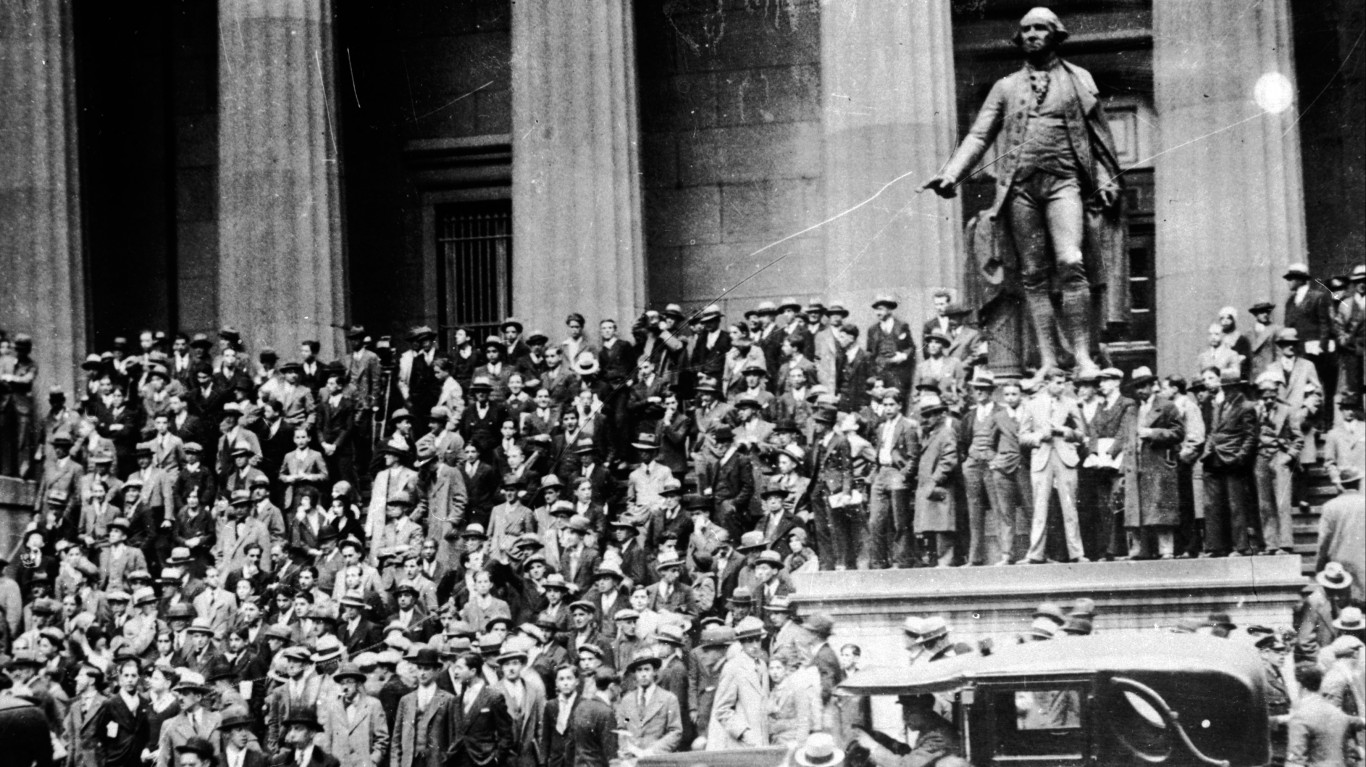
There are two premises behind a stock market crash effect. The first is that huge headlines would conjure up Black Monday on October 19, 1987, and other record drops. The U.S. market tumbled almost 23% that day. Less well remembered was the catastrophe overseas. Hong Kong’s Hang Seng fell more than 45%. The crisis was a global event, not just a local one.

The second and more persuasive argument is the amount of wealth that would be shattered in such a short period. Individual investors may not control trading in the markets anymore because their participation is so small. But the ripples that reach them thought mutual funds, exchange traded funds (ETFs) and direct holdings would be something akin to the housing crisis played out in an instant. When people watch much or all of their savings disappear, the eventual and likely fast effect on consumer spending and confidence would cause an instant outcry about what Washington had done to destroy the personal wealth that was rebuilt from the market bottom in March 2009.

The other immediate problem a crash could cause would be the crisis among institutions, both governmental and corporate. Pension values would fall, at least to the extent that some municipal and company funds still hold substantial equity positions. The access to capital provided by healthy stock prices would be gone. The IPO market would dry up in an instant.

Among the difficult parts of gauging a stock market shock is how much of a drop is enough, at least as seen from Washington. The DJIA has risen from just over 11,000 in November 2011, largely on the basis that the economy and earnings would recover from their depths two years earlier. With the DJIA at almost 15,000, some large portion of that would have to be reversed. Maybe half of the difference — 2,000 points — would be enough. That number is 13%, and not shockingly large — unless the dive was spread over just a few days.

A government shutdown, or even a default, might start ruining the economy. That would not happen overnight. A stock market crisis would.


Photo of Douglas A. McIntyre
About the Author Douglas A. McIntyre →

Douglas A. McIntyre is the co-founder, chief executive officer and editor in chief of 24/7 Wall St. and 24/7 Tempo. He has held these jobs since 2006.

McIntyre has written thousands of articles for 24/7 Wall St. He is an expert on corporate finance, the automotive industry, media companies and international finance. He has edited articles on national demographics, sports, personal income and travel.

His work has been quoted or mentioned in The New York Times, The Wall Street Journal, Los Angeles Times, The Washington Post, NBC News, Time, The New Yorker, HuffPost USA Today, Business Insider, Yahoo, AOL, MarketWatch, The Atlantic, Bloomberg, New York Post, Chicago Tribune, Forbes, The Guardian and many other major publications. McIntyre has been a guest on CNBC, the BBC and television and radio stations across the country.

A magna cum laude graduate of Harvard College, McIntyre also was president of The Harvard Advocate. Founded in 1866, the Advocate is the oldest college publication in the United States.

TheStreet.com, Comps.com and Edgar Online are some of the public companies for which McIntyre served on the board of directors. He was a Vicinity Corporation board member when the company was sold to Microsoft in 2002. He served on the audit committees of some of these companies.

McIntyre has been the CEO of FutureSource, a provider of trading terminals and news to commodities and futures traders. He was president of Switchboard, the online phone directory company. He served as chairman and CEO of On2 Technologies, the video compression company that provided video compression software for Adobe’s Flash. Google bought On2 in 2009.

Continue Reading

Top Gaining Stocks

CBOE Vol: 1,568,143
PSKY Vol: 12,285,993
STX Vol: 7,378,346
ORCL Vol: 26,317,675
DDOG Vol: 6,247,779

Top Losing Stocks

LKQ
LKQ Vol: 4,367,433
CLX Vol: 13,260,523
SYK Vol: 4,519,455
MHK Vol: 1,859,865
AMGN Vol: 3,818,618