



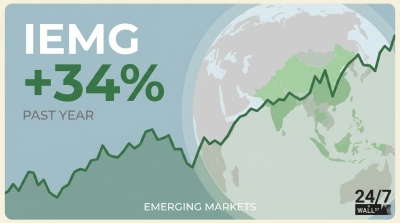
After closing at $39.41 on March 18, 2014, the last down day in the market was on March 19, when this ETF closed down handily on active volume at $38.57. The difference here is massive as there has not been a losing day since:
- March 31, 2014: $41.01
- March 28, 2014: $40.74
- March 27, 2014: $40.42
- March 26, 2014: $39.90
- March 25, 2014: $39.81
- March 24, 2014: $39.36
- March 21, 2014: $38.98
- March 20, 2014: $38.74
- March 19, 2014: $38.57
- March 18, 2014: $39.41
What is happening is a backing off of the rate-hike timing, better economic data, hopes of a China stimulus, a decreasing of tensions with Russia over Crimea and Ukraine, and the S&P 500 Index hitting all-time highs. Another driving force is that many emerging markets have been battered.
In 2013, the iShares China Large-Cap Index (NYSEMKT: FXI) was down 2.1% and the WisdomTree India Earnings Fund (NYSEMKT: EPI) was down 9.3%. Even the iShares MSCI Brazil Capped Index (NYSEMKT: EWZ) fell by a whopping 17.5% in 2013. And the Market Vectors Russia ETF Trust (NYSEMKT: RSX) managed to drop almost 1% in 2013, but this was battered during the height of tensions with Russia and the West.
Keep in mind that the iShares MSCI Emerging Markets Index (NYSEMKT: EEM) is dominated by the following 10 nations with a total weighting of 87.90%:
- China 17.95%
- South Korea 15.84%
- Taiwan 11.94%
- Brazil 11.01%
- South Africa 7.73%
- India 6.67%
- Mexico 5.12%
- Russia 5.09%
- Malaysia 3.88%
- Indonesia 2.66%
If the gains of 0.6% to $41.25 on the iShares MSCI Emerging Markets hold up on Tuesday, then the emerging markets ETF streak will be nine days, going into a key unemployment report in three trading days.





 Top Gaining Stocks
 Top Losing Stocks