



It’s been a wild ride in 2019. The seasonal theme of “sell in May and go away” passed and seemingly has turned into “Hold your nose and buy in June.” Now the Dow Jones industrial average is up 11.9% and the S&P 500 was up 15.3%, as of June 14, and most major equity indexes are within striking distance of all-time highs again. It is important to understand that the stock market is really a market of stocks. Not all are created equal, and some companies have pathetic share price performance even in strong markets.
Running a screen on Finviz reveals that nearly half of the Dow’s 30 components are not even up by double-digit percentages in 2019. Five of the 30 components still are basically down so far in 2019, and some more are literally just one bad day away from being down for the year.
24/7 Wall St. has added color on each of these names, and we have included some candidates that are very near the red zone.
[nativounit]
Walgreens Boots Alliance Inc. (NASDAQ: WBA) is down the worst, as it joined the Dow just in time for more health care valuations and changing models in drug pricing and other health care transparency that might hurt the company. It’s the worst performer, with a drop of 21.5% year to date, and that is even after a 1.5% gain the prior day and after a 7.2% rally since the end of May.
Last seen trading at $52.89, Walgreens has a 52-week range of $49.31 to $86.31 and a dividend yield of about 3.5%.
3M Co. (NYSE: MMM | MMM Price Prediction) caught a mini-case of the GE disease as its shares have continued to be under pressure. The conglomerate has many issues, from a write-down in Venezuela to environmental pollution. Oh, and it can’t seem to make its earnings numbers. Its shares are about 10% so far in 2019, with a dividend hike streak of 61 consecutive years now completely ignored.
Shares of 3M closed at $168.85, in a 52-week range of $159.32 to $219.75 and with a dividend yield of about 3.6%.
Pfizer Inc. (NYSE: PFE) is still in the red in 2019 with a drop of 1%, even with a high dividend yield. And the drug price pressure, ongoing transparency issues and patent cliffs all continue to weigh on Pfizer. This looks even worse on a relative basis as Merck shares were up about 8% so far in 2019.
Trading at $42.50, Pfizer has a 52-week range of $35.73 to $46.47 and a dividend yield of about 3.5%.
UnitedHealth Group Inc. (NYSE: UNH) is the largest health insurer in America, and it has a lot to lose if a Medicare for all plan or something similar replaces health care insurance as we know it. This is still way too soon to call, but it continues to be a risk on CNBC and mainstream media that are vocalizing a call for nationalized health care of some sort. UnitedHealth was last seen down 1.3% so far in 2019, and having one of the lowest dividend yields of the 30 Dow stocks means it’s harder for the dividend to make up what would otherwise be a small loss.
UnitedHealth recently closed at $244.96, in a 52-week range of $208.07 to $287.94. It has just a 1.45% dividend yield.
Intel Corp. (NASDAQ: INTC) screened out as negative on Thursday, but the gain before the negative Broadcom news had it teetering on the red/black divide. Intel was just named one of 10 dirt-cheap old-school technology dividend stocks, but guess what that means: it’s cheap because of slow growth and because it underperformed so far this year. Intel still has lots of exposure to personal computers and China, and rivals AMD and Nvida are doing whatever they can to take market share. Intel was up just 0.7% so far in 2019, if you include its dividends for a total return basis, but the Broadcom-related drop now has Intel challenging a red/black line.
At $46.70 a share, Intel has a 52-week range of $42.36 to $59.59, and it has a 2.7% dividend yield.
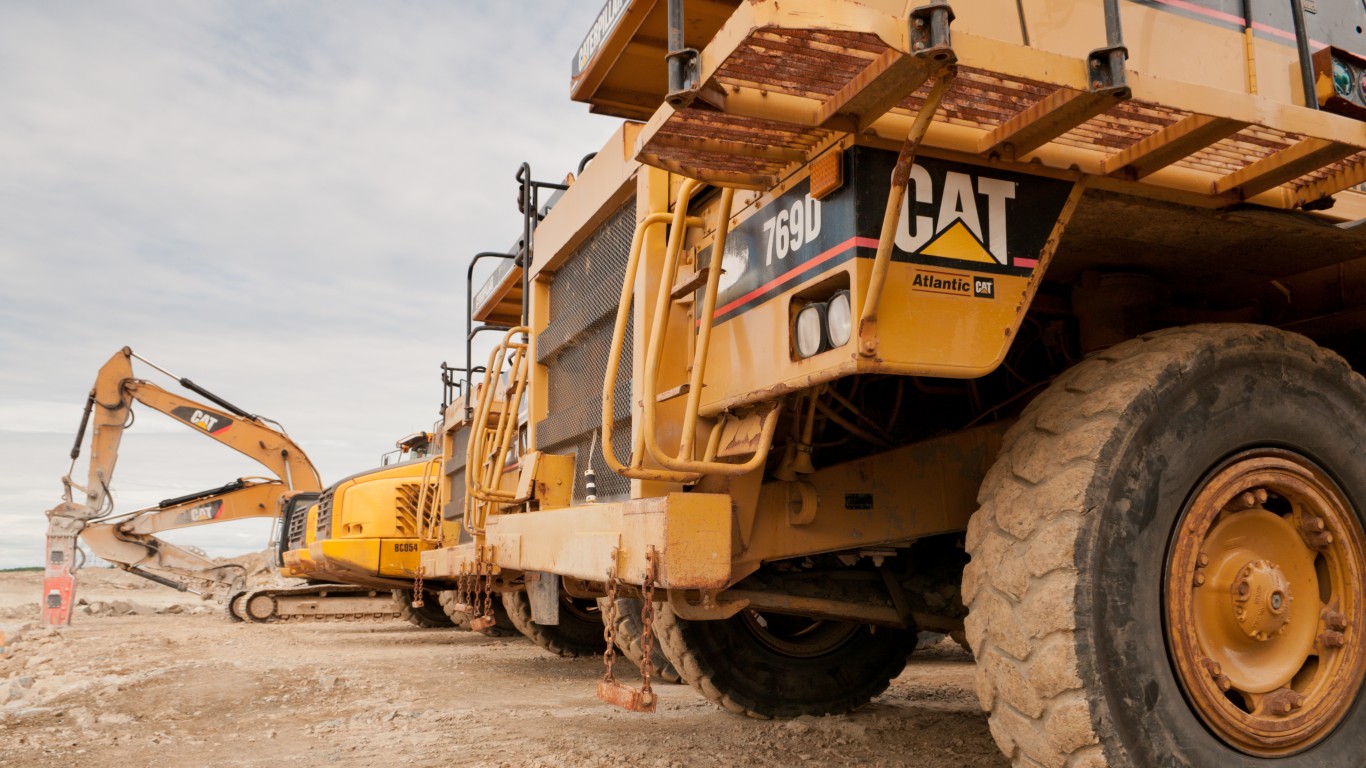
Caterpillar Inc. (NYSE: CAT) is one of the China-exposure stocks often considered as a barometer for global growth. Up to 10% of all sales come from China too, and it recently indicated that Asia-Pacific sales were down 4% for the trailing three-month period. Its shares were up less than 0.1%, without adding in its two dividend payments of 86 cents per share in 2019.
At $127.17 per share, Caterpillar has a 3.4% dividend yield and a 52-week trading range of $112.06 to $159.37.
Verizon Communications Inc. (NYSE: VZ) may be in better shape with less new debt than rival AT&T, but it is not even up 3% so far in 2019. The wireless telecom operator has not been as aggressive in acquisitions as AT&T, and it now has a simpler model for defensive investors to understand. Still, it has recovered handily from its low point.
Trading at $57.62, Verizon has a 52-week range of $47.13 to $61.58, and its dividend yield was 4.2%.
[recirclink id=553929]
Other Dow stocks are lagging too in 2019, but many are holding up better than most investors might have guessed.
With all of the 737 MAX planes grounded and unable to be sold, Boeing Co. (NYSE: BA) was still up 8%. Coca-Cola Co. (NYSE: KO) was still up 8%, despite no investors wanting to buy into it. And despite the drop in oil prices, Chevron Corp. (NYSE: CVX) was up 11% and Exxon Mobil Corp. (NYSE: XOM) was up over 9% so far in 2019. Despite the weakness in banks and the flat to inverted yield curve fears, JPMorgan Chase & Co. (NYSE: JPM) was last seen up 12%, and Goldman Sachs Group Inc. (NYSE: GS) was up 14% so far in 2019.
Again, there are still many losers and laggards in the broader market. It really does look like a market of stocks rather than a stock market.
Are airline stocks ready to lead transportation stocks (and the market) higher?
[wallst_email_signup]









 Top Gaining Stocks
 Top Losing Stocks