


The battle in the Senate over the “Build Back Better” bill has been held up to some extent because of Senator Joe Manchin, who represents West Virginia. The state is the closest possible to being the coal capital of the nation. The tug of war could affect a portion of America’s energy future. It is an example of the fact that a move to “clean energy” is not easy.
However, as the world wrestles with climate change, it is clear that clean energy is essential to the actions needed to keep the ice caps from melting rapidly and curtailing extreme weather changes. In America, it could have a profound effect on the job market as the rotation from fossil fuels to cleaner alternatives continues.
Though the number of clean energy jobs declined during the pandemic year 2020, such jobs have surged in recent years, reaching about 3.36 million the year before the pandemic, according to E2’s recent Clean Jobs America report. The number of people employed in clean energy jobs is nearly three times the number of people employed in fossil fuel extraction and generation.
About two-thirds of clean energy jobs are related to energy efficiency and include workers in buildings, those involved in producing Energy Star appliances and energy-efficient lighting, and heating and cooling. About half a million jobs are in renewable energy such as solar and wind. The remaining jobs are in the clean vehicles, grid and storage, and fuel subsectors.
[nativounit]
To find the state adding the most clean energy jobs, 24/7 Wall St. reviewed E2’s 2021 Clean Jobs America report. States are ranked by job growth in the three years from 2018 to 2020. E2 is a nonpartisan group advocating for environmental policies.
Clean energy jobs did not grow uniformly in all states. While they grew by 6% nationwide in the three-year period to $3.05 million (despite a 9.1% decline in 2020), they grew by as much as 38.9% in the state with the largest growth.
The number of these jobs will continue to increase in the foreseeable future as the world focuses on climate change. With the growing numbers of national and municipal governments pledging to reach carbon neutrality by 2050, there is a worldwide drive toward non-carbon energy solutions.
Spurred by emerging clean energy policies and by both public and private assistance, clean energy is already becoming increasingly economically competitive. By 2025, it will be cheaper to build new solar and wind power sources than to continue operating most existing coal plants, according to research from Energy Innovation and Vibrant Clean Energy.
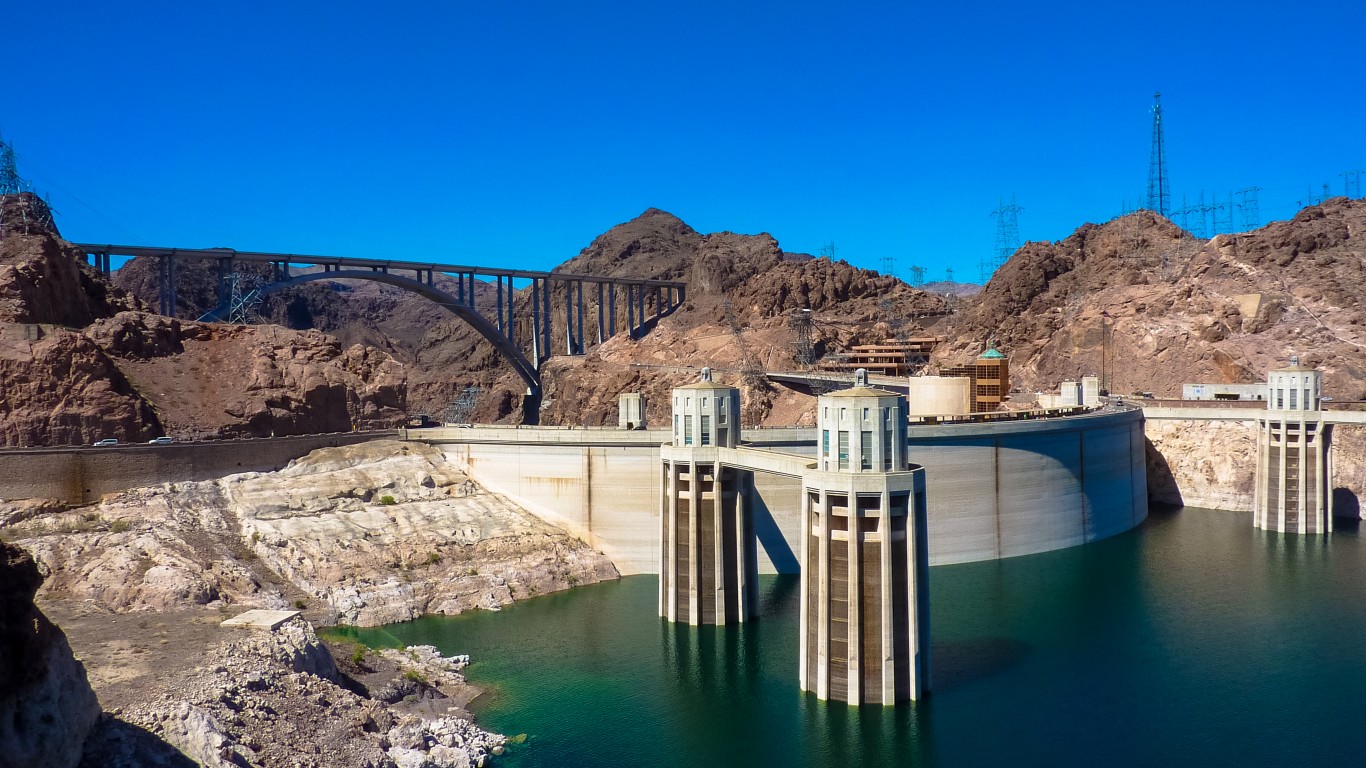
The state adding the most clean energy jobs is Nevada. Here are the details:
> Clean energy employment growth 2018-2020: 38.90% — the highest
> Clean energy jobs lost in 2020: 2,597 (-7.70% — 12th highest)
> Clean energy jobs recovered — Jun-Dec 2020 growth: 8.40% — 16th lowest
> Total employment in clean energy: 31,191 — 22nd lowest
> Pct. working in clean energy of state workforce: 2.49% — 16th highest
Methodology: To find the state adding the most clean energy jobs, 24/7 Wall St. reviewed E2’s 2021 Clean Jobs America report. States are ranked by job growth in the three years from 2018 to 2020. The analysis is based on preliminary employment data from the 2021 U.S. Energy and Employment Report, which uses Bureau of Labor Statistics data.
Clean energy employment spans economic sectors and includes jobs in renewable energy, solar and wind, storage and grid, energy efficiency, clean fuels, and clean vehicles. E2 does not include jobs in corn ethanol, woody biomass, large hydropower, and nuclear. Similarly, jobs in retail trade, repair services, water or waste management, and indirect employment or induced employment are not included.
[wallst_email_signup]







 Top Gaining Stocks
 Top Losing Stocks