



While history shows the stock market to be the single best way for the average person to accumulate wealth over time, alternative investments have been popular for centuries.
Especially for the wealthy, seeking out investments beyond stocks is part of having a well-diversified portfolio. Art auction houses Christie’s and Sotheby’s exist in part to serve this market.
Trading cards might not rise to the level of fine art, but they can have more intrinsic value than a duct-taped banana that some fool recently bought for $6.2 million.
A sporting chance for wealth
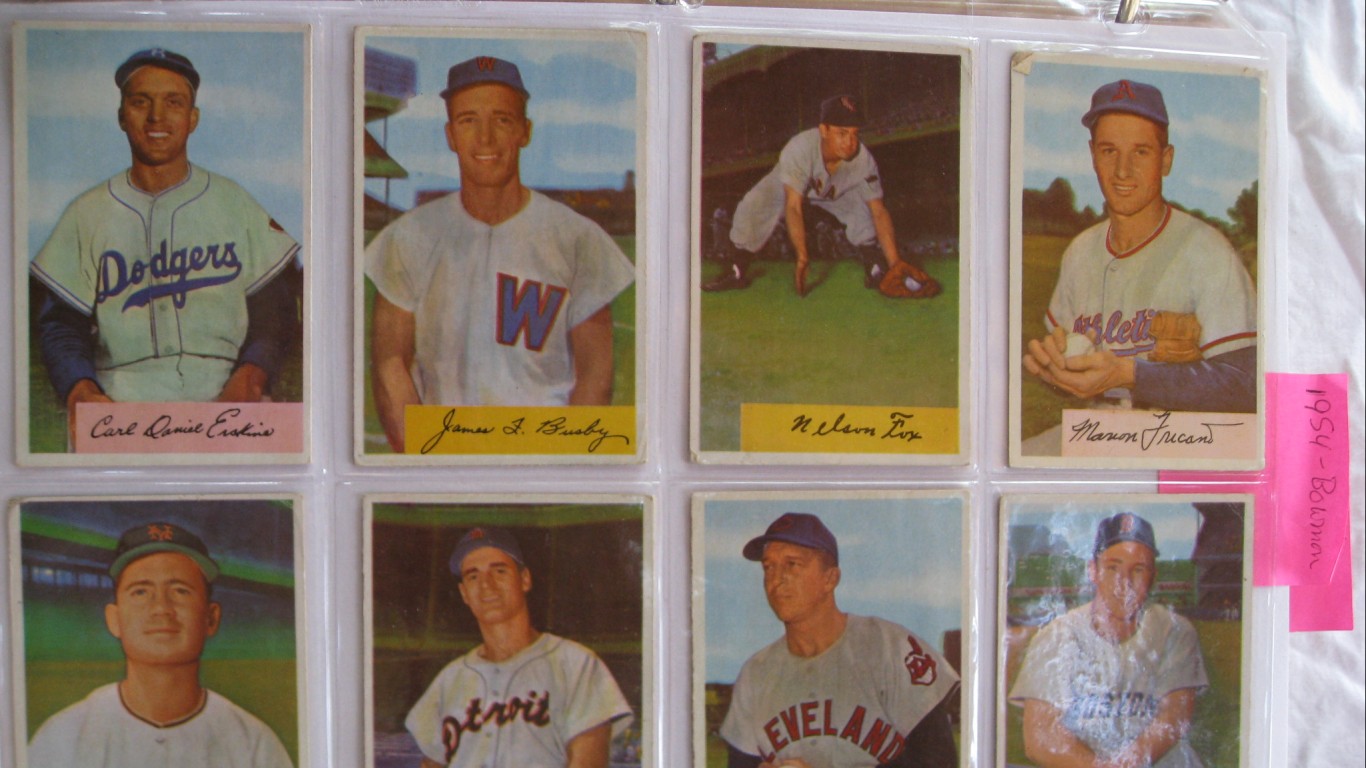
Baseball trading cards were one of the first collectibles to really gain popularity and it continues until tday
For example, sports trading cards, particularly baseball cards, are still a multi-billion industry. Consulting firm Market Decipher predicts the sports memorabilia market will grow to almost $20.5 billion by 2032.
But there are other collectible cards that have just as an enthusiastic following, including Pokemon and Yu-Gi-Oh! One of the better options, however, could be Magic: The Gathering, the tabletop and digital card game first released by Wizards of the Coast in 1993.
Now owned by Hasbro (NASDAQ:HAS | HAS Price Prediction), Magic has been one of the toymaker’s most consistently profitable businesses since it was acquired in 1999. Its Wizards of the Coast and digital gaming segment made $1.17 billion in sales through the first nine months of 2024 and generated operating profits of $551 million.
In fact, many Magic: The Gathering players view themselves much like stock investors, seeking out the most undervalued cards and sets on the market. A whole field of “Magic finance” has evolved and there are sites dedicated to tracking the pricing of different card values, almost like looking up the price of Tesla (NASDAQ:TSLA) stock on your broker’s website.
There are, of course, major differences between buying TSLA shares and buying a Swords to Plowshares card.
Making a market

Magic: The Gathering tournaments are still wildly popular, drawing thousands of enthusiasts to play
The first is the stock price of Tesla is the same no matter where you look it up, whether on Yahoo! Finance, Google, or your broker. It shows the last price the stock traded at. Not so with a Magic card. If you look up the price, all you have is what someone is willing to sell the card at and that can fluctuate dramatically.
For example, the original print run of a Swords to Ploughshares Magic Alpha card on MTGStocks shows the average price at $2,209.99, which means the average price listed across all marketplaces, though the market price is just $325, which is the most likely selling price based on recent sales data.
On CardKingdom, the card can be bought for $879.99 while on TCGplayer, a heavily played card fetches $650. On ManaPool, a moderately played version goes for $1,470.
There are a lot more variables involved in buying Magic: The Gathering cards than purchasing a stock. It’s also important to note that some 82.4 million shares of Tesla trade daily while you might see just one card bought or sold in a month or year on the Magic trading sites. The stock market is much more liquid than the trading card market.
Better than stocks?
So can buying Magic: The Gathering cards beat the stock market? Here are the returns of the the three most popular MTG cards of all time, according to War Gamer.
- Sol Ring. The card has been released in multiple sets, including from the Vault: Relics in 2010, Commander 2016, and Commander 2017. MTGStocks shows the earliest price available in 2012 was $176.82 and while it had climbed as high as $3,087.89 in 2021, today it goes for $1,286.01, a 627% return.
- Craterhoof Behemoth. The card was released in the Avacyn Restored set on May 17 2012 and has gone from $2.92 at the time to $76.56 in 2021, and is priced at $34.71 today for a 1,089% return.
- Gaea’s Cradle. This card was released in the Urza’s Saga set in 1998 and is often considered one of the most iconic lands in Magic history. MTGStocks shows its price in 2012 at $70.29, spiking to $1,199.86 in 2021 and trading for $830.57 today, a 1082% return.
Key takeaways
It’s clear both stocks and Magic: The Gathering trading cards can have their peaks and valleys, and the Covid pandemic lockdowns caused a spike in interest, playing, and card value.
Although many of the cards have far exceeded the 387% return of the S&P 500 from 2012 until today, the liquidity and transparency of stock prices compared to MTG cards means investors would be better off buying Tesla or other stocks rather than trading cards.










 Top Gaining Stocks
 Top Losing Stocks