



The Allure of the S&P 500
For decades, investing in the S&P 500 has been a cornerstone of wealth-building strategies. The simplicity of buying and holding index funds like Vanguard S&P 500 ETF (NYSEARCA:VOO | VOO Price Prediction) or State Street’s SPDR S&P 500 ETF Trust (NYSEARCA:SPY), both tracking the S&P 500, has offered investors a low-cost, low-effort way to capture the market’s long-term growth.
Historically, this “set and forget” approach has outperformed most actively managed funds, delivering average annual returns of around 10% over the long haul. By spreading investments across 500 of America’s largest companies, these ETFs provided diversification, stability, and consistent gains, making them a favorite for both novice and seasoned investors.
The strategy’s success lay in its ability to harness the collective strength of the U.S. economy without the need for constant tinkering. However, recent shifts in the S&P 500’s composition suggest that this once-reliable approach may no longer be the safe bet it once was.
The Concentration Crisis in the S&P 500
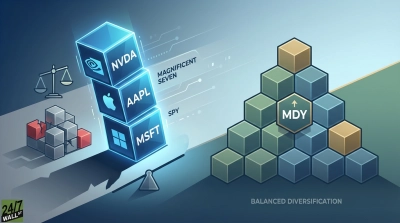
The S&P 500 is no longer the broadly diversified index it once was. Today, just 10 stocks account for approximately 40% of the index’s total market capitalization, a level of concentration surpassing even the dot-com bubble era.
This top-heavy structure is driven by the dominance of mega-cap technology and growth stocks, which have soared in value while other sectors lag. Such concentration introduces significant risks, as the index’s performance is now heavily tied to the fortunes of a small group of companies. If these stocks falter — due to regulatory scrutiny, market corrections, or sector-specific challenges — the entire index could suffer disproportionately, dragging down ETFs like VOO and SPY.
Why Concentration Is a Problem
This unprecedented concentration undermines the diversification that made S&P 500 ETFs attractive. When 40% of an index’s value hinges on just 10 companies, investors are exposed to heightened volatility and sector-specific risks, particularly in technology.
For example, a tech sector downturn could erase gains across the index, even if other sectors perform well. Historical data from the dot-com crash illustrates this: the S&P 500 fell nearly 50% from 2000 to 2002, largely due to overvalued tech stocks. Today’s concentration, driven by similar dynamics, increases the likelihood of sharp declines if market sentiment shifts.
Moreover, high price-to-earnings ratios — currently averaging 29.5x for the index — suggest overvaluation, echoing the frothy valuations of the early 2000s. Investors relying on VOO or SPY may unknowingly be betting on a handful of stocks rather than the broader market.
The Top 10 Stocks Dominating the S&P 500
The following companies represent roughly 40% of the S&P 500’s market cap, based on recent analyses:
- Nvidia (NASDAQ:NVDA)
- Microsoft (NASDAQ:MSFT)
- Apple (NASDAQ:AAPL)
- Amazon (NASDAQ:AMZN)
- Alphabet (NASDAQ:GOOG)(NASDAQ:GOOGL)
- Meta Platforms (NASDAQ:META)
- Broadcom (NASDAQ:AVGO)
- Berkshire Hathaway (NYSE:BRK-A)(NYSE:BRK-B)
- Tesla (NASDAQ:TSLA)
- JPMorgan Chase (NYSE:JPM)
This reflects the outsized influence of tech giants, with seven of the top 10 being technology or tech-adjacent firms.
Alternative ETFs to Consider
To mitigate the risks of concentration, investors may want to explore ETFs with broader diversification or different focuses. The Invesco S&P 500 Equal Weight ETF (NYSEARCA:RSP) weights all 500 S&P companies equally, reducing reliance on mega-caps and offering exposure to smaller, potentially undervalued firms.
RSP currently has an expense ratio of 0.20%, slightly higher than VOO’s 0.03% or SPY’s 0.09%. However, its balanced approach may offer better risk-adjusted returns in a volatile market.
Another option is the iShares MSCI World ETF (NYSEARCA:URTH), which provides global exposure, spreading risk across international markets and sectors. With an expense ratio of 0.24%, it diversifies beyond the U.S. tech-heavy landscape, potentially cushioning against domestic market shocks.
Key Takeaway
The S&P 500’s concentration in just 10 stocks, representing 40% of its value, makes VOO and SPY riskier than their reputation suggests. Investors are no longer getting the broad market exposure they expect but are instead tethered to the performance of a few tech titans.
This top-heavy structure amplifies volatility and vulnerability to sector-specific downturns, reminiscent of the dot-com bubble. To safeguard their portfolios, investors may be better off exploring diversified ETFs like RSP or URTH, which offer broader exposure and reduced reliance on a handful of companies. Diversification remains the bedrock of sound investing, and today’s S&P 500 ETFs is falling short of that ideal.












 Top Gaining Stocks
 Top Losing Stocks