



The S&P 500 has been a cornerstone of wealth-building for decades, delivering average returns of about 10% annually through diversified exposure to America’s largest companies.
Since the advent of the artificial intelligence (AI) era, roughly marked by the 2020s, the index has soared, with a 27% gain in 2024 alone, following a 24% rise in 2023. The gains were driven largely by the “Magnificent Seven” — tech giants like Nvidia (NASDAQ:NVDA | NVDA Price Prediction), Microsoft (NASDAQ:MSFT), and Meta Platforms (NASDAQ:META).
These AI-fueled leaders have propelled exchange-traded funds (ETFs) like the SPDR S&P 500 ETF Trust (NYSEARCA:SPY) to new highs, capitalizing on the market’s tech-heavy momentum. However, this dominance has created a top-heavy index, raising concerns about concentration risk. While SPY has outperformed the Invesco S&P 500 Equal Weight ETF (NYSEARCA:RSP) recently, RSP’s long-term track record since its 2003 inception shows superior returns.
Investors now face a choice: ride SPY’s tech-driven wave or opt for RSP’s balanced approach to mitigate emerging risks.
The S&P 500’s Concentration Crisis
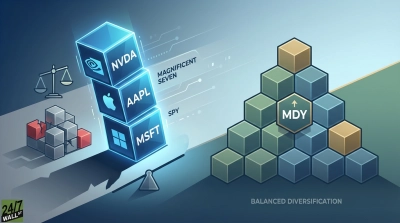
The S&P 500’s once-broad diversification has eroded, with just 10 stocks — Nvidia, Microsoft, Apple (NASDAQ:AAPL), Amazon (NASDAQ:AMZN), Alphabet (NASDAQ:GOOG)(NASDAQ:GOOGL), Meta, Broadcom (NASDAQ:AVGO), Berkshire Hathaway (NYSE:BRK-A)(NYSE:BRK-B), Tesla (NASDAQ:TSLA), and JPMorgan Chase (NYSE:JPM) — now accounting for roughly 40% of its market capitalization, a multi-decade high. This concentration surpasses the 27% seen at the 2000 dot-com peak and reflects the outsized influence of tech giants fueled by AI enthusiasm. These top 10% of U.S. stocks, including the S&P’s leaders, represent a record 76% of the U.S. equity market, echoing pre-Great Depression levels.
This gap — where 10 stocks generate only 30% of index earnings but 40% of its value — signals overvaluation risks. If these tech titans falter due to regulatory scrutiny, AI hype cooling, or economic shifts, the index — and thus SPY — could face sharp declines, reminiscent of the 2000 to 2002 crash when the S&P 500 fell nearly 50%.
SPY’s Recent Dominance
SPY, tracking the market-cap-weighted S&P 500, has thrived in the AI era, capitalizing on the meteoric rise of the Magnificent Seven. Its market-cap weighting tilts heavily toward these high-flying tech stocks, leading to a 5.5% gain in July alone, with Nvidia accounting for 46% of that move.
SPY’s low expense ratio of 0.09% and massive liquidity make it a go-to for investors seeking broad market exposure. Since 2020, SPY’s tech-heavy composition has driven significant outperformance over RSP, as the top 10 stocks’ valuations soared.
However, this reliance on a few mega-caps amplifies volatility. High P/E ratios, averaging 29.5x for the index, suggest overstretched valuations, and a tech sector downturn could drag SPY down disproportionately.
While SPY’s recent gains are impressive, its dependence on a handful of stocks heightens risk, especially if market sentiment shifts.
RSP’s Long-Term Edge
Since inception, RSP, which equally weights all 500 S&P companies, has outperformed SPY, offering a more balanced exposure that mitigates concentration risk. RSP has a total return of 975% compared to the 962% return of SPY.
With an expense ratio of 0.20%, RSP reduces reliance on mega-caps, giving smaller firms like Lamb Weston (NYSE:LW) or Enphase Energy (NASDAQ:ENPH) equal footing. This approach has historically delivered better risk-adjusted returns, especially during market corrections when tech-heavy indices falter.
For instance, RSP’s equal-weight strategy cushioned losses during the 2000 to 2002 dot-com crash aftermath, as it avoided overexposure to overvalued tech stocks. Today, with the S&P 500’s top 10 stocks at a record 40% of market cap, RSP’s diversification across sectors like industrials (1.6%), financials (14.9%), and consumer discretionary (10.2%) offers a hedge against a potential tech bubble burst. Investors seeking stability in a volatile market may find RSP’s structure more resilient.
Key Takeaway
Despite SPY’s recent outperformance, RSP is the better buy today. Its equal-weight approach counters the S&P 500’s 40% concentration in 10 stocks, reducing exposure to tech volatility. With a proven long-term edge since 2003, RSP offers diversified stability in an overvalued, top-heavy market, making it a safer bet.













 Top Gaining Stocks
 Top Losing Stocks