


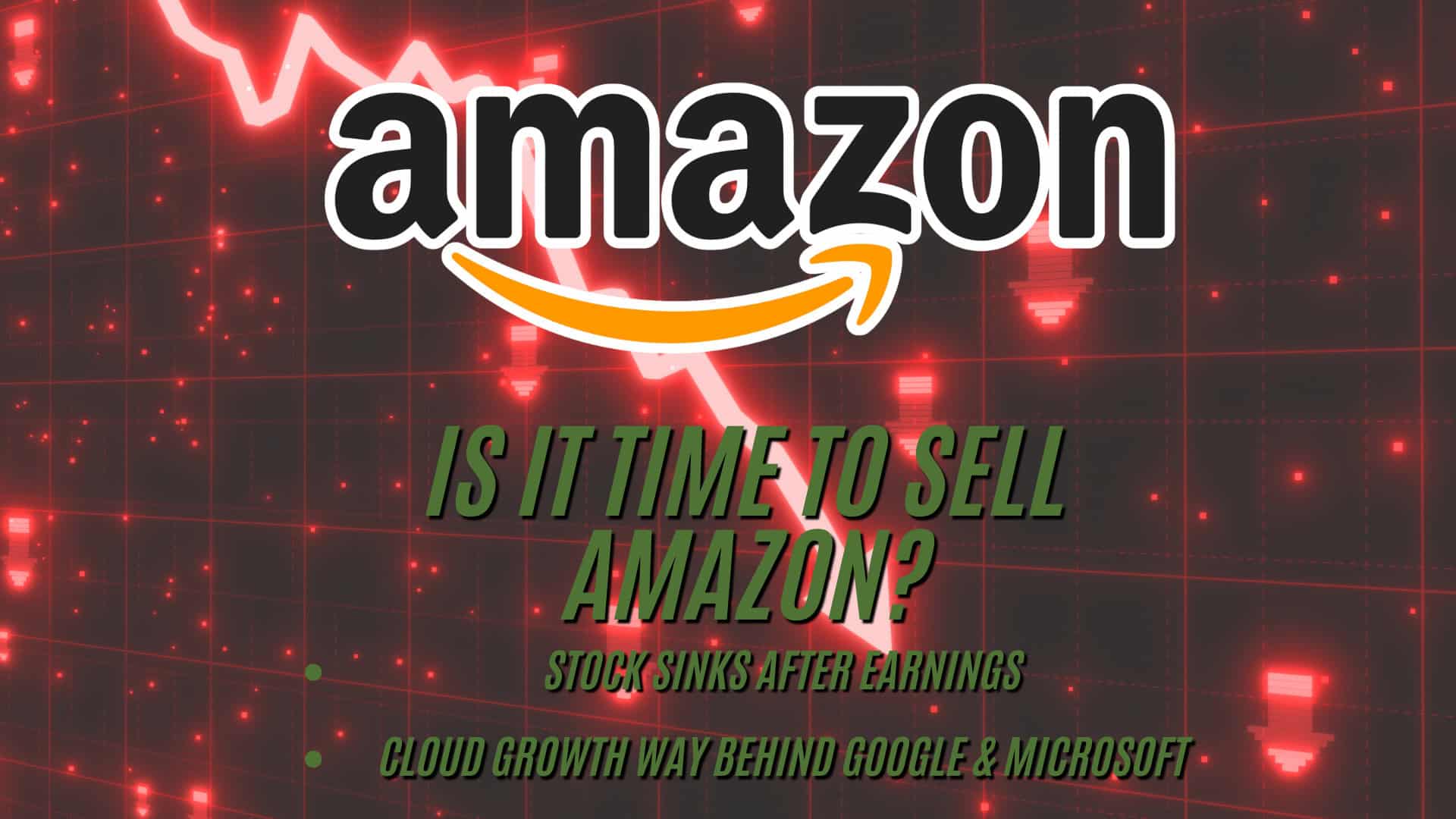
Watch Our Analysis on Whether Amazon is a Sell After Their Last Earnings
In a recent AI Investor podcast episode, hosts Austin and Eric Bleeker dove into the competitive landscape of the cloud computing market, focusing on Amazon‘s (Nasdaq: AMZN | AMZN Price Prediction) disappointing performance in its latest earnings report.
While companies like Microsoft and Google just reported outstanding quarters from their cloud computing divisions, Amazon’s AWS division has struggled to keep pace. This raises questions about AWS’s future in the rapidly evolving AI-driven market. The hosts noted that Amazon’s stock fell by 8% following the earnings call, highlighting investor concerns over AWS losing market share.
During the discussion, Eric Bleeker pointed out that CEO Andy Jassy’s lackluster performance during the earnings call contributed to the stock’s decline, as his unclear responses about Amazon’s position relative to Microsoft led to a loss of confidence among investors.
With AWS’s growth lagging behind Azure’s impressive 39% growth rate, the hosts expressed concerns about Amazon’s strategic direction and its ability to compete effectively in the AI space. They also announced plans to sell $50,000 of Amazon stock from their $500,000 AI Portfolio to invest in more promising opportunities, such as agentic AI stocks and robotics.
As the conversation unfolded, it became clear that while Amazon’s long-term prospects remain strong, immediate challenges in the cloud market could necessitate a reevaluation of its strategies and leadership. The hosts speculated on the potential return of founder Jeff Bezos to the company.
Get More AI Stock Ideas
If you’re on the hunt for more AI stock ideas, check out the latest episode of 24/7 Wall St.’s AI Investor Podcast.
Each week, we break down the biggest news in the AI space and invest $500,000 in our favorite AI ideas. The best part? You can subscribe and follow along with what we expect to be the biggest trend in technology history for free. You can listen to the latest episode (where we discuss why we’re selling $50,000 of our Amazon position after their recent earnings) in either Spotify or Apple Podcasts below.
Transcript
Austin Smith: It seems like every couple of weeks there was a new front runner in the AI space. However, we are starting to see some consistent winners. Amazon, at least as of this most recent earnings call, looks to be on the wrong side of that. Amazon does have AWS, and they compete with Azure and Google Cloud.
Azure’s growth is being rewarded by Wall Street, while Amazon’s earnings are being punished. The company is down 8% as of this filming today. Now, Amazon is more than just AWS, but in the context of this portfolio and the technology we’re discussing, AWS is what we’re going to focus on. What’s going on here? Why is Microsoft being rewarded in this environment while AWS is not? Is it simply that Azure has ChatGPT tokens, or is there more?
Eric Bleeker: Austin, you’re kind of bumming me out. We’re talking about Microsoft and Meta, these incredible earnings, and now we have to go to Amazon.
But there is something deeply interesting here. As longtime listeners of the show will note, we bought $100,000 of Amazon and $100,000 of Meta. We said we would sell down these positions, but we were kind of parking it as a hedge with the hyperscalers. The moment after these earnings is where we’re going to announce a sell; we are going to remove $50,000 of Amazon. That’s partially due to some factors we’re seeing in these earnings.
As you know, Amazon was down 8% overnight, but it has clawed back some gains as the market progresses on Friday [the day after earnings].
A few things to note: there was a really bad conference call from Amazon CEO Andy Jassy. You almost never see this, but as he was answering a question about whether they’re falling behind Microsoft, you could see the stock tick down. It went down almost 4% during one of his answers. I’m reminded of the Billy Madison quote about that being the most incoherent, rambling answer ever. It just went nowhere, and you could see the market losing confidence in him as he spoke.
So, Austin, if we’re talking numbers, you’ve done a good job highlighting Microsoft and Azure’s growth rates. They were at 31% two quarters ago and are now at 39% this most recent quarter. What did Amazon do in that same period? They went from 16.9% growth to 17.5%. That’s an 8% point growth from Microsoft and less than 1% for Amazon. If you’re an Amazon investor, that is a big problem.
There are a couple of reasons Amazon is losing market share. Microsoft is in the process of a breakup with OpenAI, but for now, they get all that OpenAI demand, which provides a huge catalyst. Second, when you look at Amazon’s other rival, Google, they went out of their way to court AI companies at the outset of this megatrend back in 2023, and they now have a strong group of AI companies on Google Cloud. That’s just Amazon being asleep at the wheel a little bit, and they’re now paying for it.
I’ll bring up one other factor. If we look at data on who’s buying Nvidia GPUs, Google has 19% market share, buying 20% of Nvidia GPUs, Microsoft has 30% market share, buying 30% of Nvidia GPUs, and Amazon has 44% of total cloud market share but is not investing in the primary resource that customers want, which is Nvidia GPUs. They only get 20% of NVIDIA’s GPUs.
Even if that figure is slightly off, it is directionally significant. You cannot ignore it. So the short answer, Austin, is that Amazon has dropped the ball in several ways. They haven’t caught the right customers, and they’re not investing in the right infrastructure that their customers want.
Long term, I think they’re going to be fine. Their ad business is doing well, and their e-commerce business is strong. In terms of robotics, almost no company has the gains that Amazon will see, which can fundamentally transform their entire cost structure. However, in the near term, this is a problem.
Eric Bleeker: I think there’s a chance Amazon can close these growth rate differences as we move from a lot of training as a high percentage of revenue at these cloud companies and move more towards inference.
If I’m looking to sell either that $100,000 Meta position or Amazon at $100,000 right now, I would prefer to sell Amazon. So we’re going to sell $50,000 of that. We’re going to use that capital to buy our plays in areas like agentic AI and robotics in the coming episode.
Austin, I think this is an issue, and you do wonder if Andy Jassy, who comes from AWS, is giving rambling, incoherent answers that cause Amazon to lose $100 billion in a conference call. At what point will Bezos say he needs to get back into day-to-day operations?
Austin: I’ve heard some other people talking about that as well. We’ve got Howard Schultz, Bob Iger. Is Bezos next on the return tour? It remains to be seen how much he feels invested in Blue Origin relative to Amazon at this point. I think Wall Street would welcome his return despite Andy Jassy leading AWS to enormous success. However, AWS was built as the most cost-effective B2B platform, not necessarily the fastest AI platform, which is what the market is rewarding now. AWS has not been built for that world, and that is now being rewarded by Wall Street.
Eric Bleeker: Again, I’m not throwing in the towel on Amazon; they’re just looking a lot less levered to this trend at a really exciting point. I would rather deploy my capital elsewhere.
Austin: That’s big news. That is the first sell in the portfolio. We alluded to that in the last two episodes. I expect there will be more in the next few weeks, but we’ve got $50,000 coming off the table here to redeploy into new positions.













 Top Gaining Stocks
 Top Losing Stocks