


Summary:
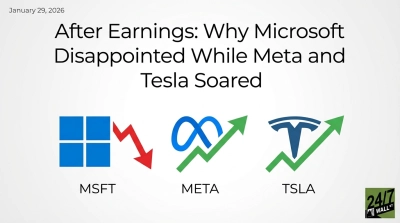
For Meta (META) and Microsoft (MSFT), it has indeed been a tale of two tech giants as of late. While Microsoft has struggled, Meta, thanks in part to its dedication to AI and abandonment of the Metaverse, has soared.
During a recent episode of The AI Investor Podcast, co-hosts Eric Bleeker and Austin Smith discussed the market divergence between Meta and Microsoft following recent earnings announcements. While Meta surged after projecting 30% to 33% revenue growth and announcing $135 billion in capital expenditures, Microsoft, despite strong earnings, declined due to slower-than-expected Azure growth and projected supply constraints.
“This is a story of what the market is rewarding,” Smith explains.
The pair discussed the way consensus narratives can often be incorrect in fast-moving technology cycles with Bleeker pointing out that, “Media coverage once framed Microsoft as the prudent adult. Now they must dig out.”
Meanwhile, by investing aggressively in AI, Meta has secured Wall Street’s permission to reinvest heavily and control its own destiny.
Both hosts are encouraging investors not to hit the panic button any time soon, however. With Microsoft being an amazing company, its history along with that of artificial intelligence, is still being written.
Transcript:
Austin: There is a weird divergence going on with Meta (NASDAQ: META) | META Price Prediction and Microsoft (NASDAQ: MSFT), right?
Eric Bleeker: Mm-hmm.
Austin: Meta pops 10%. This is a story of what the market is rewarding. Meta pops 10% throwing out, I think it was $150 billion in CapEx, or actually I see your number here, it’s $135 billion. Microsoft drops after earnings. It’s a tale of two tech companies. Now remember, Microsoft broke the mold early on with their early OpenAI investment. This was very much the first big tech Mag Seven company in the AI race via their OpenAI investment. People looked at it sideways. I think you called it the greatest venture investment of all time, and you were right. Now Microsoft has pulled away from heavy AI investing. Meta is going heavy into it. Meta soars on that announcement, Microsoft drops. This feels like a story of divergent paths and what the market is rewarding. What are you seeing? Because both companies had great earnings.
Eric Bleeker: Definitely.
Austin: This is all forecasting, and Meta’s forecasting CapEx.
Eric Bleeker: I’m in a bit of a ranting mood today, Austin, so we’re going to rant a little. This goes back to ideas that are perpetuated at nearly 100% agreement and are wrong. We called this out as being wrong, and we are seeing the seeds of what was sowed nearly a year ago.
Meta is up because they’re guiding toward 30% to 33% revenue growth at the midpoint. The reason they can do that is because they’ve made a massive investment in AI. People like to say, “Where is the money generated on AI? Who is billing anything?” Meta has one of the strongest examples.
Austin: Look at their ROIC. That’s where the return is. Of course the first application is going to be internal. They understand their own use cases better. That’s where you’re seeing the return. We’ve said this for a year and a half. That doesn’t mean the return will be limited there, but when people ask where the return is coming from, it’s internal. Look at what you’re seeing at Meta.
Eric Bleeker: The number is up to $135 billion in capital expenditures this year, which is astronomical. It’s beyond anything that could have been conceived. But what they’re doing is they have permission, as long as revenue growth is this high, to invest every dollar back into the business. The more they invest into their products, the more money they have to reinvest.
Now Microsoft beat earnings. They were very good earnings. But they reported Azure growth of 39%, which was below Wall Street expectations. They projected it will be below expectations next year. Azure is broadly seen as the future.
Microsoft says Azure growth is 100% a supply issue. They don’t have enough GPUs or compute to rent out, so they can’t grow revenue. Why do they have less supply? Because they need to take some of their compute infrastructure and use it internally the same way Meta is. When they do that, they miss on cloud growth.
What this creates is a prisoner’s dilemma. Microsoft is watching this Claude Code moment unfold. One of the biggest use cases of Claude is Excel. They have an Office product suite that carries risk of disruption, similar to what people feared about Google Search in 2024. They need to devote compute to improve their products. But they took their foot off the pedal early last year, and nearly all media coverage congratulated them for being the adult in the room.
Austin: Right.
Eric Bleeker: Now we see that was a poor decision. It puts them in a tenuous position. They need to make the investment, which could cause them to miss on Azure, and they’ll need to accept that consequence.
If Meta had pulled back on spending, they would be in the same position Microsoft is, because they wouldn’t be able to secure GPUs. Meta controls its own destiny. Mark Zuckerberg can decide whether to devote AI resources to revenue-generating products or to long-term initiatives. They delivered the right message to Wall Street and gained permission to invest aggressively. Microsoft does not have that permission.
Ironically, if Microsoft allocates more capacity to Azure, they may be renting it to companies that are disrupting them. That’s the dilemma. Media coverage once framed Microsoft as the prudent adult. Now they must dig out. I believe Microsoft will be fine. I’m happy to buy Microsoft in the $300s, but they are correcting past mistakes. This shows why obvious consensus narratives are often wrong. We called it, and now it’s playing out.
Austin: The inverse example is Alphabet (NASDAQ: GOOGL). Google was written off as being behind in AI. They had their own prisoner’s dilemma – investing in AI could disrupt Search. But Sundar Pichai invested heavily. Google’s ROIC improved. They were late to the race, invested aggressively, and caught up.
It was Microsoft’s early lead to lose, and they gave it up by being too prudent. In both cases, media consensus was wrong. Google ended up being the best-performing Mag Seven stock last year, and Microsoft gave up perhaps the greatest early lead in tech history. That said, history is still being written. Microsoft is still an amazing company.
Eric Bleeker: They still have time.
Austin: Yeah.














 Top Gaining Stocks
 Top Losing Stocks