


Despite persistent inflation and some signs of labor market weakness, the stock market has shown resilience. With major indices reaching new highs even as volatility persists, stocks have shrugged off macroeconomic headwinds in what investors call a “Wall of Worry.” Pessimism about economic cycles often overshadows pockets of opportunity that defy broader trends.
Artificial intelligence (AI) continues to stand out as a transformative force, fueling growth for select companies insulated from economic turbulence. With valuations in some tech giants like Nvidia (NASDAQ:NVDA | NVDA Price Prediction) stretching thin, other players are poised to capitalize on AI’s expansion.
If you have $10,000 to invest — money not needed for bills or emergencies — you can turn it into more than $26,000 in just four years by investing in the following two stocks.
Microsoft: The AI-Powered Cloud Titan
Microsoft (NASDAQ:MSFT) has cemented itself as a leader in the AI revolution, leveraging its Azure cloud platform and strategic investments in AI technologies. The company’s stock has delivered a stellar 20% compound annual growth rate (CAGR) over the past five years, driven by its pivot to cloud computing and AI integration.
Azure’s AI capabilities, enhanced by Microsoft’s partnership with OpenAI, have attracted enterprises seeking scalable AI solutions. From Copilot, an AI-powered productivity tool, to AI-driven analytics, Microsoft is embedding intelligence across its ecosystem, including Office 365 and Dynamics.
This AI focus is fueling robust growth. Analysts project Microsoft’s revenue to grow at 13.5% annually over the next five years, with earnings per share (EPS) rising at a 15% clip. The company’s ability to monetize AI through cloud subscriptions and software ensures sustained expansion, even as macroeconomic pressures mount.
If we conservatively lower MSFT’s stock CAGR to 15% over the next four years, a $5,000 investment today would grow to $8,759 by the end of 2029. Beyond that, Microsoft’s diversified portfolio — spanning cloud, gaming, and AI — positions it to outpace competitors as AI adoption accelerates globally.
Broadcom: The Dark Horse of AI Accelerators
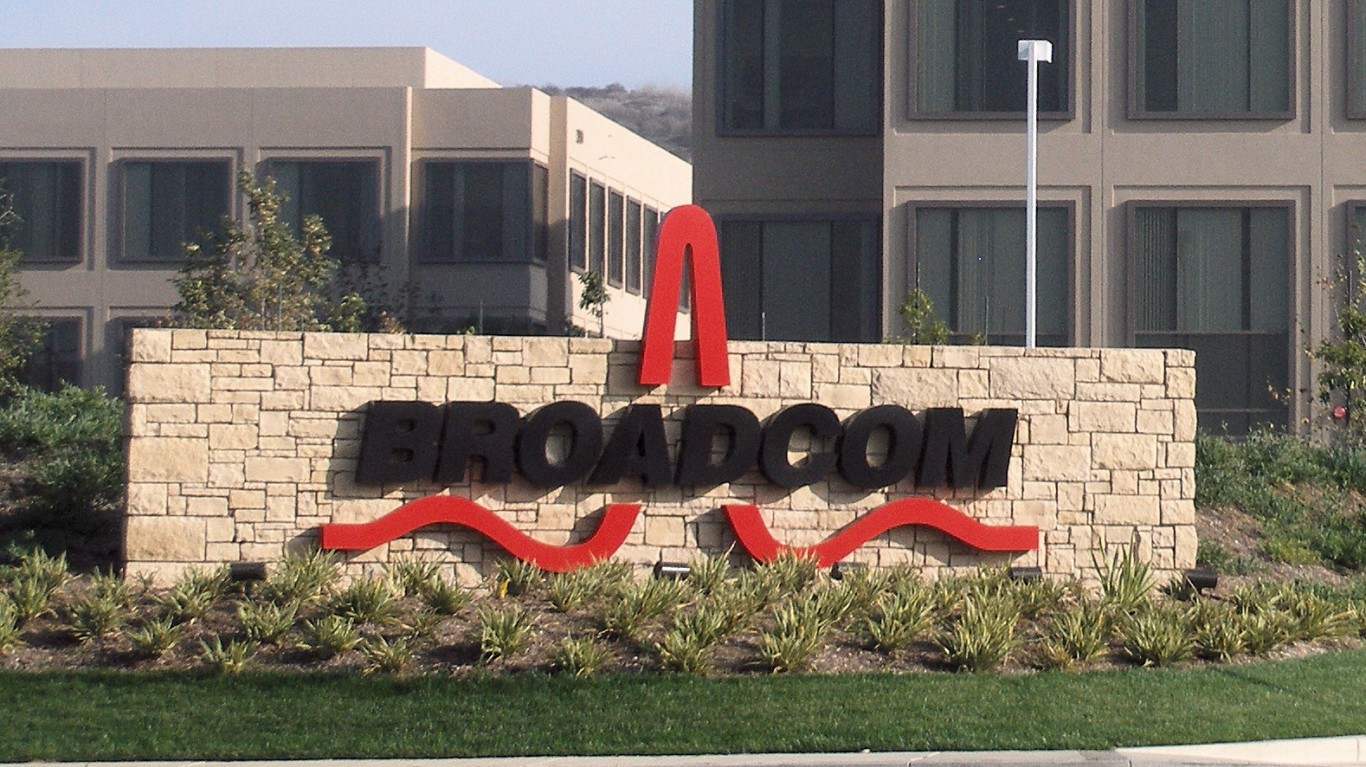
Broadcom (NASDAQ:AVGO) is emerging as a formidable player in the AI hardware space, potentially challenging Nvidia’s dominance. Its stock has soared at a jaw-dropping 58% CAGR over the past five years, propelled by its expertise in custom silicon and networking solutions.
Recent speculation suggests Broadcom may have secured a massive $10 billion deal to supply custom AI accelerators to OpenAI, a move that could signal its ability to steal market share from Nvidia. This deal underscores Broadcom’s growing role in powering AI infrastructure, supporting everything from data centers to edge computing.
Analysts forecast Broadcom’s revenue and EPS to grow at 15% and 17% annually, respectively, over the next five years. Its custom chip designs and networking solutions are critical for AI workloads, positioning it to capture more business as enterprises scale AI deployments.
If we temper expectations and assume a 35% forward CAGR for its stock, a $5,000 investment today would balloon to $16,554 by 2029. Looking ahead, Broadcom’s ability to innovate in AI hardware and expand its customer base could make it a dominant force in the semiconductor space, even as competition intensifies.
Key Takeaway: Winning AI Bets
Microsoft and Broadcom are poised to be standout performers in the AI-driven tech landscape, outshining overhyped names like Nvidia and Palantir Technologies (NYSE:PLTR), which face valuation headwinds.
By splitting a $10,000 investment equally between Microsoft and Broadcom, investors could see their portfolio grow to $26,046 by 2029, based on conservative stock gains, plus uninvested cash from the original sum. This figure does not include any dividends that may be received from these tech titans.
Obviously, there are no guarantees. However, by being conservative with our estimates and choosing stocks that offer a compelling blend of stability and growth, the odds for success of capitalizing on AI’s long-term potential and increasing our wealth simultaneously greatly improve.














 Top Gaining Stocks
 Top Losing Stocks