


Watch the Video
Ford’s Recall Avalanche
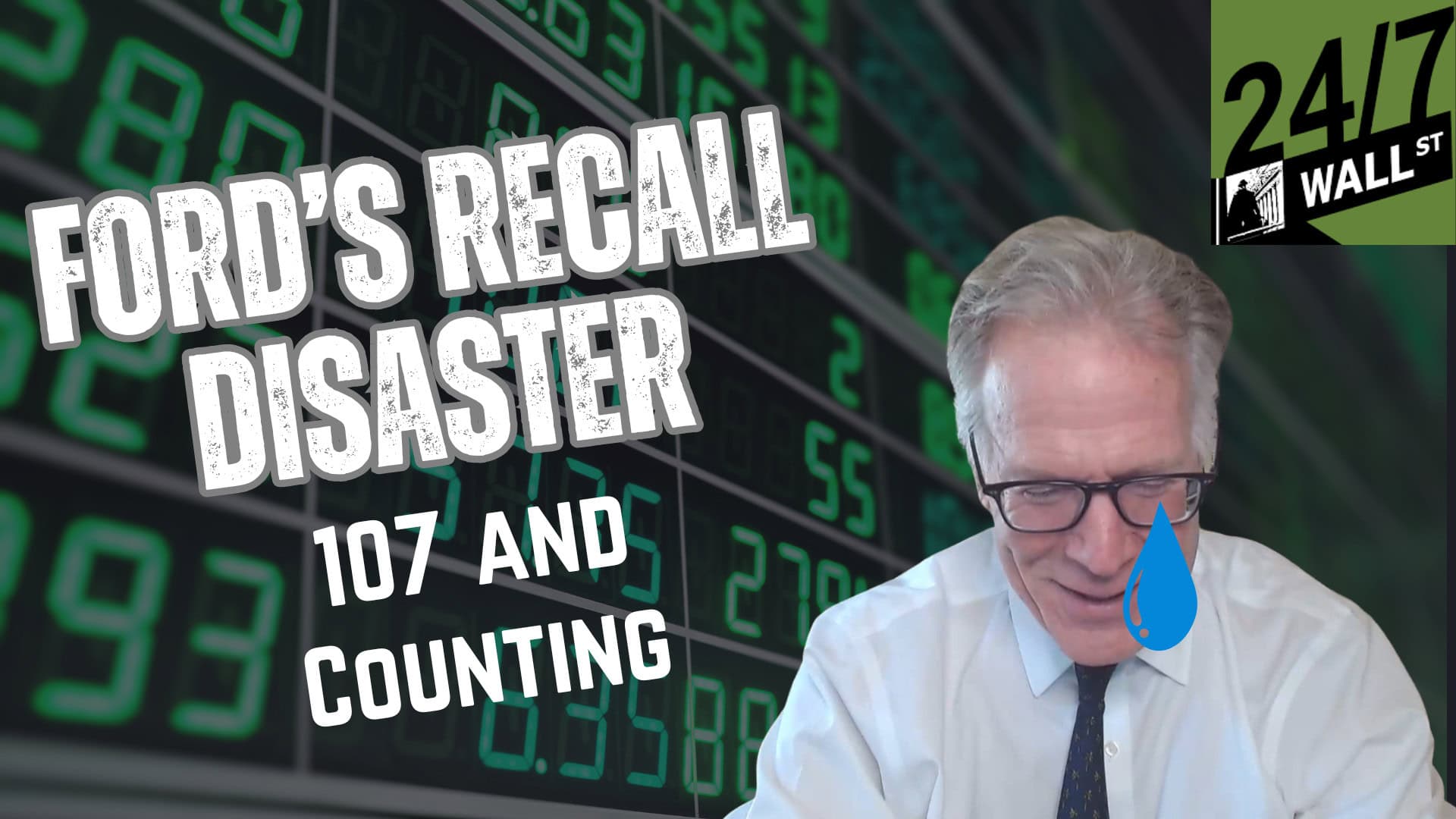
When I told Lee I’d counted 107 recalls this year, even he was shocked. And that’s not far off the mark. Ford has issued a record-breaking 103 safety recalls in 2025, according to Fox Business. That covers roughly 8 million vehicles, nearly quadruple its annual output.
One recall involved 1.4 million vehicles for faulty rear-view cameras (WardsAuto), another affected 850,000 for defective fuel pumps (CBS News), and most recently, 80,000 vehicles for door and light-bar issues (Reuters).
I told Lee: if you make two million cars a year and recall eight million, you’ve effectively recalled four years of production. That’s not just bad luck, it’s systemic failure.
Same Leader, Same Results
Ford’s share price has barely budged in five years, yet its leadership remains unchanged. Executive Chairman Bill Ford has held the role since 1999, while CEO Jim Farley has been in place for about three years. Together, they earned about $22 million last year, while presiding over record recalls and a flat stock.
Lee laughed when I said that if I ran a company with 107 recalls, I’d want my obituary to say, “World Record Holder: Most Car Recalls in a Year.” But the joke hides a real frustration, Ford’s governance structure gives the family total control, leaving outside shareholders powerless.
Leadership and Accountability
Lee and I agreed: investors need to ask whether Ford is a turnaround story or just treading water. Recalls eat into profits, reputation, and consumer trust. Meanwhile, the dividend may be the only thing propping up the share price.
Until Ford fixes its quality and leadership issues, we don’t see how it breaks out of its five-year stagnation.
Why It Matters for Investors
1. Cost & Margin Pressure
Each recall carries direct costs: parts, labour, logistics, warranty claims, and worst of all: brand damage, reduced resale value, increased capital tied up in remediation. The more recalls stack up, the more margin erosion threatens Ford’s ability to invest in EVs, software, or new growth models. For investors, it means that dividend yield may be at risk if earnings don’t improve.
2. Brand and Consumer Confidence
Repeated quality failures can erode consumer trust; especially in an industry shifting toward software-driven features and EVs. Ford’s recall history suggests that its transition risk may be higher than peers, potentially affecting sales and long-term competitiveness.
3. Governance Risk
Lee and I highlighted a structural issue: the Ford family’s dual-class share control may insulate management from shareholder pressure. Without strong external accountability, incremental improvements may be slow, and strategic pivots delayed.
4. Portfolio Implication
For existing shareholders, the message is clear: Monitor Ford’s progress on recall reduction, margin improvement, EV growth, and leadership change. For potential entrants, ask: Are you buying a turnaround story or catching a company with systemic issues?
Transcript
[00:00:04] Douglas: Lee, we’ve got another recall from Ford (NYSE: F) | F Price Prediction, the Ford Motor Company.
[00:00:10] Lee Jackson: How is that even possible?
[00:00:12] Douglas: I tried to count and it could be off by one or two, but I think this is 1 0 7 for the year. 107 recalls for the Ford Motor Company. It
[00:00:27] Lee Jackson: That’s a lot.
[00:00:28] Douglas: by a lot. As a matter of fact, it’s probably close to any typical two years. And Ford makes about 2 million new cars a year. The total of these recalls are now in the neighborhood of 8 million. So you make 2 million cars a year, and your total recalls in the same year are for about 8 million vehicles. Now I don’t want the Ford people to call me and be upset ’cause this math may not be exactly right. But that means that you’ve recalled four years worth of assembled cars. If you just add ’em all up you know, dump ’em in a,
[00:01:11] Lee Jackson: Right,
[00:01:12] Douglas: So let’s take a
[00:01:12] Lee Jackson: right.
[00:01:13] Douglas: again, we do this a lot, but let’s look at this for a second. Ford’s stock price is basically unmoved in five years. If you take the S and
[00:01:25] Lee Jackson: Un moved since like 2022.
[00:01:29] Douglas: Even further, but, but anyway, so two years, three
[00:01:33] Lee Jackson: Yeah.
[00:01:34] Douglas: back, let’s just say five, it’s unmoved. I’ve talked to the PR people. They say, well, you know, we pay a dividend and, okay, thanks. I, if, if I just put my money into the s and p 500 basket, you know, I would’ve doubled it and I stuck with you guys.
[00:01:51] Douglas: Yeah, got a crummy dividend so that’s really good. The other thing that’s amazing to me is, is that the same two people run the company, Bill Ford, has been the chairman or executive chairman since 1999, and Chris
[00:02:15] Lee Jackson: And been in the mix forever.
[00:02:18] Douglas: his friend Mr. Farley, been the CEO for about three years. Now, Bill Ford has gone through a number of CEOs. He’s very good at it. He’s, you know. For him. They’re, I think, like, sort of like tissues. They come and go. When he is done with one, he
[00:02:35] Lee Jackson: Yeah,
[00:02:35] Douglas: rid of it, probably pays good severance. The reason I want
[00:02:39] Lee Jackson: sure.
[00:02:39] Douglas: I wanna, I want to be in charge of that many recalls. I want my, my obituary to read Douglas A. McIntyre, former CEO of Ford and record holder, world record holder in history, of running the car with the most company, with the most car recalls in the year. That’s what I want it to say. it
[00:03:02] Lee Jackson: All right. Well, I guess that could be a range.
[00:03:03] Douglas: money severance. I mean, listen, these two guys last year, made $22 million, 20
[00:03:14] Lee Jackson: That’s a lot.
[00:03:15] Douglas: Bill Ford is. Holder of the Class B shares. So he’s well taken care of. And you have to,
[00:03:24] Lee Jackson: Right,
[00:03:24] Douglas: I’m gonna close by saying this, I do not see how it’s possible that the Ford family keeps him in there. He’s their representative. He’s there to make the Ford Family money, period. He’s not there to do anything for the other shareholders, nor does he.
[00:03:39] Douglas: I
[00:03:39] Lee Jackson: The shareholders.
[00:03:40] Douglas: the case of the other shareholders, we can’t throw him out. But if I were a member of the Ford family, I’d just say. Are you out of your mind? We’ve let you do this for 26 years.
[00:03:51] Lee Jackson: Yeah.
[00:03:53] Douglas: So anyway.
[00:03:55] Lee Jackson: You know, it’s interesting, I read this thing recently and lemme see if I have it over there. Your, your friend Cramer, likes Ford stock. I thought this was interesting. Let’s see if I can find it. yeah, he thinks Ford is good because it has the most production in the United States.
[00:04:10] Douglas: standpoint, alright, we’re gonna grade Ford. I’m gonna say from a tariff standpoint, on a one to five scale paying tariffs, they’re probably a nine on one. One. Let’s do one to 10. One to 10. They’re probably a nine when it comes to the amount of money they have to
[00:04:27] Lee Jackson: Okay.
[00:04:28] Douglas: management, minus two of products, minus 16. You know, nice cars
[00:04:37] Lee Jackson: Yeah.
[00:04:38] Douglas: reliable minus 75. So Cramer, listen, I’ve known Cramer. We’ve known each other since we were 20, 50 years, and he’s not perfect. I’m gonna tell all of you now, he’s not perfect. He misses a lot.
[00:04:57] Lee Jackson: Yeah, but I thought that was interesting that he threw that out. This and that was this week. Yeah.
[00:05:02] Douglas: already, there was too much said about AI for the week, so he had to find something else.
[00:05:05] Lee Jackson: Absolutely.






 Top Gaining Stocks
 Top Losing Stocks